


Export Oriented Unit Scheme: Benefits & Registration Process
Introduction
India encourages businesses to expand into international markets through different export promotion frameworks. One such framework is the Export Oriented Unit Scheme, which is designed for eligible businesses that primarily intend to manufacture goods or provide services for export.
The Export Oriented Unit Scheme operates under Chapter 6 of India’s Foreign Trade Policy. An approved Export Oriented Unit, commonly called an EOU, can access certain import, procurement and operational facilities, subject to the conditions prescribed under the Foreign Trade Policy, Handbook of Procedures, customs laws and other applicable regulations.
However, EOU status should not be treated simply as a way to obtain tax exemptions. Units must comply with Net Foreign Exchange requirements, conditions specified in their Letter of Permission, rules governing Domestic Tariff Area sales and ongoing reporting obligations. Businesses should therefore understand both the advantages and responsibilities before choosing this route.
What is the Export Oriented Unit Scheme?
The Export Oriented Unit Scheme provides a regulatory framework for eligible units that undertake to export their entire production of goods and services, except for sales that are specifically permitted in the Domestic Tariff Area under the Foreign Trade Policy.
EOUs may be established for manufacturing goods, including activities such as repair, remaking, reconditioning and re-engineering. The framework also covers rendering of services, development of software and specified activities in agriculture, aquaculture, animal husbandry, biotechnology, floriculture and horticulture.
Trading units, however, are not covered under the EOU framework. A business that merely purchases and resells goods cannot qualify solely because those goods are intended for export.
The Export Oriented Unit Scheme operates alongside other schemes under Chapter 6, including Electronic Hardware Technology Park, Software Technology Park and Bio-Technology Park schemes.
Businesses beginning international trade may also need to understand their IEC Registration requirements before starting import or export operations.
Objectives of the Export Oriented Unit Scheme
The main objective of the Export Oriented Unit Scheme is to increase exports from India and contribute to foreign exchange earnings.
The framework also seeks to encourage investment and employment through export-focused manufacturing and service activities. Eligible units may receive specific facilities related to the import and procurement of goods required for their approved operations.
The scheme therefore provides an organised framework for businesses that intend to build a significant export presence from India. However, the facilities available to an EOU are linked with prescribed performance and compliance requirements.
Who Can Set Up an Export Oriented Unit?
A business planning to operate under the Export Oriented Unit Scheme must satisfy the eligibility requirements prescribed under the Foreign Trade Policy.
EOUs may be established for eligible manufacturing, production, repair, remaking, reconditioning, re-engineering, software development, services and specified agricultural or related activities.
There is also an important investment criterion. As a general rule, only projects with a minimum investment of ₹1 crore in plant and machinery are considered for establishment as EOUs.
However, this minimum investment condition does not apply to existing units, EHTP, STP and BTP units, and EOUs in specified sectors including handicrafts, agriculture, floriculture, aquaculture, animal husbandry, information technology, services, brass hardware and handmade jewellery. The Board of Approval may also permit establishment of an EOU with a lower investment criterion in appropriate cases.
Therefore, eligibility under the Export Oriented Unit Scheme depends on both the nature of the proposed activity and the applicable investment and sector-specific conditions.
Key Benefits of the Export Oriented Unit Scheme
The Export Oriented Unit Scheme provides various facilities to approved units, but these should not be confused with blanket tax exemptions.
Import and Procurement Facilities
An EOU may import or procure eligible goods required for its approved operations, subject to the conditions prescribed under the Foreign Trade Policy and applicable customs provisions.
Depending on the authorised activity, these goods may include raw materials, components, consumables, spare parts, packing materials and capital goods.
Capital Goods
Eligible capital goods required for approved operations may be imported or procured by an EOU. Certain second-hand capital goods may also be permitted subject to applicable policy and customs conditions.
Domestic Procurement
An EOU can procure eligible goods from the Domestic Tariff Area in accordance with the prevailing legal framework. The GST, customs and other tax consequences depend on the nature of the transaction and the applicable notifications.
Export-Focused Framework
The Export Oriented Unit Scheme can be useful for businesses that have a sustained export-focused business model and require a structured framework for procurement, production and exports.
It is important to understand that EOU approval does not automatically provide a blanket exemption from income tax, GST or customs duty. The applicable benefit or duty treatment must be determined separately under the law governing the particular transaction.
Businesses that are still establishing their international operations may also review our Export Business Registration assistance.
Net Foreign Exchange Requirement Under the EOU Scheme
Maintaining positive Net Foreign Exchange is one of the core obligations under the Export Oriented Unit Scheme.
Net Foreign Exchange, commonly referred to as NFE, broadly compares eligible foreign exchange earnings from exports with specified foreign exchange expenditure.
EOUs are required to be positive NFE earners. Under the Foreign Trade Policy, NFE is calculated cumulatively in blocks of five years starting from the commencement of production.
Some sectors may also be subject to specific value-addition or performance conditions.
Businesses operating under the Export Oriented Unit Scheme should therefore continuously monitor exports, imports and other relevant foreign exchange transactions instead of checking NFE only at the end of the prescribed period.
Failure to achieve the required NFE or comply with the conditions of the Letter of Permission or Legal Undertaking may result in action under the Foreign Trade (Development and Regulation) Act and other applicable laws.
Registration Process Under the Export Oriented Unit Scheme
Setting up a unit under the Export Oriented Unit Scheme requires approval under the procedure prescribed in Chapter 6 of the Handbook of Procedures.
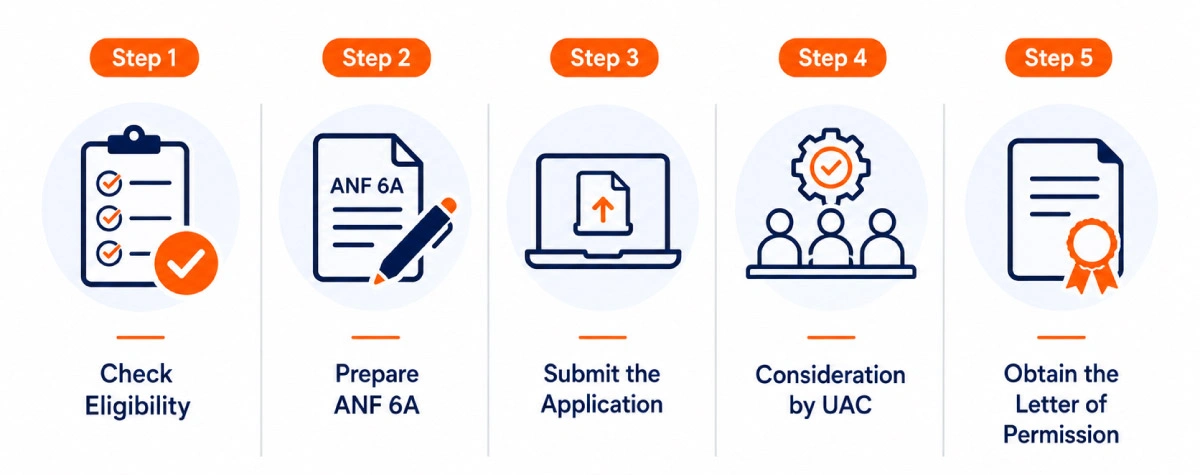
Step 1: Check Eligibility
The applicant should first check whether the proposed manufacturing, service or other activity is permitted and whether the ₹1 crore minimum investment criterion or any exception applies.
Step 2: Prepare ANF 6A
The prescribed application for setting up a new EOU or converting an eligible existing unit is made in ANF 6A.
The application requires information relating to the business, promoters, proposed activity, capital investment, foreign exchange projections, location and other project particulars.
Step 3: Submit the Application
The application is submitted to the Development Commissioner of the concerned Special Economic Zone in accordance with the prescribed procedure.
Step 4: Consideration by UAC
Applications for setting up EOUs are considered by the Units Approval Committee according to the prescribed approval criteria and applicable sector-specific conditions.
Under the applicable HBP framework, such applications are to be approved or rejected by the Units Approval Committee within 15 days, subject to the relevant conditions and approval requirements.
Step 5: Obtain the Letter of Permission
After approval, the competent Development Commissioner or designated authority issues the Letter of Permission.
The unit must subsequently comply with applicable post-approval requirements, including execution of the prescribed Legal Undertaking and relevant customs procedures where required.
Approval under the Export Oriented Unit Scheme should therefore be viewed as the beginning of a regulated export operation rather than the end of the registration process.
Documents Required for EOU Registration
The exact documentation required under the Export Oriented Unit Scheme depends on the constitution of the applicant, nature of the project and proposed sector.
Generally, an applicant may need to provide business constitution documents, details of promoters or directors, information about the proposed capital structure, project details, investment particulars, foreign exchange projections, premises information and details of plant and machinery.
Information and declarations prescribed in ANF 6A must also be provided. Additional approvals may be required where the proposed activity falls within a regulated or sector-specific category.
Since requirements can differ according to the project, businesses should verify the latest application form and requirements before filing rather than relying solely on an old document checklist.
Can an EOU Sell Goods in the Domestic Market?
A common misconception about the Export Oriented Unit Scheme is that an EOU is completely prohibited from selling goods or services within India.
EOUs undertake to export their production, but the Foreign Trade Policy permits specified sales and supplies in the Domestic Tariff Area, subject to prescribed conditions.
For eligible goods, DTA sales may be permitted only when the relevant requirements are met, including positive NFE and applicable customs, GST, cess or other conditions. The treatment can vary according to the nature of the goods, inputs used and category of the EOU.
Certain products or activities may be subject to separate restrictions, while service and software units have their own rules governing domestic supplies.
Therefore, there is no single domestic sales rule that can safely be applied to every EOU.
A business considering the Export Oriented Unit Scheme should assess its expected domestic sales before applying because significant dependence on the Indian market may affect whether the EOU model is commercially suitable.
Compliance Requirements for Export Oriented Units
Registration under the Export Oriented Unit Scheme creates ongoing compliance obligations.
NFE Monitoring: The unit must monitor its Net Foreign Exchange position and ensure that the prescribed positive NFE requirement is satisfied.
Record Maintenance: Proper records should be maintained for imports, domestic procurement, production, stock, exports and permitted DTA clearances.
LoP Compliance: The EOU should carry out activities within the scope and conditions specified in its Letter of Permission.
Reports and Returns: Applicable reports, statements and returns must be submitted to the prescribed authorities according to the current regulatory requirements.
Customs Compliance: Where goods are imported or procured under customs-related facilities, the unit must comply with the relevant notifications and conditions governing their receipt, use, disposal or domestic clearance.
Non-compliance under the Export Oriented Unit Scheme can result in recovery of applicable duties or benefits and regulatory action under the FTP, FT(D&R) Act, customs law or other applicable legislation.
Export Oriented Unit Scheme vs SEZ
The Export Oriented Unit Scheme and Special Economic Zone framework are both associated with export-oriented businesses, but they are legally different.
An EOU operates under Chapter 6 of the Foreign Trade Policy. Although EOU approvals are administered through the concerned Development Commissioner, an EOU does not become an SEZ unit merely because the Development Commissioner of an SEZ administers its approval.
An SEZ unit operates within a notified Special Economic Zone and is principally governed by the Special Economic Zones Act, 2005, SEZ Rules and other applicable laws.
Location requirements, regulatory procedures, domestic transactions and tax or customs treatment may therefore differ between the two models.
Is the Export Oriented Unit Scheme Suitable for Your Business?
The Export Oriented Unit Scheme can be useful for businesses with a strong and sustainable export focus, but it is not automatically the best option for every exporter.
Before applying, businesses should assess expected export turnover, domestic sales, plant and machinery investment, NFE projections, import requirements, procurement plans and ongoing compliance costs.
Companies should also determine whether the ₹1 crore investment criterion applies to their project or whether they fall within an exempted category.
Businesses expecting substantial domestic sales should carefully examine the applicable DTA conditions before selecting the Export Oriented Unit Scheme.
The commercial benefits of becoming an EOU should always be compared with the compliance obligations and other export frameworks available under Indian law.
Why Connect with Ebizfiling for EOU Registration Assistance?
Understanding the Export Oriented Unit Scheme involves more than completing an application form. Businesses need to determine their eligibility, understand investment requirements, prepare project information and comply with the prescribed approval process.
At Ebizfiling, we assist businesses with understanding applicable EOU requirements, preparing documentation and navigating the registration process. We can also help businesses understand ANF 6A requirements, the Letter of Permission process and related compliance requirements. For businesses starting international operations, Ebizfiling also provides assistance with IEC Registration and Export Business Registration. Our approach focuses on accurate documentation and an understanding of current regulatory requirements rather than relying on outdated claims about EOU tax exemptions.
Get expert assistance with Ebizfiling and take the next step towards your export plans. Contact Ebizfiling Today.
Conclusion
The Export Oriented Unit Scheme continues to provide an important framework for businesses that intend to manufacture goods or provide eligible services primarily for international markets.
The scheme offers specific import, procurement and operational facilities, but it also creates responsibilities relating to minimum investment where applicable, positive NFE, DTA sales, recordkeeping, reporting and compliance with the Letter of Permission.
Businesses considering the Export Oriented Unit Scheme should therefore evaluate their export plans, domestic sales requirements, investment structure and ability to meet ongoing compliance obligations before applying.
A proper assessment of both the regulatory requirements and commercial benefits can help a business decide whether establishing an Export Oriented Unit is the right approach for its long-term export strategy.
Suggested Reads:
Import Export Code: Exempted Categories and Restricted Items
How to Check IEC Application Status in India
Frequently Asked Questions
1. Can an existing DTA unit convert into an Export Oriented Unit?
Yes. An existing Domestic Tariff Area unit can apply for conversion into an EOU, subject to the eligibility criteria, approval requirements, and conditions prescribed under the current EOU framework.
2. Can an EOU outsource or subcontract part of its production to a DTA unit?
Yes. An EOU can subcontract permitted production processes to a Domestic Tariff Area unit through job work, subject to the prescribed conditions. The goods are generally required to return to the EOU after completion of the job work, although export from the job worker’s premises may be permitted in specified cases.
3. Can an EOU extend the validity of its Letter of Permission?
Yes. Extension of an EOU’s Letter of Permission may be permitted by the competent Development Commissioner or other prescribed authority, subject to the applicable Handbook of Procedures and satisfaction of the required conditions. The current HBP specifically provides for permission relating to extension of an EOU.
4. Can an EOU undertake job work for a Domestic Tariff Area unit?
An EOU may undertake specified job work or related activities for DTA units where permitted under the Foreign Trade Policy and Handbook of Procedures. The exact treatment depends on the nature of the goods, activity, customs requirements, and applicable conditions.
5. How is scrap, waste or by-product generated by an EOU treated?
Scrap, waste and by-products generated during an EOU’s approved operations may be exported, cleared into the Domestic Tariff Area, or otherwise disposed of subject to the relevant FTP and customs conditions. Applicable duties and taxes depend on the nature and manner of clearance.
6. Can an EOU transfer goods or inputs to another EOU?
Inter-unit transfer of eligible goods or services may be permitted between EOUs and certain other specified units, subject to applicable approval, documentation, NFE and customs requirements. Such transfers must be recorded correctly because they can affect the NFE calculation of the units involved.
7. How can an EOU exit or debond from the EOU Scheme?
An EOU can exit the scheme through the prescribed debonding process. Before final exit, the unit may need to satisfy applicable NFE obligations and pay relevant customs duties, taxes, or other liabilities on goods procured or imported under the EOU framework. The current HBP separately provides for permission for final exit of an EOU.
8. Can an EOU change or expand its approved business activity after obtaining the LoP?
An EOU may seek approval for changes or expansion of its approved activities, capital goods, or project parameters where permitted. Such changes should not be implemented merely on the basis of the original Letter of Permission if fresh approval or amendment is required under the applicable EOU procedure.
9. Can Ebizfiling help an existing business apply for EOU status?
Yes. Ebizfiling can assist an eligible existing business with understanding EOU requirements, preparing the required documentation, and navigating the application and approval process. Businesses entering international trade can also consider Ebizfiling’s IEC Registration assistance for applicable import-export requirements.
10. Can Ebizfiling assist with IEC registration for an Export Oriented Unit?
Yes. Ebizfiling provides assistance with Import Export Code Registration, including application preparation and DGFT-related filing support. IEC requirements should be assessed separately from EOU approval because the two serve different regulatory purposes.





IEC Registration
Get IEC registered. Online IEC Registration in India is compulsory if you wish to export or import.
About Ebizfiling -



Reviews
Akash Shinde
09 Apr 2022It was a wonderful experience with ebiz filing I had opted for company incorporation package specially Ayushi Mam and Pulkit sir they helped me a lot .Thank you so much dear mam and sir It was very smooth process.I will recommend to everyone
Ashish Paliwal
29 Sep 2018Let me be honest and tell you that I did not choose eBiz filing after my initial LLP company registration did to pricing. A lot of companies contact me with better rates so I generally choose them. However, I will still rate eBiz filing 10/10 on work ethics. You guys are professionals in true sense.
Devang Panchal
09 Sep 2018They helped me with my company’s name change and I was quite satisfied with the way they served me. I am surely coming back to you in case of any compliance problem.
October 6, 2026 By Srishti M
October 7, 2026 By Srishti M
October 3, 2026 By Srishti M
Revised ITR Under Old Tax Regime: Change Rules Explained Overview A salaried taxpayer may file an Income Tax Return under the new tax regime and later realise that the old tax regime could be more suitable because of eligible deductions […]