


-
September 24, 2026
-
BySiddhi R
All You Need to Know About Section 12AB and 80G Registration
Introduction
12AB and 80G registration helps charitable and non-profit organizations in India claim eligible tax benefits and improve donor confidence. Eligible NGOs, trusts, societies, and Section 8 companies traditionally obtained registration under Section 12AB for tax exemption, while Section 80G allowed eligible donors to claim deductions on qualifying donations.
From 1 April 2026, the Income-tax Act, 2025, introduced a new framework for these registrations. Section 332 now covers the registration of eligible non-profit organizations, while Section 354 deals with approvals related to donation deductions. Existing valid registrations under the earlier law continue subject to the applicable transition provisions. Therefore, understanding the 12AB and 80G registration framework remains important for NGOs managing tax and donation-related compliance.
Key Takeaways
- 12AB registration traditionally helped eligible NGOs claim tax exemption on qualifying income, subject to applicable conditions.
- 80G registration allows eligible donors to claim tax deductions on qualifying donations made to approved organizations.
- From 1 April 2026, Sections 332 and 354 of the Income-tax Act, 2025 govern the corresponding registration and donation approval framework.
- Form 104 and Form 105 now apply to relevant registration and approval applications in place of the earlier Form 10A and Form 10AB framework.
- NGOs must maintain proper accounts, donor records, activity details, and required filings to continue receiving applicable tax benefits.
Understanding 12AB Registration for NGOs
Section 12AB was introduced under the Income-tax Act, 1961 as part of the registration framework for charitable and religious trusts and institutions.
Registration under this framework allowed eligible organizations to claim exemption on qualifying income, subject to compliance with Sections 11, 12 and other applicable provisions. It did not mean that every receipt of an NGO automatically became tax-free. The organization had to satisfy prescribed conditions relating to its objects, application of income, investments, reporting, and other statutory requirements.
From 1 April 2026, the corresponding registration framework for non-profit organizations falls under Section 332 of the Income-tax Act, 2025. NGOs considering 12AB and 80G registration should therefore understand the current provisions along with the earlier terminology.
Which Organizations Need Charitable Registration?
Registration may be relevant for charitable trusts, registered societies, and Section 8 companies that operate for eligible charitable or religious purposes and intend to claim income-tax benefits.
Organizations that already held valid registration under the earlier law do not lose their registration merely because the Income-tax Act, 2025 came into force. Existing approvals and registrations generally continue according to the applicable transition provisions.
Newly established organizations seeking provisional registration must follow the application requirements applicable from 1 April 2026.
Why Is Charitable Registration Important?
- Income Exemption: Registration allows an eligible non-profit organization to claim tax exemption on qualifying income, provided all prescribed conditions are satisfied.
- Legal Recognition: Valid income-tax registration demonstrates that the organization is operating within the applicable tax-compliance framework for charitable institutions.
- Donor Confidence: Proper registration, record keeping, and regulatory compliance can improve transparency and strengthen donor confidence.
- Donation Approval: Charitable registration is also relevant when an NGO seeks approval that enables eligible donors to claim tax deductions on qualifying donations.
For many NGOs, completing the 12AB and 80G registration requirements supports both tax compliance and fundraising activities.
Important Compliance Points for NGOs
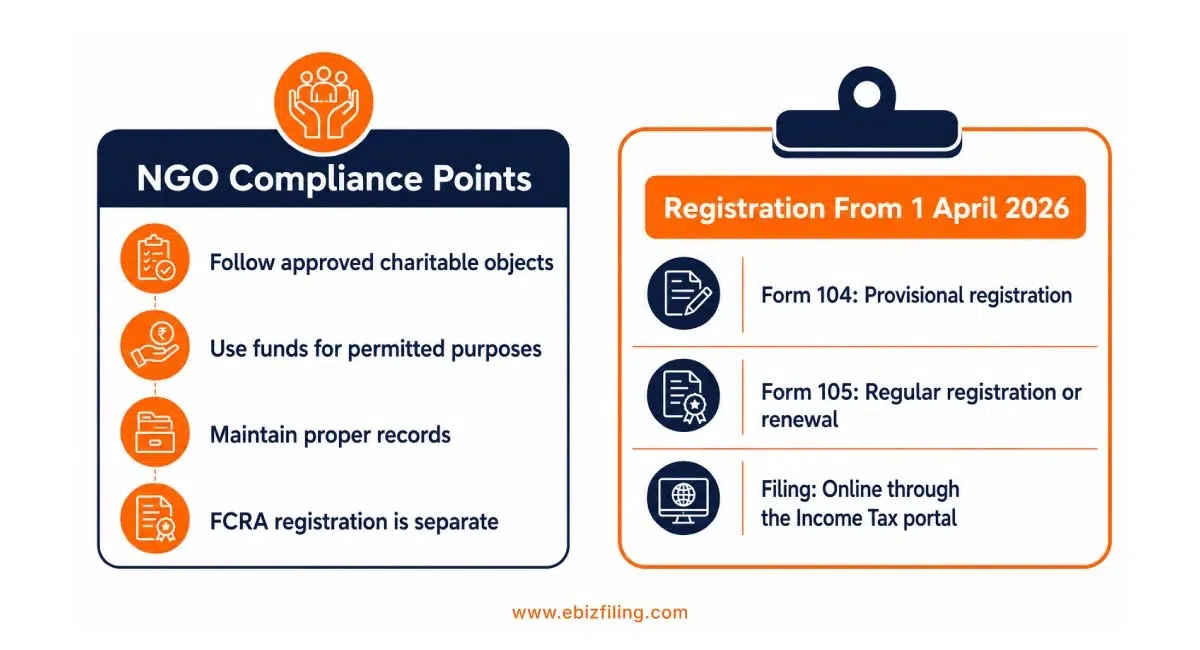
An organization seeking tax exemption must operate according to its stated charitable or religious objects and comply with the applicable provisions of income-tax law.
Funds and assets should be used for permitted purposes, and proper books and supporting records should be maintained. Where the organization earns business income incidental to its objectives, additional requirements, including maintaining separate books where applicable, may arise.
NGOs should also remember that income-tax registration and FCRA registration are separate legal requirements. Obtaining 12AB and 80G registration does not automatically permit an organization to receive foreign contributions. Foreign contributions are governed separately under the Foreign Contribution (Regulation) Act.
Current Registration Process From 1 April 2026
The application procedure changed with the Income-tax Act, 2025.
A charitable organization whose activities have not yet commenced and that seeks provisional registration or provisional approval generally files Form 104.
For regular registration or approval, including relevant situations involving the commencement of activities, expiry of provisional registration, renewal, or modification of objects, Form 105 is used. Form 105 corresponds to the earlier Form 10AB.
Applications are filed electronically through the Income Tax e-Filing portal. The Income Tax Department may examine the organization’s objects, activities, documents, and compliance before granting regular registration or approval.
Therefore, organizations following the 12AB and 80G registration process should ensure that their documents and activity records are complete and accurate before filing.
What Is 80G Approval?
Under the earlier Income-tax Act, 1961, Section 80G allowed eligible taxpayers to claim deductions for qualifying donations made to approved funds and charitable institutions.
The purpose of this provision was to encourage charitable giving by providing tax benefits to eligible donors.
From 1 April 2026, the corresponding framework is addressed under the Income-tax Act, 2025, including Section 354 for approval of eligible non-profit organizations.
An important distinction in 12AB and 80G registration is that charitable registration primarily relates to the organization’s tax exemption, while donation-related approval provides benefits to eligible donors.
Conditions for Donation-Related Approval
An organization seeking approval must satisfy the conditions prescribed under income-tax law. In general, its governing documents and activities should be charitable, funds should not be diverted for prohibited purposes, and proper accounts should be maintained.
The organization should also maintain appropriate donor and donation records. Restrictions may apply to organizations established for the benefit of a particular religious community or caste, subject to the provisions and exceptions available under the law.
Approval should not be treated as a one-time compliance requirement. Continued compliance is necessary for retaining the applicable tax benefits and approvals.
How Much Deduction Can a Donor Claim?
Not every donation receives the same tax deduction.
Depending on the approved institution or fund and the applicable provision, donations may qualify for:
- 100% deduction without a qualifying limit
- 50% deduction without a qualifying limit
- 100% deduction subject to the qualifying limit
- 50% deduction subject to the qualifying limit
Therefore, NGOs should avoid stating that every donation automatically qualifies for a full deduction.
Under the current framework, a deduction for a donation exceeding ₹2,000 is available only when the payment is made through a mode other than cash. A similar restriction applied under the earlier Section 80G framework.
Understanding these rules is an important part of 12AB and 80G registration, especially for organizations that regularly raise funds from individual or institutional donors.
Donation Reporting Requirements for NGOs
- An approved organization has reporting responsibilities for donations received.
- Under the earlier framework, organizations filed Form 10BD containing prescribed donation details and issued Form 10BE certificates to donors.
- Under the Income-tax Act, 2025, these have been mapped to Form 113 for the statement of donations and Form 114 for the certificate of donation.
- Accurate donor information is important because the reported details support the donor’s deduction claim.
Organizations maintaining 12AB and 80G registration should ensure that donation records, donor details, and prescribed filings remain accurate and up to date.
Apply for 12A/12AB and 80G Registration with Ebizfiling
Ebizfiling provides professional support for NGOs, trusts, societies, and Section 8 companies seeking tax-related registrations in India. Our team assists organizations with the application process, document preparation, and compliance requirements.
- 12A/12AB Registration Service: Ebizfiling helps eligible charitable and non-profit organizations complete their 12A/12AB registration process and submit the required documents for tax exemption registration.
- 80G Registration Service: Ebizfiling assists NGOs and charitable organizations with 80G registration so eligible donors can claim tax deductions on qualifying donations, subject to applicable income-tax provisions.
With Ebizfiling, organizations can get expert assistance in understanding the applicable registration requirements, preparing documents, and completing the online filing process.
Conclusion
12AB and 80G registration has traditionally been an important part of the income-tax compliance framework for NGOs in India. Charitable registration helps eligible organizations claim exemption on qualifying income, while donation-related approval allows eligible donors to claim deductions subject to applicable conditions. Since 1 April 2026, NGOs must also understand the transition to the Income-tax Act, 2025. New applications now follow the updated framework, including Sections 332 and 354 and Forms 104 and 105.
For NGO, registration is only the beginning. Maintaining proper accounts, using funds for permitted purposes, reporting donations correctly, and complying with renewal and filing requirements are equally important for protecting tax benefits and maintaining regulatory compliance.
Frequently Asked Questions
1. Can an NGO apply for 80G registration without 12AB registration?
Under the current framework, an NPO seeking approval under Section 354 must generally have the applicable charitable registration under Section 332 or the corresponding earlier provisions, have a Section 332 application pending, or apply for both registrations together, as applicable.
2. Is 12AB and 80G registration compulsory for every NGO?
No. 12AB and 80G registration is not compulsory for every NGO simply because it is formed as a trust, society, or Section 8 company. However, organizations that want to claim applicable income-tax exemptions or offer eligible donor deductions generally need the relevant registrations.
3. What is the difference between 12AB registration and 80G registration for NGO?
12AB registration for NGO mainly relates to tax exemption on eligible income of the organization. 80G registration for NGO mainly benefits eligible donors by allowing them to claim deductions on qualifying donations. Both registrations therefore address different sides of NGO tax compliance.
4. What documents are usually checked during the 12AB and 80G registration process?
Common 12AB registration documents may include the registration certificate, trust deed or constitutional documents, PAN, activity details, financial records, trustee or director details, and existing tax approvals, depending on the organization’s structure. The authority may also review whether the NGO’s activities match its stated charitable objects.
5. Does an 80G certificate mean that every donation is 100% tax deductible?
No. An 80G certificate does not mean every donation qualifies for a 100% deduction. Depending on the approved institution and applicable provision, donations may qualify for 50% or 100% deduction, with or without a qualifying limit.
6. Can an NGO receive foreign donations after getting 12AB and 80G registration?
No. 12AB and 80G registration does not automatically allow an NGO to receive foreign contributions. FCRA registration or prior permission is governed separately under the Foreign Contribution (Regulation) Act.
7. What happens if an NGO changes its objects after obtaining registration?
If an NGO changes its objectives or constitutional documents, it may need to follow the applicable modification or re-registration procedure. Under the post-1 April 2026 framework discussed in this blog, relevant cases may require filing through Form 105, depending on the nature of the change.
8. Can Ebizfiling help with both 12AB registration and 80G registration?
Yes. Ebizfiling provides assistance with 12AB registration, 80G registration, document preparation, application requirements, and online filing support for eligible NGOs, trusts, societies, and Section 8 companies.
9. Does Ebizfiling help NGOs prepare documents for tax exemption registration?
Yes. Ebizfiling can assist organizations in understanding the required documents and filing steps for NGO tax exemption registration. This can be useful for entities that are unsure about the documents applicable to their legal structure or registration stage.
10. Can donors claim a deduction for large cash donations under 80G?
A donor cannot claim the applicable deduction where a cash donation exceeds ₹2,000. Donations above this amount should be made through permitted non-cash modes if the donor intends to claim the available tax benefit.





Section 12A Registration
Get your Charitable Institution exempted under Section 12A
About Ebizfiling -


Follow Author
Leave a Reply
Reviews
-

Chandrashekhar Nimmalwar
28 Oct 2020(Translated by Google) Ebizfiling has a company providing support for time period service and proper guidance. It is my personal experience at present. Chandrashekhar Nimmalwar. Today Aas Family Foundation (Original) ईबिज फायलीग की सेवा समय अवधि कार्य प्रणाली एव उचित मार्गदर्शन के लिए सहायता प्रदान कम्पनी है।यह मेरा वर्तमान में नीजी अनुभव है। चन्द्रशेखर निममलवार। आज आस परिवार फाउंडेशन
-
Pradyumna sahu
28 Sep 2020Ebizfiling provides good service and also transparent. Some process are Lately working but its okay. Lata medam was also cooperate to us according to in our requirements. Thanks for all team members of ebizfiling. I hope future and further reference about in your org will provide to others. Again thanks for all team. Also provide good price


-
-
September 26, 2026 By Srishti M
Company compliance calendar October 2026Company Compliance Calendar October 2026: Key Due Dates & Filings Introduction The Company Compliance Calendar October 2026 provides an overview of important statutory and regulatory compliances that companies need to track during the month under the Companies Act, 2013 and […]
-
-
-
September 26, 2026 By Srishti M
TDS and TCS Compliance Calendar October 2026TDS and TCS Compliance Calendar October 2026: Compliance Guide Introduction The TDS and TCS Compliance Calendar October 2026 provides an overview of important tax deduction and collection obligations applicable to deductors and collectors. It helps businesses, government offices and other […]
-
-
-
September 25, 2026 By Srishti M
OPC compliance calendar October 2026: Due DatesOPC Compliance Calendar October 2026: Important Filings & Requirements Introduction The OPC Compliance Calendar October 2026 highlights the key statutory obligations that One Person Companies should monitor during the month. October primarily includes compliance requirements related to financial statement filing […]
-




Hello B R Tarafdar,
Thank you for your Inquiry!
The team will get in touch with you soon. Meanwhile, you can get in touch with Ebizfiling on +919643203209 / info@ebizfiling.com