


-
September 11, 2026
All You Need To Know About Tax Deductions
Introduction
Tax deductions play a crucial role in reducing the taxable income of individuals and businesses. They are an effective way to minimize tax liability and retain more of your hard-earned money. In India, the Income Tax Act offers various provisions for tax deductions, allowing taxpayers to claim exemptions on specific expenses and investments. In this article, we will explore what tax deductions are, their significance, and the income tax deductions available to salaried employees in India.
What is a Tax Deduction?
A tax deduction is an expense, allowance, or exemption that lowers a person’s or a company’s taxable income. It assists people and organizations in reducing their overall tax obligation by deducting allowable expenses from their gross income. Taxpayers can drastically lower their tax liability by claiming tax deductions, which produces sizable savings.
What is Tax Deduction in India?
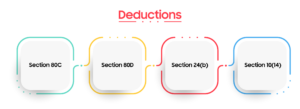
The Income Tax Act in India offers a detailed list of tax deductions that people can use. The rules and restrictions for claiming each of these deductions are listed in the various sections of the legislation under which they fall. Tax deductions in India include:
-
Section 80C Deductions: Taxpayers may deduct up to Rs. 1.5 lakh in expenses and investments under Section 80C. This comprises, among other things, contributions to the Employee Provident Fund (EPF), the Public Provident Fund (PPF), the National Savings Certificate (NSC), and life insurance premiums.
-
Section 80D Deductions: Health insurance premiums for one’s family, one’s parents, and oneself may be written off under Section 80D. Taxpayers are permitted to deduct expenses for themselves, their families, and their parents up to a total of Rs. 25,000. Senior citizens are also eligible for a larger deduction of Rs. 50,000.
-
Section 24(b) Deductions: Homeowners can claim deductions on the interest paid on a home loan under Section 24(b). The annual maximum deduction allowed is Rs. 2 lakh.
-
Section 10(14) Deductions: Salaried employees can claim deductions on allowances such as house rent allowance (HRA), conveyance allowance, and medical allowances, subject to certain limits and conditions.
Income Tax Deductions for Salaried Employees
Several income tax deductions in India are available to salaried workers, which they can use to lower their tax obligations. Salary workers may deduct the following expenses in addition to those already mentioned:
-
Standard Deduction: As per the Union Budget 2018, salaried employees are eligible for a standard deduction of Rs. 50,000 from their taxable income. This deduction replaces the earlier transport allowance and medical reimbursement, providing a flat deduction to all salaried individuals.
-
Leave Travel Allowance (LTA): Under the LTA clause, salaried employees may deduct costs related to domestic travel within India. Actual travel expenses are eligible for the exemption, subject to some restrictions.
-
House Rent Allowance (HRA): HRA is an allowance that employees receive from their employer to cover the cost of their rented housing. Subject to a few restrictions, HRA may be partially or completely tax-exempt.
-
Children’s Education Allowance: Employees can get the Children’s Education Allowance to help with the cost of their children’s education. For a total of two children, this stipend is exempt from a monthly cap of INR 100 per child.
Conclusion
Understanding tax deductions in India is essential for every taxpayer, as it helps in optimizing tax planning and reducing the tax burden. By taking advantage of the various income tax deductions available in India, individuals can ensure they pay the right amount of tax while maximizing their savings. It is advisable to consult a tax professional or refer to the Income Tax Act for accurate information regarding specific deductions, eligibility criteria, and documentation requirements. By staying informed and making smart financial decisions, you can make the most of the tax deductions and achieve better financial stability.
Suggested Read:
Donation to Political Parties: Claim Tax Deduction under Section 80GGC





File Income Tax Returns
Filing of Income Tax return is necessary if you have earned any income.
About Ebizfiling -



Reviews
Akshay Shah
17 Jun 2017I would give them 4 stars for their efficiency and pricing.
arti ittannavr
18 Apr 2022Took trademark registration from Ebizfiling india private limited service was excellent thank you 😊
DEEPAK BAGRA
08 Sep 2018I find the service, working approach and commitments very professional. Their progress updates are commendable. I really liked working with them.
September 7, 2026 By Steffy A
Health Insurance Deduction Under Section 126: Rules & Limits Introduction Health insurance protects families from rising medical costs and can also provide a tax benefit when the legal conditions are satisfied. Section 126 of the Income Tax Act, 2025 provides […]
August 29, 2026 By Steffy A
OPC Compliance Calendar September 2026: Key Due Dates Introduction The OPC Compliance Calendar September 2026 lists the major tax, GST, labour law, and ROC obligations that One Person Companies may need to complete during the month. September includes important compliances […]
August 29, 2026 By Steffy A
TDS and TCS Compliance Calendar September 2026: Key Deadlines Introduction The TDS and TCS Compliance Calendar September 2026 helps deductors, collectors, government offices, property buyers and eligible individuals or HUFs identify the forms applicable to them. Reviewing these requirements in […]