
New EPFO withdrawal rules explaining changes to provident fund withdrawal provisions

EPFO Withdrawal Rules 2026: Major Changes Explained

Introduction

The EPFO Withdrawal Rules 2026 include major changes approved by the Central Board of Trustees (CBT) on 19 November 2026. These decisions aim to provide greater withdrawal flexibility and retirement security for EPF members, subject to the applicable scheme amendments and implementation procedures.


The key decisions include reducing the minimum PF balance requirement from 25% to 10%, shortening the final withdrawal waiting period from 12 months to 2 months and introducing a voluntary Systematic Withdrawal Plan (SWP).


These changes aim to improve access to retirement savings while protecting members’ long-term financial security.


However, CBT approval does not automatically make every change operational. Members should check the relevant notifications and EPFO procedures before applying under the revised provisions.


To know about the employee PF wage ceiling limit, read our blog on EPFO Wage Ceiling Increased to ₹25,000


Key Highlights

  • The Board approved reducing the minimum PF balance requirement from 25% to 10%.
  • Eligible members may be able to withdraw up to 90% of the relevant PF corpus, subject to applicable rules.
  • The waiting period for final PF withdrawal has been approved for reduction from 12 months to 2 months.
  • Retiring members may receive their savings through periodic payouts under the proposed Systematic Withdrawal Plan.
  • Eligible establishments may receive a six-month renewal window for expired EDLI exemptions.
  • Implementation depends on applicable scheme amendments, notifications and operational procedures.


Major EPFO Withdrawal Changes Approved in 2026

The Employees’ Provident Fund Organisation (EPFO) manages provident fund, pension and insurance-related social security benefits for eligible employees.


During its 240th CBT meeting on 19 November 2026, chaired by Union Labour and Employment Minister Dr. Mansukh Mandaviya, the Board approved several proposals to improve withdrawal flexibility, retirement security and EPFO administration.


The EPFO Withdrawal Rules 2026 focus primarily on three areas: minimum PF balance requirements, final settlement waiting periods and periodic retirement withdrawals.


The meeting also addressed EDLI exemption cases, digital claim processing and investment management.


For employees, these developments could mean improved access to accumulated savings. For employers, they highlight the importance of maintaining accurate records and understanding changes in EPFO compliance requirements.
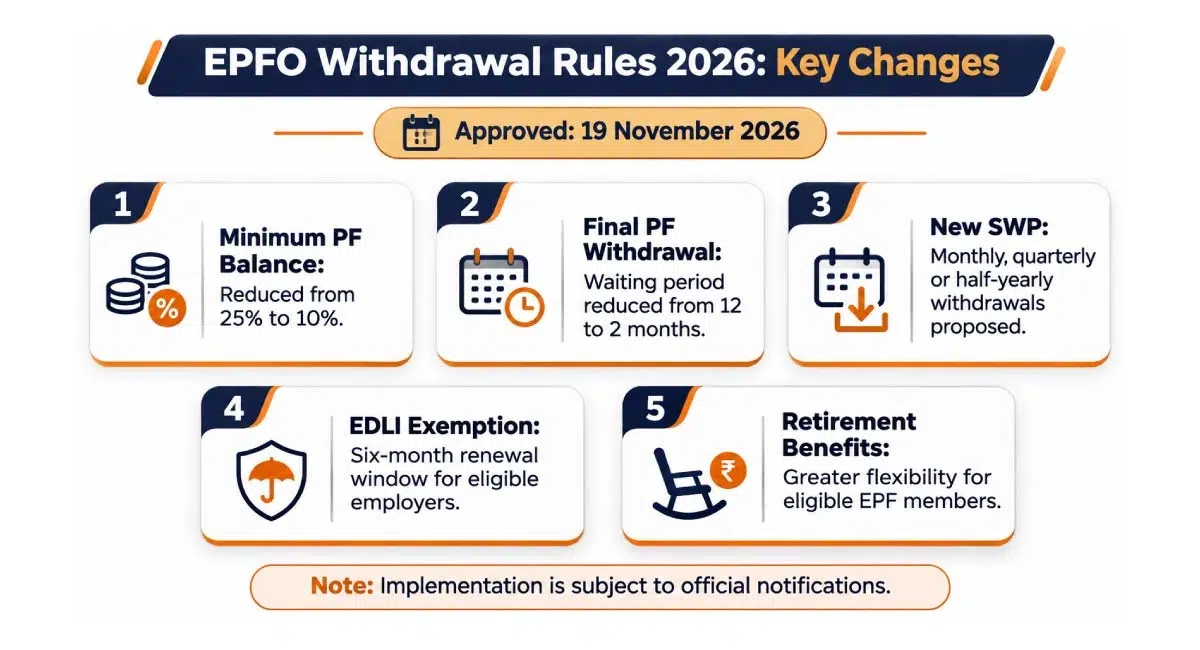
 

 Key changes in EPFO withdrawal rules 2026 for employees and PF members

1. EPFO Reduces Minimum PF Balance to 10%

One of the most significant decisions under the EPFO Withdrawal Rules 2026 concerns the amount that members must retain in their provident fund accounts.
The CBT approved reducing the earmarked minimum balance from 25% to 10% of the relevant contributions.


This decision aims to provide greater financial flexibility while preserving a portion of employees’ savings for retirement.


Under the earlier framework, 25% was earmarked as a minimum balance. The approved revision reduces this requirement to 10%.


As a result, eligible members may gain access to a larger portion of their accumulated contributions, depending on the applicable withdrawal category and conditions.


Illustrative Example

Suppose the relevant contribution balance considered for a withdrawal is ₹5,00,000.


Particulars

Earlier requirement

Approved revision

Minimum retained percentage

25% 10%
Illustrative retained amount ₹1,25,000

₹50,000

Illustrative balance above minimum

₹3,75,000

₹4,50,000


Important: This comparison only demonstrates the percentage difference. It does not guarantee that a member can withdraw the entire amount shown. Actual eligibility depends on the applicable EPF withdrawal provisions.


The revised requirement may help eligible employees meet financial needs without exhausting their retirement savings.


The reduction in the minimum retained balance does not automatically allow every EPF member to withdraw 90% of their total PF savings. Actual withdrawal eligibility depends on the purpose of withdrawal, applicable conditions and implementation of the revised provisions.


2. Final PF Withdrawal Waiting Period Reduced to 2 Months

Another major decision under the EPFO Withdrawal Rules 2026 is the reduction in the waiting period for final PF withdrawal.


The Board approved reducing the waiting period from 12 months to 2 months.


Once implemented, this change may allow eligible members who have left employment to apply for final settlement after satisfying the prescribed two-month waiting period.


The shorter waiting period could provide financial support to members who remain unemployed after leaving their jobs.


However, employees should understand the following conditions:

  • The revised waiting period applies to eligible final PF withdrawal.
  • Members must satisfy the applicable unemployment and settlement conditions.
  • Resignation alone does not guarantee immediate full withdrawal.
  • EPF and Employees’ Pension Scheme (EPS) benefits follow separate provisions.

The EPFO withdrawal waiting period should therefore be assessed with reference to the specific claim and the rules applicable when the member submits it.


Members can check the latest claim procedures on the official EPFO website.


Employees can also read our detailed guide on EPF withdrawal online to understand the claim process, eligibility and required documents.


Important Update

The CBT approved reducing the final PF withdrawal waiting period from 12 months to 2 months on 19 November 2026. Members should verify whether the revised provisions have been formally implemented before submitting a settlement claim.


3. EPFO Approves a New Systematic Withdrawal Plan (SWP)

The EPFO Withdrawal Rules 2026 also include a proposal to provide retiring members with more flexibility in receiving their accumulated savings.


The Board approved the introduction of a voluntary EPFO Systematic Withdrawal Plan that would allow eligible members to receive periodic payments rather than withdrawing their entire PF balance in one lump sum.


Under the proposed framework, members may choose withdrawals at the following intervals:

  • Monthly
  • Quarterly
  • Half-yearly

The remaining provident fund corpus would continue generating returns according to the applicable scheme provisions.


This arrangement could help retired employees manage their expenses while retaining ownership of their remaining savings.


The proposed SWP will require the necessary EPF Scheme amendments and operational guidelines. The government has also indicated that corresponding changes to the Income Tax Act are being pursued. Members should verify the final eligibility, withdrawal and taxation provisions once notified.


Example:


Consider a retiring employee with an accumulated EPF balance of ₹12 lakh.


Instead of withdrawing the entire amount immediately, the employee could choose periodic payments under the proposed SWP.


The remaining funds would stay within the EPF framework, subject to the final conditions.


The actual payment amount, eligibility criteria and operating procedure will depend on the notified rules.


4. Eligibility and Benefits Under the Proposed EPFO SWP

The proposed SWP is expected to benefit members who prefer regular access to savings after retirement.


According to the official announcement, approximately 6.32 lakh EPF members aged above 55 with PF accumulations exceeding ₹5 lakh could be primary beneficiaries during the initial phase.


The proposal also includes provisions for eligible family members and beneficiaries.


If a participating member dies during the payout period, the nominee or eligible dependent may be able to withdraw the remaining balance or continue receiving periodic payments.


These arrangements are subject to the final scheme provisions.


The proposal also introduces UAN-linked mechanisms for direct voluntary contributions and third-party micro-contributions, including contributions such as customer tips.


These mechanisms would operate independently of traditional employer payroll arrangements, subject to the necessary amendments.


5. EDLI Exemption Reforms for Employers

Alongside the EPFO Withdrawal Rules 2026, the Board approved amendments relating to Employees’ Deposit Linked Insurance (EDLI) exemption cases.


These changes are intended to help eligible establishments resolve pending or expired exemptions.


The approved reforms include:

  • A six-month window for eligible establishments to renew expired EDLI exemptions.
  • Conditional relief from contributions, interest and penal damages for verified transitional periods.
  • Resolution of certain longstanding exemption cases.
  • Consideration of continuous group insurance arrangements providing benefits equal to or better than statutory EDLI coverage.

The relief is not automatic. Establishments must satisfy the prescribed conditions and verification requirements.


These measures could particularly benefit employers who maintained qualifying group insurance coverage but faced procedural difficulties in renewing their exemptions.


For more details, refer to the official PIB announcement dated 19 November 2026.


Employers can also explore the EPFO wage ceiling FAQs to understand the separate changes affecting employee coverage.


Need Help Managing
Monthly PF Returns?

Simplify monthly ECR filing and employee contribution reporting with professional PF return filing assistance from Ebizfiling.

File PF Returns

EPFO Withdrawal Rules 2026: Old vs New Comparison

The following table summarises the major decisions announced at the 240th CBT meeting.


Particulars

Earlier framework

Approved changes

Minimum PF balance

25% 10%
Illustrative withdrawal flexibility Balance above 25% minimum

Balance above 10% minimum, subject to eligibility

Final PF withdrawal waiting period

12 months 2 months
Systematic Withdrawal Plan No comparable approved facility

Voluntary periodic payouts proposed

SWP payout frequency

Not applicable Monthly, quarterly or half-yearly
Expired EDLI exemptions Existing procedures

Six-month renewal window for eligible establishments


The New PF withdrawal rules 2026 should be read alongside subsequent notifications because approval and operational implementation are separate stages.


Who Will Benefit from the EPFO Changes?

The EPFO Withdrawal Rules 2026 may benefit employees, retirees and certain employers in different ways.


Employees Facing Financial Emergencies

The lower minimum retained balance may allow eligible employees to access a larger portion of their savings when facing financial difficulties.


Employees Leaving Employment

The shorter final settlement waiting period may improve access to PF savings for members who meet the prescribed unemployment conditions.


Retiring Members

The proposed SWP could provide regular withdrawals and reduce the need to take the entire retirement corpus in one payment.


Nominees and Dependants

Eligible family members may receive additional flexibility in accessing the remaining PF balance under the proposed SWP.


Employers with EDLI Exemptions

Qualifying establishments may benefit from transitional relief and additional time to renew expired exemptions.


Other Important Decisions at EPFO’s 240th CBT Meeting

The November 2026 meeting also reviewed EPFO’s investment approach, exempted establishments and digital service improvements.


Investment and Transfer of Exempted Establishments

The Board granted in-principle approval for investment of up to 3% of fresh fund accretion in eligible Alternative Investment Funds (AIFs), within the existing overall investment ceiling and subject to safeguards.


Separately, the Board reviewed exemption surrender proposals involving 27 establishments and cancellation cases involving four establishments.


These cases concern approximately ₹5,996 crore in accumulated PF savings covering 1,44,437 members.


Improvements in Digital Claim Processing

EPFO also reported progress under its Centralised IT Enabled System (CITES) 2.0.


According to the official announcement:

  • Auto-processing of claims increased from 39% to 71%.
  • The overall claim rejection ratio declined from 23% to 7.82%.
  • Average claim settlement time reduced from 11.15 days to 2.57 days.

These figures reflect reported system-level improvements and do not guarantee a specific processing time for every individual claim.


What Do the New EPFO Rules Mean for Employers?

Although the EPFO Withdrawal Rules 2026 primarily concern employee withdrawals, employers should understand how related developments may affect their administrative responsibilities.


1. Maintain Accurate Employee Records

Employers should update employee information, joining dates and exit records accurately to support eligible EPFO claims.


2. Review UAN and KYC Details

Correct UAN information and employee records can help reduce administrative difficulties during claim processing.


Employees can refer to our UAN generation guide to understand the UAN creation and activation process.


3. Examine EDLI Exemption Status

Establishments with expired or pending exemptions should assess whether they qualify for the approved transitional relief.


4. Communicate Changes Carefully

HR and payroll teams should distinguish between CBT decisions and formally implemented provisions when informing employees.


5. Continue Regular Statutory Compliance

Employers must continue following applicable EPF contribution and reporting requirements. The withdrawal-related decisions do not automatically change normal employer filing obligations.


Employers can refer to the PF and ESI Compliance Calendar FY 2026-27 to track applicable contribution and filing deadlines.

EPFO WITHDRAWAL RULES 2026

When Will the New EPFO Withdrawal Rules Be Applicable?

The CBT approved major EPFO withdrawal-related changes on 19 November 2026. However, approval does not automatically mean that every revised facility is operational.

Certain proposals, particularly the Systematic Withdrawal Plan, require further scheme amendments and implementation guidelines.

Employees should check the latest EPFO notifications and official procedures before submitting claims under the revised provisions.

Expert EPF Compliance Assistance by Ebizfiling

The EPFO Withdrawal Rules 2026 highlight the importance of keeping employee-related records and compliance procedures up to date.


Ebizfiling assists businesses with registration, reporting and statutory compliance requirements.


Our services include:

  • EPF Registration: Assistance with applicable employer registration and documentation requirements.
  • Monthly PF Returns: Support with employee contribution reporting and ECR filing.
  • Payroll-Related Compliance: Assistance with employee salary records and related statutory requirements.
  • Employee Compliance Support: Guidance on organising required employee information and applicable filing obligations.

Businesses registering under EPFO can explore our EPF Registration Services.

Looking to Simplify Your Company's
EPF Compliance?

Get expert support with EPF registration, contribution reporting and ongoing employer compliance requirements.

Get EPF Compliance Support

Conclusion

The EPFO Withdrawal Rules 2026 represent an important development in India’s provident fund framework.


The CBT’s decision to reduce the minimum retained PF balance from 25% to 10%, shorten the final withdrawal waiting period from 12 months to 2 months and introduce a voluntary Systematic Withdrawal Plan may provide greater financial flexibility for eligible members.


The proposed EDLI exemption reforms and improvements in digital claim processing could also benefit employers and simplify administration.


However, employees and employers should verify the operational status of each change before taking action.


Disclaimer: This article is based on the decisions announced at EPFO’s 240th CBT meeting on 19 November 2026. The applicability of approved changes is subject to relevant scheme amendments and official notifications.


Frequently Asked Questions


1. What are the major EPFO withdrawal changes approved in November 2026?

The EPFO Withdrawal Rules 2026 include approval for reducing the minimum PF balance requirement to 10%, shortening the final withdrawal waiting period to 2 months and introducing a voluntary Systematic Withdrawal Plan for retiring members.


2. Can employees withdraw 90% of their PF balance?

The approved minimum balance reduction may provide greater withdrawal flexibility. However, 90% PF withdrawal is not an automatic entitlement for every member. Actual eligibility depends on the relevant withdrawal category and applicable conditions.


3. Has the waiting period for final PF withdrawal been reduced to 2 months?

The CBT approved reducing the waiting period from 12 months to 2 months on 19 November 2026. Members should verify that the revised rule has become operational before relying on it.


4. What is the minimum PF balance requirement after the approved change?

The approved EPF minimum balance requirement is 10%, compared with the earlier 25% provision. Its application to individual claims depends on the relevant rules and implementation status.


5. Is the Systematic Withdrawal Plan mandatory for retiring members?

No. The proposed SWP is voluntary and is intended to offer eligible retirees an alternative to receiving their entire provident fund savings in one lump sum.


6. Will the remaining PF balance earn returns under SWP?

The proposed framework allows the remaining corpus to continue generating returns. The applicable interest treatment and withdrawal conditions will depend on the notified provisions.


7. Can employees withdraw their complete PF balance immediately after resignation?

No. Resignation alone does not guarantee immediate final settlement. Members must satisfy the applicable conditions for full withdrawal.


8. Will the two-month waiting period also apply to EPS withdrawal?

The announced reduction concerns final PF withdrawal. EPS benefits follow separate provisions, and the same waiting period should not automatically be assumed to apply.


9. What relief has EPFO approved for employers under EDLI?

Eligible establishments may receive a six-month renewal window for expired EDLI exemptions and conditional relief from contributions, interest and penal damages for verified transitional periods.


10. How can Ebizfiling help employers with PF compliance?

Ebizfiling provides assistance with EPF registration, monthly PF returns, payroll-related records and employer compliance requirements. Businesses can seek professional support to manage their statutory obligations.

About Ebizfiling -

EbizFiling is a concept that emerged with the progressive and intellectual mindset of like-minded people. It aims at delivering the end-to-end corporate legal services 0f incorporation, compliance, advisory, and management consultancy services to clients in India and abroad in all the best possible ways.
 
To know more about our services and for a free consultation, get in touch with our team on  info@ebizfiling.com or call 9643203209.
 
Ebizfiling

Author: siddhi

Siddhi Rathi is an Advocate by profession, Legal Research Scholar, and Legal Content Writer at Ebizfiling. She is currently pursuing her Ph.D. in Law from Nirma University, Ahmedabad, and brings a strong research-oriented approach to legal and compliance content. Her work focuses on taxation, tax compliance, corporate law, regulatory laws, business compliance, and emerging legal developments in India. At Ebizfiling, Siddhi combines legal research, statutory interpretation, and content writing to create accurate, structured, and reader-friendly content for startups, businesses, professionals, and taxpayers. She focuses on simplifying complex legal provisions, compliance procedures, due dates, penalties, and regulatory updates into practical content that readers can understand and apply. With her background as an Advocate and researcher, Siddhi’s writing reflects legal precision, academic depth, and a practical understanding of business compliance requirements. Her content helps readers understand not only what the law provides, but also how it applies to real compliance responsibilities.

Follow Author

Leave a Reply

Your email address will not be published. Required fields are marked *

  • Rating

Hi, Welcome to EbizFiling!

Hello there!!! Let us know if you have any Questions.

Thank you for your message.

☎
whatsapp