


FIFO Taxation for Shares and ETFs: Rules and Tax Impact
Introduction
Have you ever bought the same share or ETF at different prices and later sold only a part of your holding? The main tax question in such cases is which units should be treated as sold first and which purchase price should be used for capital gains calculation. This is where FIFO taxation for shares and ETFs becomes important.
Under the FIFO method, the earliest purchased shares or ETF units are considered sold first, which affects the cost of acquisition, holding period, short-term capital gains, long-term capital gains and final tax liability.
In this blog, we will understand the meaning of FIFO taxation for shares and ETFs, how it works for demat holdings, its tax impact and its treatment under the Indian income-tax framework, including the Income-tax Act, 2025.
Quick Insights
- FIFO Method: The oldest shares and ETF units are treated as sold first under the FIFO taxation method.
- Cost of Acquisition: FIFO helps determine the cost of acquisition and period of holding for shares and ETFs.
- STCG and LTCG Classification: The FIFO method affects whether capital gains are classified as short-term or long-term.
- STCG Tax Rate: Under the Income-tax Act, 2025, STT-paid short-term equity gains are taxed at 20%.
- ETF Taxation: Debt-oriented and specified mutual fund ETFs require a separate tax review under the new rules.
Applicability of Income-tax Act, 2025
The Income-tax Act, 2025 applies to Tax Year 2026-27 onwards. The Income Tax Department explains that the concept of “Tax Year” applies from 1 April 2026, for income earned during FY 2026-27 onwards. Applications or matters relating to a tax year starting before 1 April 2026 continue under the Income-tax Act, 1961.
For taxpayers who want a separate overview of new capital gains provisions, Ebizfiling has also explained Sections 196 and 198 of the Income Tax Act, 2025 in detail.
The main references are mapped as follows:
|
Topic |
Earlier Income-tax Act, 1961 |
Income-tax Act, 2025 |
|
FIFO for demat securities |
Section 45(2A) | Section 67(7)(c) |
| STCG on STT-paid listed equity and equity-oriented fund units | Section 111A |
Section 196 |
|
LTCG on STT-paid listed equity and equity-oriented fund units |
Section 112A | Section 198 |
| Specified mutual fund / market-linked debenture gains | Section 50AA |
Section 76 |
What is FIFO Taxation for Shares and ETFs?
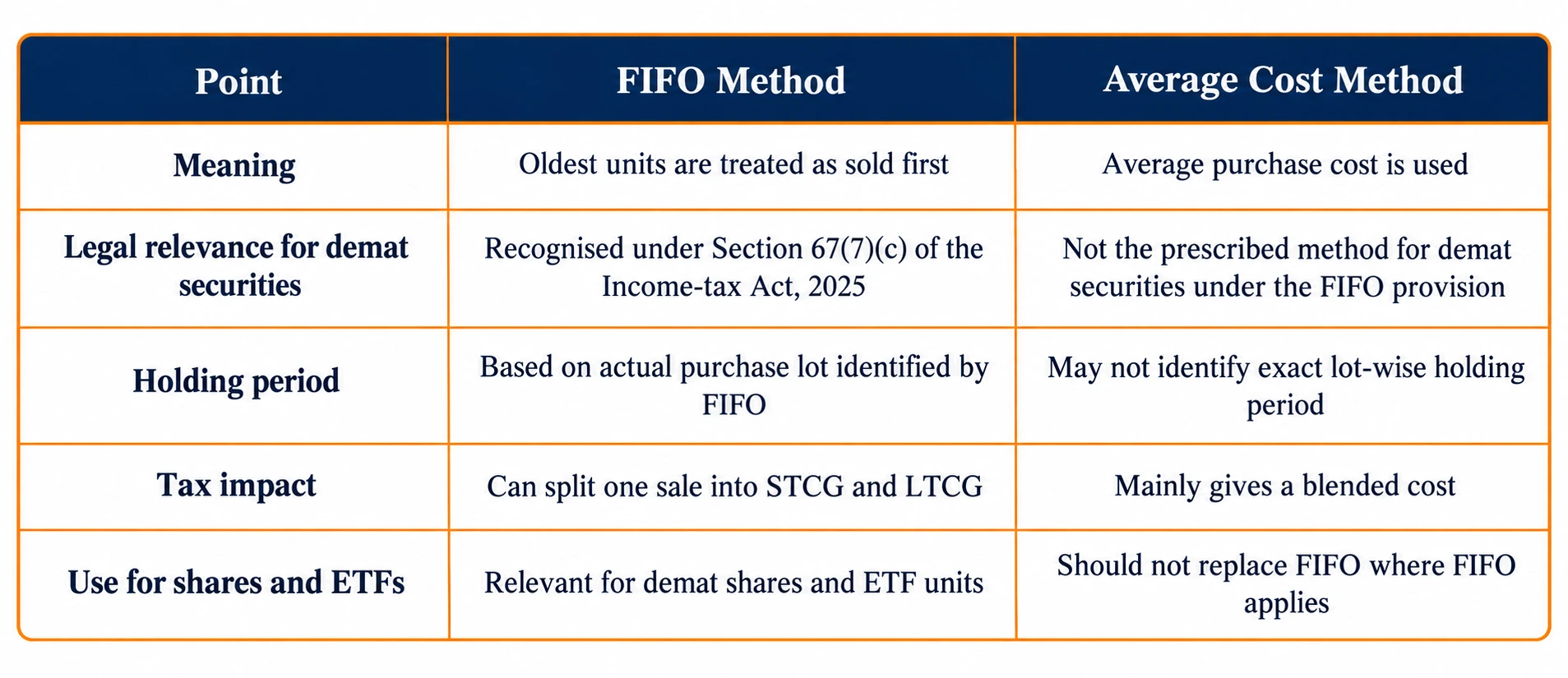
FIFO taxation for shares and ETFs is the method used to identify which shares or ETF units are sold when the same security has been purchased in different lots. Under FIFO, the units bought first are treated as sold first.
Under Section 67(7)(c) of the Income-tax Act, 2025, where a person has beneficial interest in securities and gains arise from transfer made by the depository or participant, the cost of acquisition and period of holding of such securities are determined using the first-in-first-out method. This corresponds to Section 45(2A) of the earlier Income-tax Act, 1961.
This makes FIFO taxation for shares and ETFs important because an investor cannot simply choose a later purchase lot to reduce tax. The FIFO method for shares taxation is especially relevant where the same share or ETF has been purchased on different dates and at different prices.
Why is FIFO Used for Shares and ETFs?
FIFO taxation for shares and ETFs is used to create a clear link between purchase lots and sold units. Without FIFO, investors may use different assumptions for the same holding, which can lead to incorrect capital gains reporting.
The FIFO method helps determine:
- Which purchase lot is matched with the sale
- Cost of acquisition of the sold units
- Period of holding of the sold units
- Whether the gain is short-term or long-term
- Whether Section 196, Section 198 or Section 76 of the Income-tax Act, 2025 applies
For demat holdings, FIFO taxation for shares and ETFs is not only an accounting method. It directly affects tax computation because the law recognises FIFO for securities held through the depository system.
How FIFO Taxation for Shares and ETFs Works?
FIFO taxation for shares and ETFs works in this order:
- List all purchases of the same share or ETF by date.
- Start with the oldest available purchase lot.
- Match the sale quantity against the oldest lot first.
- Move to the next lot only after the earlier lot is fully used.
- Calculate capital gain using the matched purchase cost and holding period.
The FIFO method for shares taxation should be applied security-wise. For example, FIFO for shares of one company should not be mixed with shares of another company. Similarly, units of one ETF scheme should not be mixed with another ETF scheme.
Example of FIFO Taxation for Shares and ETFs
Suppose an investor bought units of the same listed ETF as follows:
|
Date |
Transaction |
Units |
Price per Unit |
|
10 January 2025 |
Purchase | 100 | ₹100 |
| 15 May 2025 | Purchase | 100 |
₹120 |
|
20 August 2026 |
Sale | 150 |
₹160 |
Under FIFO taxation for shares and ETFs, the 150 units sold on 20 August 2026 will be matched as follows:
|
Units Sold |
Purchase Lot Used |
Cost per Unit |
Sale Price per Unit |
|
100 |
10 January 2025 lot | ₹100 | ₹160 |
| 50 | 15 May 2025 lot | ₹120 |
₹160 |
Capital gain calculation:
|
Particulars |
Amount |
|
Sale value of 100 units |
₹16,000 |
| Cost of 100 units |
₹10,000 |
|
Gain on first lot |
₹6,000 |
| Sale value of 50 units |
₹8,000 |
|
Cost of 50 units |
₹6,000 |
| Gain on second lot |
₹2,000 |
|
Total capital gain |
₹8,000 |
This example shows why FIFO taxation for shares and ETFs affects both the gain amount and the holding period. If one lot qualifies as long-term and another lot remains short-term, the same sale can have both LTCG and STCG components.
FIFO Capital Gains Calculator for Shares and ETFs
The above example shows how FIFO taxation for shares and ETFs works when shares or ETF units are bought in multiple lots and sold partly. To make the calculation easier, you can use the FIFO Capital Gains Calculator below. It helps estimate which purchase lots are treated as sold first, total cost of acquisition, sale value and capital gain or loss.







October 12, 2026 By Srishti M
Company Compliance Calendar November 2026: Key Due Dates & Filings Introduction The Company Compliance Calendar November 2026 highlights important annual return, dematerialisation and income tax compliances that companies may need to complete during the month. November 2026 is particularly […]
October 10, 2026 By Srishti M
October 12, 2026 By Srishti M
Compliance Calendar November 2026: Key Statutory Due Dates Introduction The compliance calendar November 2026 covers important statutory obligations under GST, Income Tax, TDS/TCS, Company Law, LLP regulations, EPF and ESI. It helps businesses identify the filings, payments and regulatory requirements […]