


-
September 7, 2026
-
BySteffy A
GST Compliance for LLP to Private Limited Conversion: GST & ITC Transfer
Introduction
Converting a Limited Liability Partnership into a Private Limited Company involves important legal and structural changes. One area that requires particular attention during an LLP to Private Limited conversion is Goods and Services Tax compliance. Businesses may face difficulty when they try to update the existing GST registration after conversion, especially where the GST portal shows a PAN mismatch.
GST registration is linked to the Permanent Account Number of the registered person. Therefore, where an LLP to Private Limited conversion results in a change of PAN, the existing GST registration cannot simply be amended by replacing the LLP’s PAN with the company’s PAN. The correct GST transition involves fresh GST registration for the company, transfer of eligible unutilized Input Tax Credit subject to the prescribed conditions, and cancellation of the LLP’s GST registration.
Quick Insights
- LLP to Private Limited conversion involving a PAN change requires fresh GST registration.
- The existing LLP GSTIN cannot be amended by replacing the LLP PAN with the company PAN.
- Eligible unutilized ITC may be transferred through Form GST ITC-02 subject to prescribed conditions.
- The LLP GST registration should be cancelled through Form GST REG-16 after the transition is appropriately handled.
- Vendors, clients, accounting systems, and applicable E-way bill or E-invoicing details should be updated with the new company GSTIN.
GST Registration After LLP to Private Limited Conversion
GST registration is PAN-based. A GST Identification Number is a 15-character alphanumeric number, and the third through twelfth characters are derived from the PAN of the registered person. This PAN linkage becomes important in an LLP to Private Limited conversion.
An LLP has its own PAN. When it is registered as a company under Section 366 of the Companies Act, 2013, the resulting company uses the PAN allotted to the company. The PAN linked with the LLP’s existing GST registration cannot simply be substituted with the company’s PAN. Section 366 specifically permits a Limited Liability Partnership to apply for registration as a company under the Companies Act, 2013.
An attempt to modify the existing GST registration after conversion may therefore result in a PAN mismatch. Where a change in the constitution of business results in a change of PAN, the existing registration cannot be amended for the new PAN and fresh GST registration is required. CBIC guidance expressly states that an amendment application cannot be used for a PAN change because GST registration is PAN-based.
Why PAN Cannot Be Changed in the Existing GST Registration
A common assumption is that continuity of business means the same GST registration can continue after an LLP to Private Limited conversion by changing the entity details. However, a GST registration amendment cannot be used to change the PAN where the constitution change results in a different PAN.
Because ten characters of the GSTIN are based on PAN, changing the PAN affects the identity on which the GST registration was issued. Therefore, an LLP to Private Limited conversion involving a PAN change requires fresh registration rather than amendment of the LLP’s existing GSTIN.
The LLP’s GST registration remains linked to the LLP’s PAN until it is cancelled. It should not be treated as the GST registration of the Private Limited Company after conversion.
Fresh GST Registration After LLP to Private Limited Conversion
Fresh GST registration is required where the LLP to Private Limited conversion leads to a change in PAN. The Private Limited Company must apply for a new GSTIN using the PAN allotted to the company instead of attempting to replace the PAN in the LLP’s existing registration.
After the LLP to Private Limited conversion, invoices, GST records and returns relating to the company should use the company’s GST registration.
Continuing to use the LLP GSTIN for company transactions can create reporting and Input Tax Credit issues. The GST transition should therefore be coordinated so that the correct GSTIN is used once the company is registered.
Transfer of ITC During LLP to Private Limited Conversion
Accumulated Input Tax Credit is a major concern during an LLP to Private Limited conversion. The unutilized ITC lying in the electronic credit ledger of the LLP is not automatically lost merely because the business has been registered as a company.
Section 18(3) of the CGST Act provides for transfer of unutilized ITC where there is a change in the constitution of a registered person on account of sale, merger, demerger, amalgamation, lease or transfer of business with specific provision for transfer of liabilities. Rule 41 of the CGST Rules prescribes the manner of such transfer.
Accordingly, where an LLP to Private Limited conversion satisfies the conditions of Section 18(3) and Rule 41, eligible unutilized ITC may be transferred to the Private Limited Company through Form GST ITC-02. The credit should not be described as automatically or unconditionally transferable in full; the transfer remains subject to the statutory conditions, including the requirement relating to transfer of liabilities. Form GST ITC-02 is the prescribed form for transfer of ITC under Rule 41.
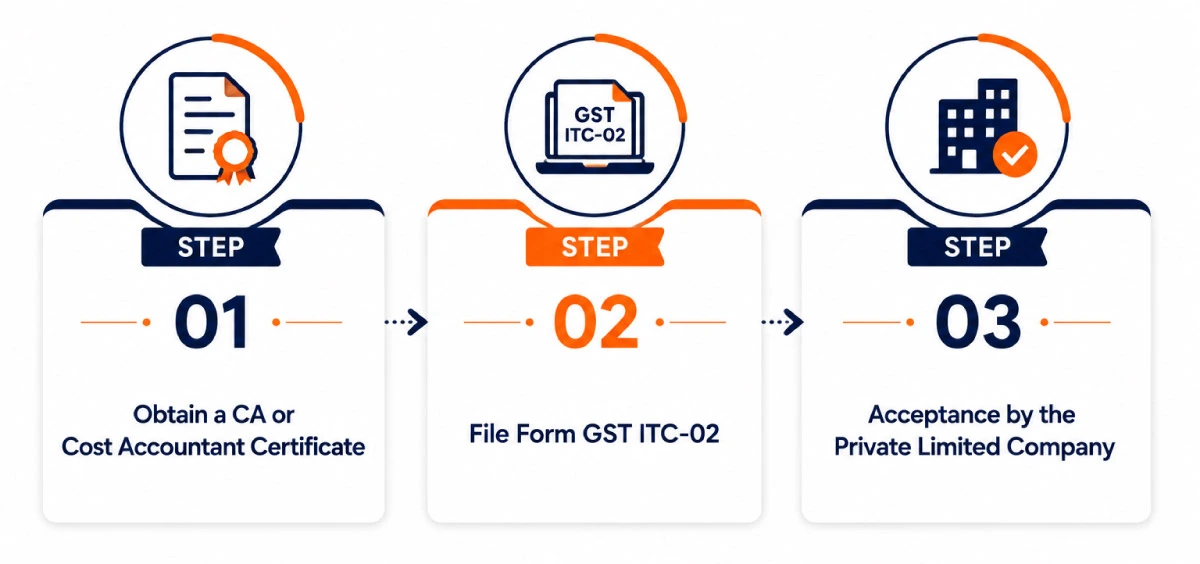
Step 1: Obtain a CA or Cost Accountant Certificate
For transfer under Rule 41, the transferor must submit a certificate issued by a practising Chartered Accountant or Cost Accountant confirming that the transfer of business has been undertaken with a specific provision for transfer of liabilities.
For an LLP to Private Limited conversion, the certificate supports the prescribed transfer of eligible unutilized ITC where the conditions for ITC-02 transfer are satisfied.
Step 2: File Form GST ITC-02
The LLP, as transferor, furnishes the transfer details electronically in Form GST ITC-02.
The LLP must provide the GSTIN of the Private Limited Company and specify the eligible unutilized credit proposed to be transferred. The required CA or Cost Accountant certificate is also submitted as part of the process. This is the prescribed mechanism for transferring eligible credit in an LLP to Private Limited conversion where Section 18(3) and Rule 41 apply.
Step 3: Acceptance by the Private Limited Company
The Private Limited Company, as transferee, must accept the details furnished by the LLP on the GST portal. Upon acceptance, the unutilized credit specified in Form GST ITC-02 is credited to the electronic credit ledger of the transferee.
This enables eligible ITC to be transferred as part of the LLP to Private Limited conversion, subject to satisfaction of the applicable conditions.
Cancellation of LLP GST Registration After Conversion
After the GST transition is appropriately handled, the LLP’s GST registration should be cancelled through the prescribed process. The LLP GSTIN cannot be converted into the GSTIN of the Private Limited Company after an LLP to Private Limited conversion because the registrations are linked to different PANs.
An application for cancellation of the LLP GST registration can be made in Form GST REG-16. The form includes, among its stated reasons for cancellation, transfer of business and change in constitution of business leading to change in Permanent Account Number. The reason selected should reflect the actual circumstances of the LLP to Private Limited conversion.
Applicable GST returns and liabilities relating to the LLP should also be appropriately dealt with as part of the transition. Pending tax, interest or penalties connected with the LLP GST registration should therefore be reviewed and appropriately settled.
It is important not to treat payment of every outstanding liability or filing of every pending return as an absolute pre-condition merely for submitting Form GST REG-16. At the same time, liabilities relating to the earlier period should not be ignored during the LLP to Private Limited conversion.
Additional Compliance Actions During LLP to Private Limited Conversion
An LLP to Private Limited conversion also requires internal systems and external billing arrangements to reflect the Private Limited Company’s details.
Update Accounting and Payroll Systems
The legal entity name, GSTIN and relevant tax settings in the accounting software should be updated after an LLP to Private Limited conversion. Newly recorded bills, expenses and automated tax calculations should be mapped to the GST records of the correct entity.
Payroll systems should also reflect the new company name so that statutory records and payslips carry the appropriate entity details. Accounting updates should ensure that newly imported bills and mapped expenses flow to the GST returns of the correct GST registration.
Inform Vendors and Clients
Vendors should be informed of the Private Limited Company’s GSTIN so that B2B invoices relating to the company are issued and reported against the correct GST registration. If vendors continue using the LLP GSTIN for transactions belonging to the company after an LLP to Private Limited conversion, the related ITC may not be available to the company under its own GST registration.
Clients should also be informed so that future billing reflects the Private Limited Company. Fresh acknowledgements or novation agreements may be used where relevant to existing commercial arrangements. These should not be treated as a mandatory GST formality in every case.
Clear communication with vendors and clients during an LLP to Private Limited conversion helps prevent transactions from continuing to be recorded under the LLP’s old GST details.
Update E-Way Bill and E-Invoicing Details
Where E-way bill or E-invoicing requirements apply, the relevant systems should be configured or registered using the correct company GSTIN after the LLP to Private Limited conversion. Existing LLP credentials or details should not be assumed to migrate automatically to the company.
Using the correct GSTIN after the transition helps ensure that applicable E-way bill and E-invoicing records correspond with the Private Limited Company’s GST registration.
Review Pending GST Liabilities
Pending tax, interest or penalties connected with the LLP GSTIN should be reviewed and appropriately dealt with. An LLP to Private Limited conversion does not by itself remove liabilities relating to the earlier period.
Proper reconciliation during the transition helps close the LLP’s GST registration while the company continues GST compliance under its own GSTIN.
Need Help with LLP to Private Limited Conversion?
Managing GST registration, ITC transfer, and other compliance requirements during an LLP to Private Limited conversion can require careful coordination.
Ebizfiling can assist you with the conversion process and related compliance requirements to help ensure a smooth transition.
Talk to an Ebizfiling expert today for professional assistance with LLP to Private Limited Company conversion.
Conclusion
An LLP to Private Limited conversion requires careful GST handling because GST registration is PAN-based. Where the conversion results in a change of PAN, the LLP’s existing GST registration cannot simply be amended by replacing its PAN with that of the company. Fresh GST registration is required for the Private Limited Company.
Eligible unutilized ITC may be transferred through Form GST ITC-02 where the requirements of Section 18(3) of the CGST Act and Rule 41 of the CGST Rules are satisfied, including the applicable transfer-of-liabilities condition. The LLP GST registration should then be appropriately cancelled through Form GST REG-16.
Updating accounting and payroll systems, vendor and client details, and applicable E-way bill and E-invoicing information is also important. A properly managed LLP to Private Limited conversion helps ensure that eligible ITC is transferred in accordance with the prescribed process and that GST records reflect the converted business structure.
Suggested Reads:
GST Registration of Pvt Ltd Company in India
Procedure to Change an LLP to Pvt Ltd Company
Complete Guide to Cancellation of GST Registration
Frequently Asked Questions
1. Is there a specific time limit for filing Form GST ITC-02 after LLP to Private Limited conversion?
Rule 41 of the CGST Rules does not prescribe a separate fixed number of days for filing Form GST ITC-02. However, the transfer should be completed while the transferor’s registration and eligible unutilized credit remain available, and the GST transition should be properly coordinated before closure of the LLP registration.
2. Is ITC required to be transferred in proportion to the value of assets during LLP to Private Limited conversion?
Not generally. The asset-value ratio under Rule 41 specifically applies in the case of a demerger. Where the LLP’s business is transferred as part of its conversion into a Private Limited Company, eligible unutilized ITC is governed by Section 18(3) and Rule 41, including the requirement for transfer of liabilities.
3. How long should GST records of the LLP be retained after conversion?
GST records should generally be retained for 72 months from the due date of the annual return for the relevant financial year. If any appeal, investigation, revision, or other proceeding is pending, the records may need to be retained for a longer period as prescribed under Section 36 of the CGST Act.
4. What happens to the LLP GSTIN after filing an application for cancellation?
Once an application for cancellation is filed, the LLP’s GST registration is generally treated as suspended from the date of submission of the application or the requested cancellation date, whichever is later, until the cancellation proceedings are completed. This is governed by Rule 21A of the CGST Rules.
5. Can the Private Limited Company continue the LLP's invoice numbering series?
The Private Limited Company should issue invoices under its own GSTIN and maintain a proper invoice series for its own GST registration. Rule 46 requires tax invoices to carry a consecutive serial number, in one or multiple series, unique for the financial year.
6. Must transferred inputs and capital goods be recorded in the Private Limited Company's books after ITC-02 transfer?
Yes. Rule 41 specifically requires the transferee to duly account for the transferred inputs and capital goods in its books of account. Therefore, the GST credit transfer should also be supported by proper accounting records in the Private Limited Company.
7. Does cancellation of the LLP GSTIN remove the requirement to preserve GST documents?
No. Cancellation of GST registration does not remove the requirement to preserve statutory records. Relevant invoices, credit notes, debit notes, stock records, delivery challans, and other prescribed GST documents should continue to be retained for the applicable statutory period.
8. Can GST authorities determine earlier LLP liabilities after cancellation of its GST registration?
Yes. Cancellation of GST registration does not extinguish tax, interest, penalty, or other liabilities relating to the period before cancellation. Such liabilities may still be determined or recovered after the GST registration has been cancelled.
9. Can Ebizfiling assist with GST registration after LLP to Private Limited conversion?
Yes. Ebizfiling can assist with GST registration for the Private Limited Company, including documentation and the online registration process. This can help businesses manage GST registration requirements arising after an LLP to Private Limited conversion.
10. How can Ebizfiling help with GST compliance during LLP to Private Limited conversion?
Ebizfiling can assist businesses with GST registration and related compliance requirements during an LLP to Private Limited conversion. This can include support with documentation, registration-related filings, and coordination of applicable GST compliance during the transition.





About Ebizfiling -



October 21, 2026 By Srishti M
Tax Planning for NRI Returning to India Before Becoming ROR Introduction Tax planning for NRI returning to India should start before the person becomes Resident and Ordinarily Resident, also known as ROR. Under the Income-tax Act, 2025, residential status decides […]
October 19, 2026 By Srishti M
October 21, 2026 By Srishti M
TDS and TCS Compliance Calendar November 2026: Compliance Guide Introduction The TDS and TCS Compliance Calendar November 2026 covers important tax deduction, collection, payment, certificate and reporting requirements applicable during the month. It helps businesses, government offices and other responsible […]