


-
September 2, 2026
-
BySteffy A
Schedule FA for US Stocks: INDmoney, Vested & ITR Filing Guide
Overview
Investing in Apple, Microsoft, Nvidia, Amazon, US ETFs and other overseas securities has become easier for Indian investors through platforms such as INDmoney, Vested and international brokerage accounts. However, foreign investing also creates additional income-tax reporting requirements in India.
For a Resident and Ordinarily Resident (ROR) individual holding US shares, Schedule FA is one of the most important disclosures while filing an Income Tax Return.
Reporting only the capital gain from selling US shares may not be enough. The foreign brokerage or custodial account, foreign shares, dividend income and foreign tax withheld may need to be reported through different ITR schedules.
This guide explains Schedule FA for US Stocks for FY 2025-26 and AY 2026-27, including the reporting period, Schedule FA A2 and A3, capital gains, US dividends, Schedule FSI, Schedule TR, Form 67, INDmoney Schedule FA and Vested Schedule FA reports.
Note: This article assumes that the investor is Resident and Ordinarily Resident in India, is not a US citizen or US tax resident, holds US shares as investments and does not carry on a trade or business in the United States. Different facts may change the tax treatment.
How US Stocks Are Reported in ITR?
Schedule FA for US Stocks is primarily a foreign asset disclosure requirement. It should not be confused with the schedules used to calculate capital gains or dividend income.
|
Transaction or Information |
Normal ITR Reporting |
|
Foreign brokerage or custodial account |
Schedule FA A2, where applicable |
| Shares of US companies |
Schedule FA A3 |
|
Sale of US shares |
Schedule CG and, where applicable, Schedule FSI |
| US dividends |
Schedule OS and Schedule FSI |
|
US tax withheld |
Schedule FSI, Schedule TR and Form 67 |
| Foreign tax credit claim |
Schedule TR and Form 67 |
The AY 2026-27 ITR provides separate reporting fields for foreign custodial accounts under A2 and foreign equity or debt interests under A3. Therefore, Schedule FA for US Stocks may involve both the account through which securities are held and the underlying US shares.
Taxpayers can also refer to the Income Tax Department’s official Schedule FA, FSI and TR filing guide for the reporting framework.
Schedule FA for US Stocks Reporting Period: Financial Year vs Calendar Year
One of the biggest mistakes in Schedule FA for US Stocks is using the Indian financial year for foreign asset disclosure.
For AY 2026-27, two different reporting periods can operate together:
|
Purpose |
Relevant Period |
|
Capital gains, dividends and other taxable income |
1 April 2025 to 31 March 2026 |
| Schedule FA for US Stocks foreign asset disclosure |
1 January 2025 to 31 December 2025 |
The distinction matters because Schedule FA for US Stocks may not contain the same annual sale figures as Schedule CG.
Suppose an investor sells US shares in February 2026. The transaction falls in FY 2025-26 and can therefore affect capital-gain reporting for AY 2026-27. However, the February 2026 sale proceeds do not form part of CY 2025 Schedule FA for US Stocks reporting.
If those shares were held at any time during CY 2025, however, the foreign shareholding itself may still need to be disclosed in Schedule FA for US Stocks. This is why the capital-gain report and Schedule FA for US Stocks can differ without either being incorrect.
Who Needs to File Schedule FA for US Stocks?
Schedule FA for US Stocks primarily concerns taxpayers who are Resident and Ordinarily Resident in India and hold reportable foreign assets or foreign accounts.
Broadly:
- Resident and Ordinarily Resident: Schedule FA for US Stocks may apply.
- Resident but Not Ordinarily Resident: Schedule FA is generally not required.
- Non-Resident: Schedule FA is generally not required.
Residential status should therefore be checked before preparing Schedule FA for US Stocks, especially where a taxpayer recently moved abroad or returned to India.
For more detail, see Ebizfiling’s guide on residential status for Income Tax purposes.
Which ITR Is Used for US Stock Investments?
A taxpayer holding foreign assets should not automatically select ITR-1 merely because salary is the main source of income.
For a typical individual investor:
- ITR-2 is generally relevant where the person has salary, house property, capital gains, dividends or other income but no business or professional income.
- ITR-3 may be required where the taxpayer also has business or professional income.
ITR-1 and ITR-4 do not contain the required Schedule FA for US Stocks reporting framework for taxpayers to whom foreign asset disclosure applies.
The correct return depends on the complete income profile of the taxpayer, not merely the existence of US stocks.
Which Schedule FA for US Stocks Tables Apply?
For most retail investors, Schedule FA for US Stocks mainly involves A2 and A3, although other tables can apply depending on the nature of the foreign asset.
|
Schedule FA Table |
What It Covers |
Relevance for US Investors |
|
A1 |
Foreign depository accounts | Relevant where a qualifying foreign depository account exists |
| A2 | Foreign custodial accounts |
Often relevant for an overseas brokerage or custodial account |
|
A3 |
Foreign equity and debt interests | Main table for shares or equity interests in US companies |
| A4 | Foreign cash-value insurance or annuity contracts |
Generally unrelated to plain equity investing |
|
B |
Financial interest in a foreign entity | Relevant in specified cases |
| C | Foreign immovable property |
Not ordinarily applicable to US stocks |
|
D |
Other capital assets outside India | Residual foreign capital assets |
| E | Foreign accounts with signing authority |
Relevant where signing authority exists and is not otherwise reported |
|
F |
Foreign trusts | Relevant for specified trust interests |
| G | Other foreign-source income |
Residual foreign income reporting |
Schedule FA for US Stocks A2: Foreign Custodial Account
Where the arrangement creates a reportable foreign custodial account, A2 can require:
- Country and country code
- Name and address of the financial institution
- Account number
- Ownership or status
- Account opening date
- Peak balance
- Closing balance
- Gross amounts paid or credited
Investors should not decide whether A2 applies merely from the brand name of an investment app. The actual brokerage and custodial structure should be reviewed.
Schedule FA for US Stocks A3: US Company Shares
A3 is particularly important for Schedule FA for US Stocks because it covers foreign equity and debt interests.
For each reportable holding, details can include:
- Country
- Name and address of the foreign entity
- Nature of the entity
- Date of acquiring the interest
- Initial investment value
- Peak value
- Closing value
- Gross amount paid or credited
- Gross sale or redemption proceeds
Schedule FA for US Stocks can therefore include shares that were held during CY 2025 even if they were sold before 31 December 2025.
What If US Shares Were Sold Before 31 December?
Schedule FA for US Stocks does not cover only shares remaining in the portfolio on 31 December.
If an investor held shares from January to September 2025 and sold the entire holding in September, the A3 disclosure may still include the acquisition details, initial value, peak value, applicable gross amounts, sale proceeds and a nil closing value.
The absence of a stock from the year-end portfolio does not automatically remove the reporting requirement. Investors should review full-year transaction information, not only the 31 December holdings statement.
Schedule FA for US Stocks Is Different From Capital Gains Reporting
Schedule FA for US Stocks is an asset disclosure schedule. It does not calculate tax on the sale of a US share.
If a US share is sold:
- Schedule FA for US Stocks deals with foreign asset disclosure.
- Schedule CG deals with taxable capital gain or loss.
- Schedule FSI reports applicable foreign-source income.
- Schedule TR reports foreign tax relief.
- Form 67 supports an eligible foreign tax credit claim.
Merely disclosing Apple, Microsoft or Nvidia shares in Schedule FA for US Stocks does not mean the related gain or dividend has automatically been included in taxable income.
Tax Treatment of US Stocks in India
Understanding US stocks tax in India requires separating capital gains, dividends and foreign tax credit.
Capital Gains on US Shares
When an Indian resident investor sells US shares held as investments, the profit or loss is generally considered under the capital-gains provisions in India.
For transfers made on or after 23 July 2024, the general holding period relevant to many capital assets is 24 months. Direct shares of US companies listed on NASDAQ or NYSE are not shares listed on a recognised stock exchange in India.
|
Holding Period |
General Classification |
|
24 months or less |
Short-term capital gain or loss |
| More than 24 months |
Long-term capital gain or loss |
Long-term capital gains covered by Section 112 are generally taxable at 12.5%, subject to applicable provisions, surcharge and cess. Short-term capital gains on direct US shares are generally taxed at the applicable slab rate where Section 111A does not apply.
Schedule FA for US Stocks should therefore not be prepared using Indian listed-equity rules merely because the shares trade on NASDAQ or NYSE.
Is Capital Gain From US Shares Taxable in the United States?
For a typical Indian resident investor who is not a US citizen or US tax resident, spends less than 183 days in the United States and does not conduct a US trade or business, ordinary portfolio capital gains are generally not subject to US tax under the usual non-resident alien rules.
For many retail investors, this broadly means:
- India taxes the capital gain.
- US tax generally does not arise on an ordinary portfolio sale.
- The treatment of dividends is different because US withholding tax commonly applies.
- Taxation of US Dividends in India
US dividends received by an Indian resident are taxable in India. The gross dividend should normally be considered, rather than only the amount received after US withholding.
For example:
|
Particular |
Amount |
|
Gross US dividend |
US$100 |
| US withholding tax |
US$25 |
|
Net amount received |
US$75 |
For Indian tax reporting, US$100 is the gross dividend income. The US$25 withholding is separately relevant for foreign tax credit India compliance.
The reporting can involve:
- Schedule OS for dividend income
- Schedule FSI for foreign-source income
- Schedule TR for foreign tax relief
- Form 67 for the FTC claim
Schedule FA for US Stocks remains separate from this income-tax reporting.
US Dividend Withholding and W-8BEN
Under the India-US DTAA, dividends paid to an Indian resident beneficial owner can generally be taxed in the United States at a maximum rate of 25% in ordinary individual-investor cases.
Investors generally provide Form W-8BEN to establish foreign status and claim applicable treaty treatment.
If the gross dividend is US$100 and US withholding is US$25, the Indian return should still consider the gross dividend of US$100. The foreign tax withheld is then examined separately for FTC purposes.
Foreign Tax Credit and Form 67 for US Stocks
If US tax is withheld from foreign income, an eligible resident taxpayer may claim foreign tax credit under Rule 128, subject to applicable conditions.
The credit is generally restricted to the lower of:
- Eligible foreign tax paid on that income, or
- Indian tax payable on the same foreign income.
Form 67 for US stocks is used to provide details of foreign income, foreign tax paid or deducted, the relevant country and supporting evidence.
Schedule FA for US Stocks should not be confused with the FTC claim. Schedule FA for US Stocks discloses foreign assets, while Form 67 and Schedule TR deal with foreign tax credit.
For more detail, see Ebizfiling’s guide on Foreign Tax Credit in India.
Currency Conversion for Schedule FA for US Stocks and Foreign Income
US investments are usually maintained in US dollars, but the Indian ITR requires relevant amounts in Indian rupees.
Different conversion rules or dates can apply depending on the item being converted:
|
Amount |
Relevant Rule or Concept |
|
Initial, peak or closing value for Schedule FA |
Schedule FA for US Stocks valuation methodology |
| Foreign-currency capital gain |
Rule 115 |
|
Foreign dividend income |
Rule 115 |
| Foreign tax paid or withheld for FTC |
Rule 128 |
Using one USD-INR exchange rate for every figure can therefore produce an incorrect return. For taxable foreign income, investors can also refer to Rule 115 of the Income Tax Rules.
For Schedule FA for US Stocks, investors should distinguish asset values from capital-gain income, dividend income and foreign tax paid.
How to Report US Investments in ITR?
A practical filing process is:
- Verify residential status.
- Select the correct ITR form.
- Download the complete broker or platform reports.
- Identify foreign accounts and shares held during CY 2025.
- Prepare Schedule FA for US Stocks, including A2 and A3 where applicable.
- Calculate realised capital gains separately for FY 2025-26.
- Report gross foreign dividends.
- Complete Schedule FSI where applicable.
- Calculate eligible foreign tax credit.
- Complete Schedule TR and Form 67 where required.
- Reconcile the final return with supporting records.
This approach keeps foreign asset disclosure separate from income taxation.
INDmoney and Vested: Schedule FA for US Stocks Reporting
Investment-platform reports can simplify data collection, but they should be treated as source documents rather than the final ITR.
INDmoney Schedule FA
An INDmoney Schedule FA report may help identify information such as:
- US company name
- Acquisition date
- Investment value
- Peak value
- Closing value
- Sale proceeds
- Capital gains
- Dividend details
- Foreign tax withheld
For Schedule FA for US Stocks, investors should still verify the reporting period, currency conversion methodology, fractional shares, corporate actions and whether the underlying account structure requires A2 reporting.
Vested Schedule FA
A Vested Schedule FA report may similarly provide foreign asset details, purchase dates, investment values, peak and closing values, sale information, dividends and foreign tax details.
The report can support preparation of Schedule FA, Schedule CG, Schedule FSI, Schedule TR and Form 67. However, Vested Schedule FA data should be reconciled with the current ITR utility before filing.
For both platforms, the practical rule is:
Platform Report → Transaction Review → ITR Schedule Mapping → Tax Calculation → Final Filing
Schedule FA for US Stocks should never be completed by blindly copying an app-generated statement.
Worked Example: Schedule FA for US Stocks Through INDmoney or Vested
Consider Mr A, an Indian ROR investor who uses INDmoney or Vested, holds US shares as investments and is neither a US citizen nor a US tax resident.
Assume the following:
|
Stock |
Purchase Date |
Total Cost |
Sale Date |
Sale Information |
|
Alpha Inc. |
15 May 2023 | US$60,000 | 15 September 2025 | Sold for US$82,000 |
| Beta Inc. | 10 June 2025 | US$40,000 | 15 February 2026 |
Shares with attributable cost of US$20,000 sold for US$26,000 |
Additional information:
- Gross US dividend: US$4,000
- US tax withheld: US$1,000
Note: The exchange rates used below are illustrative only. Actual filing should use the applicable prescribed TT buying rate or other relevant conversion rule for each item.
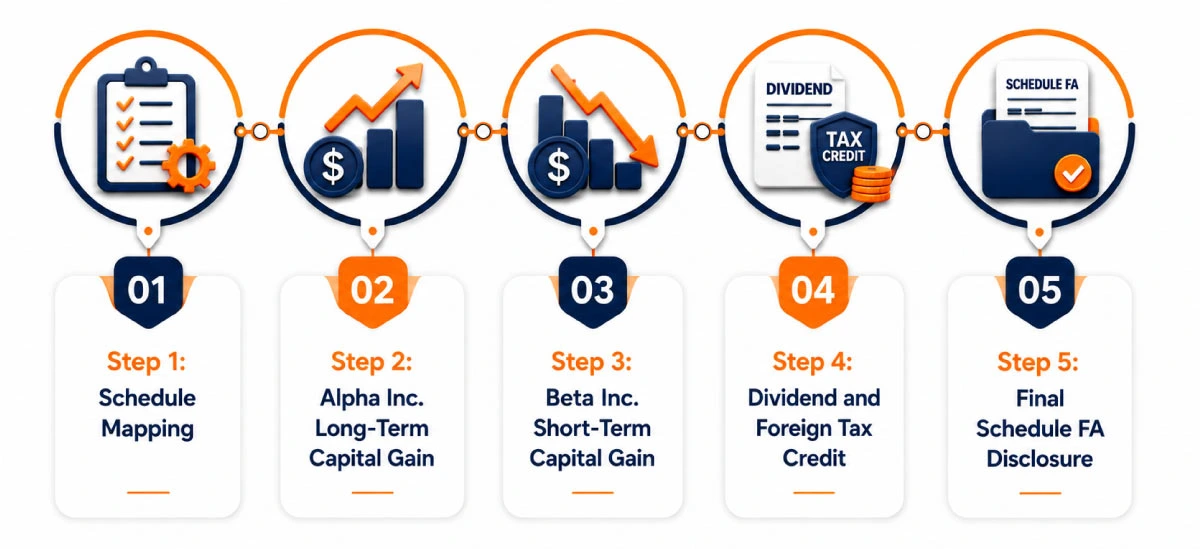
Step 1: Schedule Mapping
|
Information |
ITR Reporting |
|
Foreign brokerage/custodial account |
Schedule FA A2, where applicable |
| Alpha Inc. shares held during CY 2025 |
Schedule FA A3 |
|
Beta Inc. shares held during CY 2025 |
Schedule FA A3 |
| Alpha Inc. sale |
Schedule CG and applicable Schedule FSI reporting |
|
Beta Inc. February 2026 sale |
Schedule CG and applicable Schedule FSI reporting |
| US dividend |
Schedule OS and Schedule FSI |
|
US tax deducted |
Schedule TR and Form 67 |
Schedule FA for US Stocks can therefore differ from Schedule CG because the former follows CY 2025 while capital gains for AY 2026-27 follow FY 2025-26.
Step 2: Alpha Inc. Long-Term Capital Gain
Purchase cost: US$60,000
Sale value: US$82,000
Capital gain: US$22,000
Holding period: More than 24 months
Assume US$1 = ₹87 for illustration.
US$22,000 × ₹87 = ₹19,14,000
|
Particular |
Amount |
|
Long-term capital gain |
₹19,14,000 |
| Tax @ 12.5% |
₹2,39,250 |
|
Cess @ 4% |
₹9,570 |
| Total tax |
₹2,48,820 |
This gain is reported through the applicable capital-gain and foreign-income schedules. The Schedule FA for US Stocks disclosure remains separate.
Step 3: Beta Inc. Short-Term Capital Gain
Beta Inc. had a total investment cost of US$40,000. Out of this holding, shares having an attributable cost of US$20,000 were sold on 15 February 2026 for US$26,000.
Capital gain: US$6,000
Assume US$1 = ₹91 for illustration.
US$6,000 × ₹91 = ₹5,46,000
The gain is generally taxable at the applicable slab rate.
The February 2026 sale proceeds do not form part of CY 2025 Schedule FA for US Stocks reporting. However, because Beta Inc. shares were held during CY 2025, the holding itself may still require disclosure in Schedule FA for US Stocks for AY 2026-27.
Step 4: Dividend and Foreign Tax Credit
Gross dividend: US$4,000
US withholding: US$1,000
Net amount received: US$3,000
Assume US$1 = ₹89 for illustration.
Gross dividend = ₹3,56,000
Foreign tax paid = ₹89,000
Assume an Indian tax rate of 30% for illustration:
|
Particular |
Amount |
|
Gross dividend income |
₹3,56,000 |
| Tax @ 30% |
₹1,06,800 |
|
Health and Education Cess @ 4% |
₹4,272 |
| Total Indian tax |
₹1,11,072 |
|
Foreign tax paid |
₹89,000 |
Eligible FTC is generally the lower of the eligible foreign tax paid and Indian tax payable on the same foreign income. On these assumptions, the illustrative FTC is ₹89,000.
The dividend is reported under Schedule OS and Schedule FSI, while the FTC claim is handled through Schedule TR and Form 67.
Step 5: Final Schedule FA Disclosure
For Schedule FA for US Stocks for AY 2026-27, the relevant foreign asset period is CY 2025.
Alpha Inc. was sold in September 2025 but was held during CY 2025. It may therefore still require A3 reporting with the relevant acquisition, initial value, peak value, closing value and sale proceeds information.
Beta Inc. was purchased in June 2025 and remained held on 31 December 2025. It can therefore require A3 reporting based on its CY 2025 details. The later February 2026 sale belongs to FY 2025-26 capital-gain reporting but does not become CY 2025 sale proceeds for Schedule FA.
This example shows why Schedule FA for US Stocks and Schedule CG should reconcile logically but may not contain identical sale values.
Mistakes While Filing Schedule FA for US Stocks
Using Financial Year Data for Schedule FA: Schedule FA for US Stocks follows the relevant calendar-year period. For AY 2026-27, income reporting generally follows FY 2025-26, while Schedule FA looks at CY 2025.
Reporting Only Current Holdings: A US share sold before 31 December 2025 may still need disclosure if it was held during CY 2025.
Reporting Net Dividend Instead of Gross Dividend: The gross dividend should normally be considered for Indian income reporting, while eligible foreign tax withheld is separately examined for FTC.
Treating US Shares Like Indian Listed Shares: NASDAQ or NYSE listing does not make the security an equity share listed on a recognised stock exchange in India.
Using One Exchange Rate for Everything: Schedule FA values, capital gains, dividends and foreign tax can require different conversion rules or relevant dates.
Ignoring Form 67: Where foreign tax credit is claimed, Form 67 and the supporting requirements under Rule 128 should be reviewed.
Copying Broker Reports Without Reconciliation: An INDmoney Schedule FA or Vested Schedule FA report is useful, but the applicable law and ITR utility remain the final reporting framework.
Compliance Checklist for US Stock Investors
Before filing Schedule FA for US Stocks, verify:
- Residential status
- Correct ITR form
- Foreign brokerage/custodial account details
- US shares held during CY 2025
- Schedule FA A2/A3 information
- Acquisition dates
- Initial, peak and closing values
- Capital gains for FY 2025-26
- Gross dividend income
- Foreign tax withheld
- Schedule FSI
- Schedule TR
- Form 67
- Currency conversion methodology
- Supporting broker and tax records
Investing in US Stocks? Stay Compliant With Every Tax Rule
Global investing opens new opportunities, but reporting foreign investments in India requires careful attention. From Schedule FA for US stocks to capital gains, dividend reporting and foreign tax credit claims, every detail matters while filing your ITR.
Ebizfiling helps individuals and businesses understand complex tax requirements through professional Tax Consultancy Services covering income tax, foreign income, NRI taxation and compliance. For businesses managing wider financial, operational or strategic decisions, Ebizfiling also provides Business Advisory Services tailored to growth and compliance needs.
Whether you invest through INDmoney, Vested or other global platforms, get expert support to review your reporting and stay compliant.
Need expert assistance with foreign investment taxation? Connect with Ebizfiling today.
Conclusion
Schedule FA for US Stocks should be treated separately from the calculation of tax on US investments.
For AY 2026-27, an ROR investor using INDmoney, Vested or another overseas investment platform should identify reportable foreign assets and accounts held during 1 January 2025 to 31 December 2025 for Schedule FA. Capital gains, dividends and other taxable income should separately be reviewed for FY 2025-26.
A complete compliance process can involve:
Foreign Asset Disclosure → Income Reporting → Foreign Tax Credit
Correctly preparing Schedule FA for US Stocks therefore requires more than downloading a broker report. Schedule FA for US Stocks should be checked against the actual account structure and year-wise transaction data. The investor should reconcile the reporting period, account structure, foreign shares, capital gains, dividends, exchange rates, foreign tax and Form 67 requirements before filing the return.
Suggested Reads:
ESOP and RSU Taxation in India 2026
Frequently Asked Questions
1. If US shares are jointly held with a spouse, who should disclose them in Schedule FA?
The disclosure should be examined based on who is the legal owner, beneficial owner or beneficiary of the foreign asset. Joint holdings should not automatically be reported only by the primary account holder. The ownership structure and contribution towards the investment should be reviewed before completing Schedule FA.
2. If one person funds the US shares but the brokerage account is held in another person's name, can Schedule FA still apply?
Yes, potentially. A person who directly or indirectly provides consideration for a foreign asset that is held for that person’s benefit may qualify as a beneficial owner. The name appearing on the brokerage account alone may therefore not determine the Schedule FA disclosure requirement.
3. Are separate Schedule FA entries required when investments are held through multiple US brokers?
Yes, each reportable foreign custodial account should generally be reviewed separately. Schedule FA A2 asks for account-specific details such as the financial institution, account number, opening date, peak balance and closing balance. Multiple reportable brokerage accounts should therefore not automatically be combined into one entry.
4. Is a US brokerage account reportable if it was closed during the year?
It can still be reportable. Schedule FA covers specified foreign accounts and assets held at any time during the relevant calendar year. Closing the brokerage account before 31 December does not automatically remove the disclosure requirement for that reporting period.
5. Can foreign tax credit be claimed when the foreign tax itself is under dispute?
Generally, foreign tax credit is not available for disputed foreign tax while the dispute remains unresolved. Credit may become available after settlement, subject to Rule 128 conditions and the required supporting documents, proof of payment and prescribed compliance.
6. What documents can support a Form 67 foreign tax credit claim?
Supporting documents may include a certificate or statement from the foreign tax authority, a statement from the person who deducted the foreign tax, or other prescribed evidence of tax payment or deduction. Broker withholding statements and tax records should be retained along with Form 67 documentation.
7. What happens when a foreign tax refund arises later because of a carry-back of losses?
Rule 128 contains specific requirements where a carry-back of current-year losses results in a refund of foreign tax for which credit was claimed in an earlier year. The earlier foreign tax credit may need to be reconciled, and applicable Form 67 compliance should be reviewed.
8. Can Ebizfiling review INDmoney, Vested and multiple broker reports before ITR filing?
Yes. Ebizfiling’s Tax Consultancy Services can assist with reviewing foreign investment statements, broker reports, capital gain details, dividend income and foreign tax information before ITR filing. The review can help identify the data required for Schedule FA, Schedule FSI, Schedule TR and Form 67.
9. Can Ebizfiling help determine whether a US brokerage arrangement falls under Schedule FA A2, A3 or another table?
Yes. Ebizfiling can review the nature of the foreign account, custodial structure and underlying investments to determine the relevant reporting approach. This can be useful where investments are held through multiple platforms, foreign custodians or complex ownership arrangements.
10. Can Ebizfiling assist when foreign assets were omitted from an already filed ITR?
Yes. Ebizfiling can review the filed return, foreign investment records and available correction options based on the filing stage and applicable provisions. Therefore, timely review is important where foreign assets, foreign income or related disclosures were missed in the original return.





Stay Updated With the Income Tax Act
Navigate evolving tax provisions with expert guidance and stay informed about important compliance requirements.
About Ebizfiling -



October 21, 2026 By Srishti M
Tax Planning for NRI Returning to India Before Becoming ROR Introduction Tax planning for NRI returning to India should start before the person becomes Resident and Ordinarily Resident, also known as ROR. Under the Income-tax Act, 2025, residential status decides […]
October 19, 2026 By Srishti M
October 21, 2026 By Srishti M
TDS and TCS Compliance Calendar November 2026: Compliance Guide Introduction The TDS and TCS Compliance Calendar November 2026 covers important tax deduction, collection, payment, certificate and reporting requirements applicable during the month. It helps businesses, government offices and other responsible […]