
-
May 5, 2026
-
BySteffy A
MSME Tax Planning Strategies After Budget 2026 India
The Need for MSME Tax Planning
After Budget 2026, many MSME owners believe that handling taxes now involves more than just submitting returns. Understanding how to make the most of the benefits that are available is the true problem, not paying more taxes. In order to lower obligations and enhance cash flow, MSME tax planning becomes important in this situation. At Ebizfiling, we collaborate directly with companies to speed up MSME tax planning and help them to confidently make better financial decisions.
What Budget 2026 Means for MSMEs ?
Instead of lowering tax rates, the Union Budget 2026-27 prioritizes simplifying compliance, expanding digital tax systems, and providing targeted incentives.
Key takeaways for MSMEs:
1. New tax regime
The New Income Tax Act of 2025 (effective April 2026) simplifies tax legislation, lowers litigation, and encourages digital compliance.
2. No major tax cuts
Tax rates are basically unchanged, while investment-related benefits (green technology, exports, and innovation) contribute to minimize taxable income.
3. GST Reforms
Under the Goods and Services Tax, faster refunds and improved ITC reconciliation boost cash flow.
4. Financial Support
Increased SME growth capital and financial support boost liquidity and expansion prospects.
5. Digital Compliance Push
AI-driven assessments require MSMEs to have correct digital records in order to avoid penalties.
Strategies for Direct Tax Planning after Budget 2026
Budget 2026 places a strong emphasis on strategic incentives even though corporate tax rates are essentially maintained. With careful preparation, MSMEs can lower their taxable income.
A. Capital Investment & Depreciation Benefits
The government wants people to invest in:
- Green technology
- Sustainable energy systems
- Digital transformation
- Advanced manufacturing equipment
MSME Tax Planning can lower their taxable profits by a lot with enhanced depreciation allowances for qualified capital expenditures.
Planning Tip: If your firm wants to buy new machines or switch to energy-efficient systems, make sure to do it before the end of the financial year to get the most out of your depreciation claims.
B. Export-Linked Incentives
Export-oriented MSME Tax Planning still benefit from programs like:
- RoDTEP ( “Remission of Duties and Taxes on Exported Goods.”)
- Duty drawback plans
- Benefits of promoting exports
The RoDTEP helps exporters by refunding embedded taxes, which lowers their tax and cost burdens.
Planning Tip: Small and medium-sized businesses that export should keep accurate records and check that their export incentives are accurately included in their income calculations.
C. Startup & Innovation Incentives
Startups and MSMEs that are focused on innovation may still be able to get:
- Tax breaks
- Deductions for R&D
- Incentives connected to investments
If your business meets the requirements for startup recognition, think about how to structure your income streams to get the most out of these benefits.
Please refer to the PDF to get information about Union Budget 2026-27
Government Funds & Indirect Tax Advantages
The 2026 budget made it easier for MSMEs to get money. These don’t directly lower taxes, but they do make it easier to get cash and lower the cost of borrowing.
- Important areas of assistance are:
- Growth of the SME Growth Fund
- Support for equity infusion
- Help with working capital
- Plans for upgrading technology
Lower financing costs mean lower interest payments, which in the end makes the taxable profitability structure and financial planning better.
Long-term tax efficiency can be improved by aligning expansion plans with government-backed funding initiatives.
GST Reforms & Cash Flow Optimization
For MSMEs, the Goods and Services Tax is still a very important area of compliance. After the Budget 2026, the government will focus on making things easier instead of lowering rates.
The Goods and Services Tax framework envolves:
- Faster refund processing
- Automated reconciliation
- Reduced penalties for minor errors
- Simplified return structures
Know Importance of GST Filing with Ebizfiling
One of the main reasons why MSMEs have trouble with their cash flow is because they can’t get their Input Tax Credit (ITC).
Despite having strong sales, a small company name Fruto approached Ebizfiling with cash flow problems. We discovered that vendor mismatches caused their ITC to be banned, which delayed reimbursements.
Their cash flow steadied and their refunds increased with the implementation of monthly GST returns checks and enhanced tracking.
- Monthly GSTR-2B reconciliation
- Monitor vendor adherence
- Prevent invoice inconsistencies
- Make use of appropriate software
- Request prompt refunds
Liquidity is immediately improved by proper GST administration, not simply compliance.
Strategic Year-End MSME Tax Planning Checklist
As FY 2026–27 progresses, MSMEs should follow this checklist:
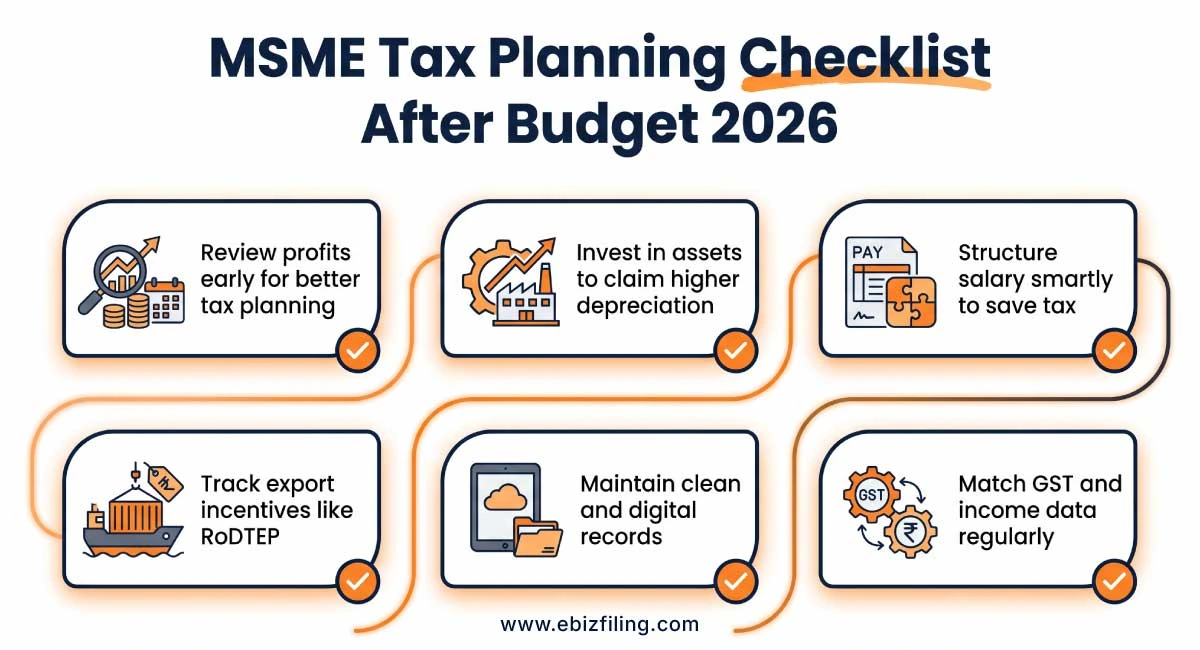
Follow this MSME tax planning checklist after Budget 2026 for better compliance and savings.
Examine profit predictions in advance to calculate your taxable revenue and do MSME Modification. This provides you more control over your tax outflow and helps prevent last-minute surprises.
Invest in qualified assets before the conclusion of the fiscal year to carefully plan your capital expenditures. This enables you to lower taxable earnings and enhance depreciation advantages.
Optimize pay and compensation plans for directors and owners and keep regulatory compliance and tax efficiency.
Make sure that export perks like RoDTEP and other incentives are accurately documented and included in your income estimates by keeping an eye on them.
To assist compliance and prevent conflicts, strengthen your documentation by keeping clear digital records, such as invoices, vendor agreements, and reconciliations.
Reconcile income tax and GST data on a regular basis to avoid mistakes that can result in refund delays or notifications.
Ebizfiling Support for MSME Tax Planning
- We review your tax details to find practical saving options.
- Our team handles GST filing, ITC checks, and refund tracking.
- Expert guidance is provided on eligible deductions and incentives.
- Your records, invoices, and reconciliations are organized properly.
- Year-end tax planning is done to avoid penalties and notices.
Conclusion
After Budget 2026, MSME tax planning will include more than filing returns; it will also include making better financial decisions. Businesses must concentrate on using deductions, effectively handling GST Registration, and maintaining digital compliance in the face of steady tax rates. Effective MSME tax planning may improve cash flow while lowering tax obligations. Businesses can maintain compliance and expand confidently with the correct strategie.
FAQs for MSME Tax Planning
1. What does Budget 2026 change the most to MSMEs?
The most significant is the change to simplified but tighter compliance regime with the New Income-tax Act, 2025. It is now about digital tracking, quicker processing and less litigation. This implies that MSMEs will have to ensure that they keep proper records and will also have to budget taxes rather than scramble to get last minute filings.
2. Does Budget 2026 lower the tax rates on MSMEs?
No, there were no significant decreases in taxes. The government however, implemented a number of incentives and compliance relaxations related to investment. Deductions, depreciation benefits and export incentives remain effective to MSME Tax Planning to lower their tax burden.
3. What is the benefit of New Income-tax Act, 2025 to MSMEs?
The new Act streamlines complicated tax rules, minimizes uncertainty and encourages quicker turnaround of returns and refunds. It also promotes digital compliance, which can assist MSMEs to evade conflicts and deal with taxes more clearly.
4. What can MSMEs do to cut down on taxes after Budget 2026?
MSMEs are able to reduce their taxes by investing in qualifying assets, depreciation, by using export subsidies such as RoDTEP, and organizing their expenses appropriately. It is important to plan them ahead instead of at the end of the year.
5. What GST reforms assist the MSMEs in enhancing their cash flow?
The GST reforms are now aimed at quicker processing of refunds, automated reconciliation of ITC and reduced number of penalties on minor errors. The changes assist MSME Tax Planning to unlock blocked funds and continue with a smoother cash flow.
6. What is the importance of digital bookkeeping post-Budget 2026?
Tax authorities have become dependent on computer records with AI-based evaluations and data correspondence. Effective bookkeeping assists MSME Tax Planning to prevent mismatches, notices, and penalties as well as to provide a clear and easy compliance.
7. What are the benefits of export incentives, such as RoDTEP, to MSMEs?
RoDTEP rebates taxes on exported goods lowering the total costs to exporters. This will directly enhance profitability and make Indian MSMEs more competitive in the global markets.
8. How does TDS planning help to optimize the tax?
Effective planning of TDS helps businesses to avoid paying excessive taxes in the year. MSME Tax Plannings can optimize working capital by reconciling the TDS periodically and apply to reduce deduction certificates in case of eligibility.
9. Why MSMEs should use professional assistance to comply with taxation?
Budget 2026 necessitates planning of taxes, proper documentation and timely decision-making in the post-Budget period. Ebizfiling eases this burden by taking care of the compliance, deadlines and advising businesses on tax-saving opportunities, enabling owners to concentrate on growth, rather than paper work.
10. How will Ebizfiling be useful in planning tax by MSMEs post-Budget 2026?
At Ebizfiling, we assist MSME registration to go beyond the standard compliance and provide them with end-to-end support in tax planning. Income tax returns and GST reconciliation, TDS management and finding out the deductions that apply, we make sure that businesses pay less in terms of taxes and remain fully compliant.



Smart MSME Tax Planning Strategies for 2026
Plan Smart. Save More. Stay Compliant.
About Ebizfiling -



May 5, 2026 By Prachi C
Section 80C of Income Tax Old vs New Law Changes 2026 The Section 80C of Income Tax Act plays an important role in tax planning in India. It’s importance has changed after the introduction of the new tax regime under […]
May 4, 2026 By Steffy A
Meal Voucher Tax Exemption up to ₹1.05L for salaried People Understand crucial changes in the meal voucher tax exemption One of the most crucial changes in the Income-tax Act 2025 in India is the meal voucher tax exemption. This alteration […]
May 4, 2026 By Steffy A
ITR-6 Form Filing: The Compliance Guide for Companies 2026 An Overview of ITR-6 Form Filing The ITR-6 form submission is more than simply an annual regulatory requirement for businesses. It is a vital compliance obligation that directly affects your financial […]