


-
August 20, 2026
-
BySteffy A
Wine Shop License in India: Documents, Cost and Process
Introduction
Starting a wine retail business requires more than renting a shop, purchasing stock and registering a business. Before storing or selling wine, the owner must obtain a valid Wine shop license from the competent State Excise Department. The license identifies the approved premises, permitted alcoholic beverages, operating conditions and nature of sale.
India does not have one nationwide Wine shop license. Alcohol regulation is mainly handled by State Governments, so license names, availability, fees and application procedures vary. An applicant should therefore check the current excise policy of the State where the proposed outlet will operate.
What Is a Wine Shop License?
A Wine shop license is an excise authorisation that permits an eligible person or business entity to possess, store and sell wine from an approved location. Depending on the license category, the holder may also be allowed to sell beer or other specified alcoholic beverages.
A retail license generally permits sealed bottles to be sold for consumption away from the premises. It does not automatically allow customers to open or consume alcohol inside or near the shop. A bar, restaurant, hotel or club serving alcohol on its premises normally requires a separate license.
The approval is linked to the applicant and the approved address. A Wine shop license cannot ordinarily be transferred, sublet or shifted without prior permission from the excise authority.
Legal Framework for Wine Retail in India
Entry 8 of List II of the Seventh Schedule to the Constitution covers the production, manufacture, possession, transport, purchase and sale of intoxicating liquor. Entry 51 permits State excise duties on alcoholic liquor for human consumption.
State Governments therefore regulate wine and liquor retail businesses through their respective excise Acts, rules, annual policies and notifications. There is no single central law that provides one common Wine shop license for the entire country. For example, Section 11 of the Delhi Excise Act, 2009 restricts the manufacture, possession, transport, purchase and sale of intoxicants except under a valid license, letter of intent or permit.
Section 12 deals with the grant of licenses, while Section 13 covers applicant qualifications such as solvency, outstanding government dues, criminal background and suitable premises. These provisions are specific to Delhi. Every Wine shop license application must be assessed under the law of the relevant State or Union Territory.
Who Issues a Wine Shop License?
A Wine shop license is generally issued by the State Excise Department or an officer authorised under the applicable excise law. The application may be examined by the Excise Commissioner, District Collector, Deputy Commissioner or Superintendent of State Excise.
Fresh retail licenses are not always available through an ordinary application. Depending on the State policy, licenses may be allotted through:
- Auction
- Tender
- Lottery
- Renewal
- Transfer
- Policy-based allotment
For example, Maharashtra’s official information states that new FL-II vendor licenses for the sale of foreign liquor are not being granted. This restriction relates to the FL-II category and should not be interpreted as a complete ban on every wine, beer, restaurant or manufacturer-related license.
Applicants should verify license availability before paying a large deposit for premises, purchasing equipment or finalising stock arrangements.
Types of Wine and Liquor licenses
The required approval depends on the products being sold and whether consumption will be allowed at the premises. Selecting the correct Wine shop license category is necessary because one license cannot automatically be used for every alcohol-related activity.
Retail license for Off-Premises Consumption
This license generally permits sealed bottles to be sold for consumption away from the outlet. It is commonly associated with a standalone retail shop. Customers cannot consume alcohol inside or near the shop unless the license expressly permits on-premises consumption.
Beer and Wine Retail license
Some States provide a combined license category for beer and wine. Maharashtra’s FL/BR-II category concerns the sale of beer, wine or both in sealed bottles for off-premises consumption. However, the official license information links eligibility to specified existing license holders.
Applicants should therefore confirm their eligibility directly with the concerned State Excise Department before treating it as an open license category.
Manufacturer-Linked Wine license
Maharashtra’s FL/W-II category permits the retail sale of wine in sealed bottles. However, official information states that this license is granted only to wine manufacturers and must be located on the manufactory premises.
It should not be treated as a general Wine shop license that is freely available to every independent retailer.
Bar or Restaurant license
A hotel, restaurant, club or bar serving alcohol for consumption on the premises usually requires a separate on-premises license. A retail Wine shop license does not permit serving, tasting or consuming wine inside the outlet unless such activity is specifically authorised.
Eligibility for a Wine Shop License
Eligibility conditions depend on the State law and license category. The licensing authority may check whether the applicant:
- Meets the prescribed age, citizenship or residency requirements
- Has no disqualifying criminal or excise-law record
- Is not blacklisted or debarred by an excise authority
- Has cleared government and excise dues
- Can explain the lawful source of investment
- Has sufficient financial capacity
- Holds suitable and legally constructed premises
- Can provide the prescribed security, bank guarantee or solvency certificate
- Meets any experience or existing-license requirement
The permitted applicant may be an individual, partnership firm, company or another specified entity. Business owners who need a formal legal structure may consider Company Registration in India, LLP Registration or Partnership Firm Registration, depending on the applicable State rules and business requirements.
Registering an entity does not guarantee a Wine shop license. Final approval remains subject to license availability, premises verification and the decision of the competent authority.
Premises and Location Requirements
The proposed premises are an important part of the application. Before entering into a long-term lease, the applicant should verify:
- Permitted commercial use of the property
- Valid ownership or tenancy documents
- Legality of construction
- Minimum shop and storage area
- Distance from restricted locations
- Municipal and fire-safety conditions
- CCTV and security requirements, where prescribed
- Access and parking requirements, if applicable
Distance requirements are not uniform across India. A State may impose restrictions relating to schools, colleges, religious places, hospitals, highways, residential areas or transport facilities. Conditions applicable to one license category cannot automatically be applied to another Wine shop license.
The license holder may also require registration under the applicable State Shops and Establishments law. Ebizfiling provides assistance with Shop License Registration based on the applicable State process. The premises must generally remain under the legal possession of the license holder. Shifting the outlet, adding a storage location or changing the approved layout may require prior approval.
Documents Required for a Wine Shop License in India
The exact checklist should be obtained from the relevant State Excise Department. Common documents include the following.
Applicant and Business Documents
- PAN, identity proof and address proof
- Passport-size photographs
- Certificate of incorporation or business registration
- Partnership deed or LLP agreement
- Memorandum and Articles of Association, where applicable
- Board resolution or authority letter
- Details of directors, partners or owners
- Income-tax returns and bank statements
- Proof of investment and source of funds
- Solvency certificate, bank guarantee or security deposit
- Affidavit concerning criminal cases and government dues
- Details of previous excise licenses, where applicable
Premises Documents
- Sale deed or registered lease agreement
- No-objection certificate from the property owner
- Property-tax receipt
- Approved site plan and shop layout
- Construction or occupancy certificate
- Shops and Establishments registration
- Municipal approval, where required
- Fire Department NOC, where required
- Photographs of the proposed premises
Missing or inconsistent documents may delay the Wine shop license application. The applicant should ensure that the lease agreement and owner’s NOC specifically permit liquor-related business at the premises.
Process to Obtain a Wine Shop License
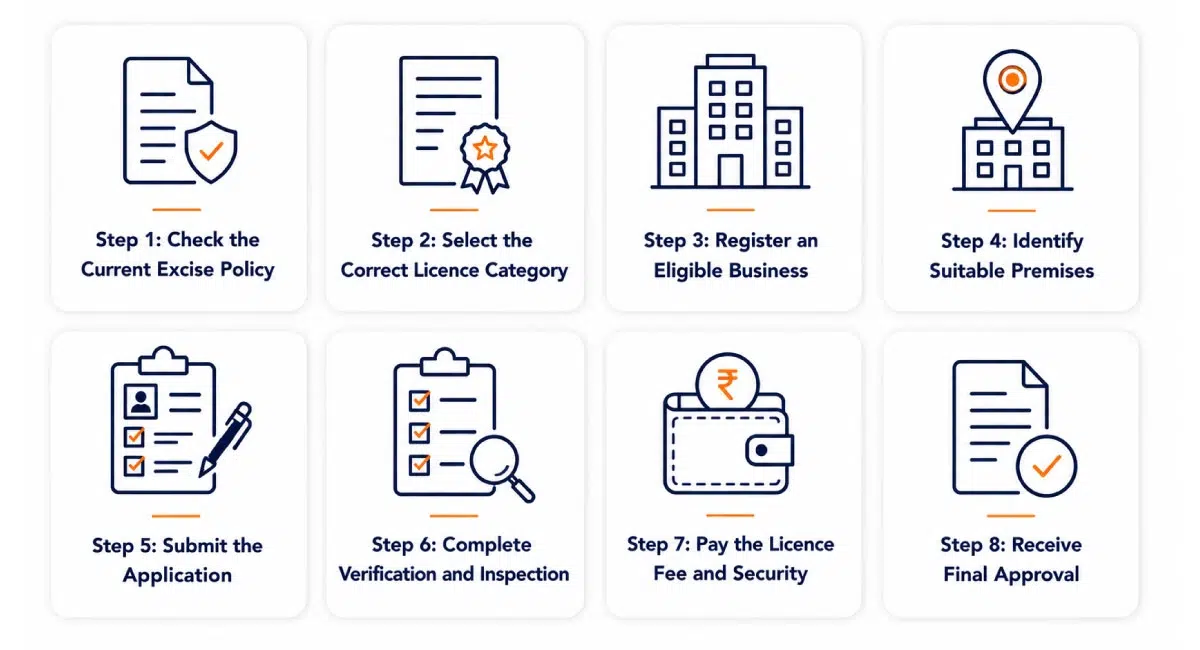
Step 1: Check the Current Excise Policy
Confirm whether the required license category is open for fresh applications. Also check whether licenses are allotted through an application, auction, tender, lottery, renewal or transfer. The availability of an application form does not necessarily mean that fresh licenses are being granted.
Step 2: Select the Correct license Category
Determine whether the proposed business requires:
- Wine-only retail license
- Beer and wine license
- Full liquor retail license
- Bar license
- Restaurant liquor license
- Wholesale license
Applying for the wrong Wine shop license category may result in delay or rejection.
Step 3: Register an Eligible Business
Choose a business structure permitted under the relevant excise policy. Obtain PAN, a current bank account and other supporting registrations. The company’s Memorandum of Association, LLP agreement or partnership deed should authorise the proposed business activity.
Step 4: Identify Suitable Premises
Check the land use, construction legality, distance restrictions, storage arrangements and local permissions. Avoid making irreversible investments in the property before verifying whether the premises satisfy the applicable excise requirements.
Step 5: Submit the Application
Complete the prescribed form, attach the required documents and pay the notified application or processing fee through the State portal or designated excise office.
Applicants may also review the general requirements involved in Business License Registration while planning the supporting registrations for the outlet.
Step 6: Complete Verification and Inspection
Excise officials may examine the applicant’s:
- Identity and background
- Financial capacity
- Source of funds
- Government dues
- Property documents
- Premises layout
- Proposed storage arrangements
They may also obtain reports from the police, municipality, fire department or another local authority.
Step 7: Pay the license Fee and Security
After approval, the applicant may be required to pay the annual license or privilege fee and provide a security deposit, bank guarantee or solvency certificate.
Step 8: Receive Final Approval
Sales may begin only after the final Wine shop license has been issued and every pre-commencement condition has been completed.
An application acknowledgement, fee payment receipt, inspection report or provisional communication does not by itself authorise wine sales.
GST and State Taxes on Wine
Alcoholic liquor for human consumption is outside GST. Its sale is generally subject to State excise duty, VAT and other applicable State levies. GST may still apply to separate taxable goods or services supplied by the business. Where GST registration is required for such transactions, the owner may review Ebizfiling’s GST Registration Service.
The State Government’s grant of an alcoholic-liquor license against an application or license fee is treated as neither a supply of goods nor a supply of services under Section 7(2)(b) of the Central Goods and Services Tax Act, 2017, read with Notification No. 25/2019-Central Tax (Rate).
This treatment concerns the government’s grant of the Wine shop license. It does not automatically extend to other expenses or taxable transactions of the shop.
Compliance After Receiving the license
After obtaining the license, the outlet should:
- Purchase wine only from authorised sources
- Sell only permitted categories and approved brands
- Maintain purchase, stock and sales records
- Follow prescribed opening and closing hours
- Remain closed on notified dry days
- Prevent sales to persons below the State’s prescribed legal drinking age
- Avoid unauthorised on-premises consumption
- Store stock only at approved premises
- Display the license and mandatory notices
- Permit inspections by authorised officers
- File prescribed returns and statements
The license holder should maintain accurate books and reconcile stock movement regularly. Professional Bookkeeping and Accounting Services can help maintain transaction records, expenses, bank reconciliations and financial reports.
Any breach of the prescribed conditions may affect the continuation or renewal of the Wine shop license.
Renewal, Transfer and Shifting of Wine shop license
A Wine shop license remains valid only for the period stated in the approval. Renewal may require:
- Payment of revised license fees
- Submission of prescribed records
- Clearance of excise dues
- Verification of previous compliance
- Renewal of supporting permissions
- Confirmation that the premises remain suitable
The license should not be sold, sublet or transferred without prior approval.
Permission may also be required for changes involving:
- Ownership of the business
- Partners or directors
- Constitution of the entity
- Trade name
- Shop layout
- Storage area
- Licensed address
A company holding the license should also keep its corporate filings updated through appropriate Company Compliance Services. Corporate compliance does not replace State excise compliance, but both may apply to the business.
Penalties for Non-Compliance of Wine shop license
Selling, possessing, transporting or storing wine without proper authority may result in:
- Seizure of wine or liquor stock
- Closure or sealing of the premises
- Monetary penalties
- Confiscation of vehicles or equipment
- Suspension or cancellation of the license
- Criminal prosecution
- Disqualification from future licensing
For example, Section 17 of the Delhi Excise Act, 2009 permits suspension or cancellation for matters such as unauthorised transfer, non-payment of excise revenue, breach of license conditions, conviction, fraud or misrepresentation.
Section 33 covers unlawful manufacture, possession, transport and sale. These are Delhi-specific examples. The applicable State excise law will determine the actual offence, procedure and punishment relating to a Wine shop license.
Reasons for Rejection of License Application
An application may be rejected due to:
- Non-availability of fresh licenses
- Selection of an incorrect license category
- Ineligible applicant or business entity
- Incomplete or inconsistent documents
- Restricted or unsuitable premises
- Missing owner NOC
- Unauthorised construction
- Adverse police or excise verification
- Outstanding government dues
- Insufficient financial capacity
- False declarations
Failure to pay the prescribed fee or security
A review of license availability, applicant eligibility and premises conditions should be completed before submitting the Wine shop license application.
Start Your Wine Retail Business with Ebizfiling
Planning to open a wine shop? Ebizfiling can help you build the right foundation for your business. From company, LLP or partnership registration to Shop and Establishment registration, GST support where separately applicable, bookkeeping, accounting and ongoing business compliance, our team helps you manage the essential registrations and documentation in one place.
Focus on setting up and growing your business while Ebizfiling supports you with the legal structure and connected compliances. Final approval of the Wine shop license remains subject to the applicable State excise policy, license availability, premises inspection and the decision of the competent authority.
Ready to start your wine retail business? Connect with Ebizfiling today for professional registration and compliance support.
Conclusion
A Wine shop license is mandatory before wine can be legally stored or sold through a retail outlet. Since alcohol regulation is State-specific, applicants should not rely on a license name, fee or document checklist prepared for another jurisdiction.
Before investing in premises or stock, confirm whether the required license is available, choose the correct category and verify the proposed location. A properly prepared Wine shop license application, supported by complete documents and compliant premises, reduces the risk of rejection, penalties and business disruption.
Frequently Asked Questions
1. Is one Wine shop license valid across all Indian states?
No. The production, possession, transport, purchase and sale of intoxicating liquor fall within the State List under Entry 8 of the Seventh Schedule to the Constitution. Each State or Union Territory has its own excise law, license categories, fees and operating conditions.
2. Can a Wine shop license be used to serve alcohol inside the premises?
A retail Wine shop license generally permits the sale of sealed bottles for consumption away from the licensed premises. Serving or allowing consumption inside the premises usually requires a separate bar, hotel, club or restaurant license under the applicable State excise rules.
3. Can a Wine shop license be transferred to another person?
An excise license is not ordinarily transferable without prior approval from the licensing authority. For example, Section 20 of the Delhi Excise Act, 2009 states that a license or permit cannot be transferred without prior approval. An unauthorised transfer or subletting may also result in suspension or cancellation under Section 17.
4. Does obtaining a Wine shop license guarantee its renewal?
No. Renewal is not an automatic right. Under Section 18 of the Delhi Excise Act, 2009, a license holder cannot claim renewal as a matter of right after the license period expires. Renewal depends on the applicable State policy, payment of fees, availability of the license category and the holder’s previous compliance record.
5. Is Maharashtra’s FL/W-II license available to every wine retailer?
No. Maharashtra’s official excise information states that the FL/W-II license is granted only to wine manufacturers and must be located on the manufactory premises. It should not be treated as a general retail Wine shop license available to every independent applicant.
6. What records must a Wine shop license holder maintain?
The license holder may be required to maintain purchase records, stock registers, sales details, duty and fee records, and prescribed returns. For example, Section 32 of the Delhi Excise Act requires licensees to maintain accounts and submit returns containing details relating to stock, duty, fees and other prescribed information.
7. Is GST payable on the grant of a Wine shop license?
The grant of an alcoholic-liquor license by a State Government against a license fee or application fee is treated as neither a supply of goods nor a supply of services under Section 7(2)(b) of the CGST Act and Notification No. 25/2019-Central Tax (Rate). This special treatment applies to the State’s grant of the liquor license and not to every other license, service or transaction of the business.
8. What happens if wine is sold without a valid license?
Unauthorised possession, storage, transport or sale of wine may result in seizure, prosecution, monetary penalties and closure of the premises under the applicable State excise law. For example, Section 33 of the Delhi Excise Act prescribes imprisonment and a monetary fine for specified unlawful excise activities. The actual penalty depends on the State and nature of the violation.
9. Can Ebizfiling obtain final approval for a Wine shop license?
Ebizfiling can assist with supporting registrations, business structuring and documentation. However, final approval of the Wine shop license is granted only by the competent State Excise Department and remains subject to the State’s policy, license availability, applicant eligibility and premises inspection.
10. What supporting services does Ebizfiling provide for a wine retail business?
Ebizfiling can assist with company, LLP or partnership registration, Shop and Establishment registration, GST registration where separately applicable, bookkeeping, accounting and ongoing entity compliance. These services help establish the legal and compliance framework of the business but do not replace the excise approval required for selling wine.





MSME Registration
Claim your access to Government Subsidies, Priority Lending and a quick start up. Register for MSME/Udyog Aadhar
About Ebizfiling -



Reviews
Nihar Chandrana
03 Jul 2017I loved the way they have served us. Good going team!
Pradyumna sahu
28 Sep 2020Ebizfiling provides good service and also transparent. Some process are Lately working but its okay. Lata medam was also cooperate to us according to in our requirements. Thanks for all team members of ebizfiling. I hope future and further reference about in your org will provide to others. Again thanks for all team. Also provide good price
Venkat
20 Dec 2018Thanks to Ishani & team, we are getting prompt and satisfactory service on GST and IT return filings and clarification of queries. Keep the good work.
September 7, 2026 By Steffy A
GST Compliance for LLP to Private Limited Conversion: GST & ITC Transfer Introduction Converting a Limited Liability Partnership into a Private Limited Company involves important legal and structural changes. One area that requires particular attention during an LLP to Private […]
September 5, 2026 By Steffy A
LLP Partner Remuneration Disallowance & Rectification Explained Introduction LLP partner remuneration disallowance can arise when remuneration recorded in an LLP’s books does not match the amount reported in the income-tax return or the deduction permitted under the applicable tax provisions. […]
September 5, 2026 By Steffy A
Property Acquisition Tax Planning: A Complete Guide Introduction Buying a residential property requires careful financial planning because it involves significant decisions related to taxation, funding, ownership structure, and long-term financial goals. Whether an individual is purchasing a first home or […]