


-
October 5, 2026
-
BySiddhi R
What is a Shareholders Agreement in India? Key Clauses Explained
Introduction
A Shareholders Agreement in India is a legal contract that defines the rights, responsibilities, and obligations of shareholders in a company. It establishes rules related to management, decision-making, share transfers, and investor protection. This blog explains the meaning, importance, and key clauses of a Shareholders Agreement in India.
Quick Insights
- A Shareholders Agreement defines the relationship between shareholders and sets clear expectations.
- It helps protect shareholder rights and establishes responsibilities among parties.
- The agreement includes clauses related to ownership, voting rights, share transfers, and dispute resolution.
- Startups often use Shareholders Agreements to define investor rights and management decisions.
- A properly drafted agreement helps reduce conflicts between shareholders in the future.
What is a Shareholders Agreement in India?
A Shareholders Agreement in India is a written agreement entered into between shareholders of a company to regulate their relationship and define their rights and obligations. It acts as a framework for managing important matters such as ownership structure, decision-making powers, transfer of shares, and responsibilities of shareholders.
Businesses planning to bring multiple shareholders or investors on board should first understand the process of Private Limited Company Registration, as the company structure plays an important role in defining ownership and management rights.
A Shareholders Agreement is a private contractual arrangement between shareholders that defines their rights and obligations. The agreement should be consistent with the Articles of Association and applicable provisions of the Companies Act, 2013 to ensure effective implementation of agreed terms.
Why is a Shareholders Agreement Important?
A Shareholders Agreement helps companies and investors establish clear rules before disputes arise. It provides clarity regarding ownership, control, and future decisions.
The importance of a Shareholders Agreement includes:
- Defining the rights and obligations of shareholders.
- Protecting minority shareholders from unfair decisions.
- Establishing voting rights and approval requirements.
- Providing rules for the transfer and sale of shares.
- Protecting investor interests in funding arrangements.
- Defining procedures for resolving disputes.
What are the Key Clauses of a Shareholders Agreement in India?
A Shareholders Agreement generally contains several clauses depending on the company’s requirements and the relationship between shareholders.
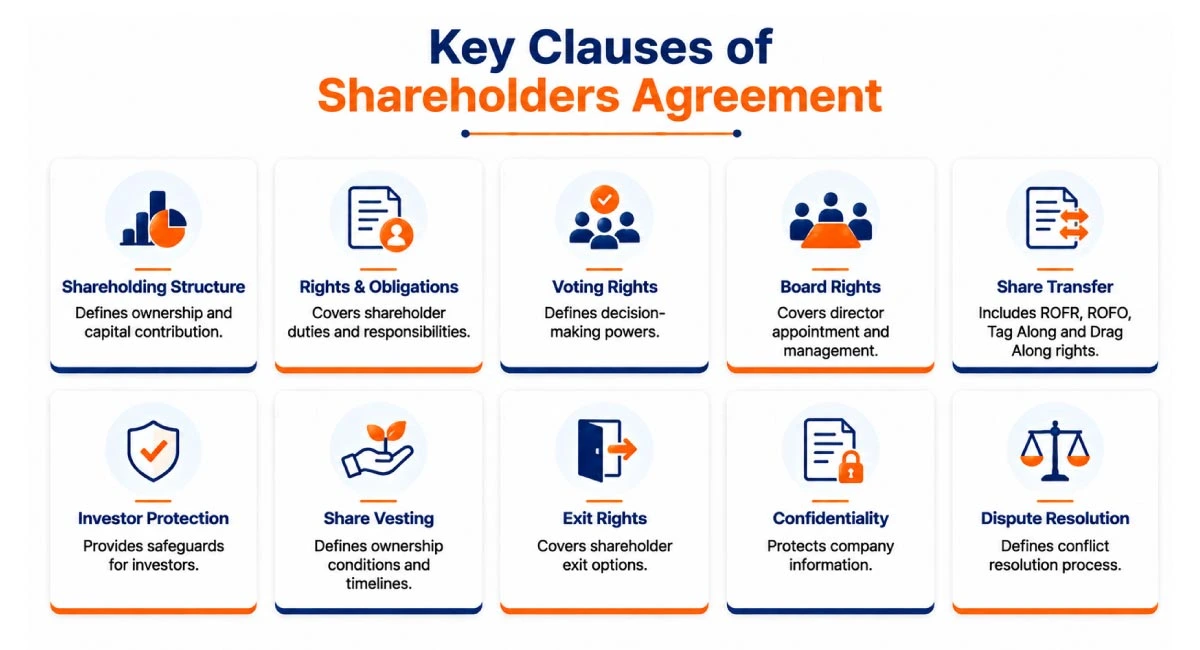
1. Shareholding Structure and Capital Contribution
This clause defines the ownership percentage of each shareholder and their contribution towards the company. It may include details about initial investment, future funding requirements, and changes in ownership. While defining ownership structure and capital contribution, founders should carefully plan the terms involved while drafting a Shareholders Agreement to avoid future disagreements between shareholders.
2. Shareholders’ Rights and Obligations
The agreement should clearly mention the duties and responsibilities of shareholders. It may include obligations related to:
- Participation in company decisions
- Confidentiality requirements
- Compliance with company policies
- Contribution towards business objectives
This clause helps maintain transparency between shareholders and the company.
3. Voting Rights and Decision-Making
Voting rights determine how shareholders participate in important business decisions. The agreement may specify matters that require shareholder approval, such as:
- Issue of new shares
- Appointment or removal of directors
- Major business decisions
- Sale of significant company assets
4. Board Composition and Management Rights
Investors may negotiate rights related to board representation and participation in company management.
This clause may cover:
- Number of directors
- Appointment rights
- Board meeting procedures
- Management responsibilities
5. Share Transfer Restrictions
Share transfer restrictions are one of the most common Shareholders Agreement clauses. These provisions control how shares can be transferred to third parties.
Common rights include:
Right of First Refusal (ROFR):
Existing shareholders get the opportunity to purchase shares before they are offered to external buyers.
Right of First Offer (ROFO):
A shareholder must first offer shares to existing shareholders before approaching external buyers.
Tag Along Rights:
Minority shareholders can sell their shares along with majority shareholders if the majority shareholder sells its stake.
Drag Along Rights:
Majority shareholders can require minority shareholders to sell their shares during a company sale.
6. Investor Protection Rights
Investors may negotiate additional rights to protect their investment. These may include:
- Access to financial information
- Consent rights for important decisions
- Board representation
- Protection against dilution
7. Share Vesting Clause
Share vesting provisions are commonly included in startup-related agreements. These clauses define when shareholders, especially founders or employees, earn ownership rights over shares.
The clause may specify:
- Vesting period
- Conditions for vesting
- Treatment of shares if a shareholder exits
8. Exit Rights
Exit provisions define how shareholders or investors can exit from the company. These may include:
- Share sale arrangements
- Buy-back provisions
- Acquisition-related rights
- Exit timelines
9. Confidentiality Clause
A confidentiality clause prevents shareholders from disclosing sensitive company information, including business plans, financial details, and customer information.
10. Dispute Resolution Clause
This clause explains the process to resolve disputes between shareholders. It may include:
- Negotiation between parties
- Arbitration
- Jurisdiction of courts
- Applicable governing law
Shareholders Agreement vs Articles of Association
|
Basis |
Shareholders Agreement |
Articles of Association |
|
Nature |
Private agreement between parties | Constitutional document of the company |
| Purpose | Defines shareholder rights and obligations |
Defines company rules and internal management |
|
Parties involved |
Shareholders and other agreed parties | Company and its members |
| Applicability | Contractual obligations |
Governed under Companies Act provisions |
Before drafting a Shareholders Agreement, it is important to understand how it differs from the Articles of Association, as both documents play different roles in defining shareholder rights and company management. Learn more about Shareholders Agreement and Articles of Association to understand their key differences.
Points to Consider While Drafting a Shareholders Agreement in India
While drafting a Shareholders Agreement, consider the following points:
- Clearly define shareholder rights and responsibilities.
- Avoid unclear terms that may create interpretation issues.
- Mention voting rights and decision-making procedures.
- Include proper share transfer rules.
- Define dispute resolution mechanisms.
- Ensure consistency with the Articles of Association.
- Consider future business growth and investor requirements.
Professional Assistance for Drafting a Shareholders Agreement in India
Drafting a Shareholders Agreement requires proper understanding of shareholder rights, business requirements, and applicable company law provisions. Ebizfiling can assist businesses and founders with professional support for preparing and reviewing Shareholders Agreements.
Ebizfiling can help with:
- Understanding the key requirements and clauses to be included in a Shareholders Agreement.
- Drafting and reviewing agreements based on the company’s ownership structure and business needs.
- Reviewing clauses related to share transfers, investor rights, voting rights, and dispute resolution.
- Ensuring consistency between the Shareholders Agreement and the company’s Articles of Association.
- Providing guidance on documentation requirements and compliance considerations.
Get professional assistance for drafting a legally structured Shareholders Agreement that protects shareholder rights and defines clear business responsibilities. Explore Ebizfiling’s Shareholders Agreement drafting service today.
Conclusion
A Shareholders Agreement in India helps establish a clear framework for managing relationships between shareholders. It defines rights, obligations, ownership matters, and decision-making processes. A properly drafted agreement can help shareholders protect their interests and manage future business situations effectively.
Frequently Asked Questions
1. Is a Shareholders Agreement mandatory for every company in India?
No, a Shareholders Agreement is generally not mandatory under the Companies Act, 2013. However, it is commonly used where multiple shareholders, founders, or investors are involved to define ownership rights, responsibilities, decision-making procedures, and dispute resolution mechanisms.
2. How does a Shareholders Agreement differ from the Articles of Association?
A Shareholders Agreement is a private contractual arrangement between shareholders that defines their rights, obligations, and agreed terms. The Articles of Association is a company document that governs the internal management and administration of the company. Both documents should be consistent to avoid conflicts.
3. What are the important provisions usually included in a Shareholders Agreement?
A Shareholders Agreement may include provisions relating to shareholding structure, voting rights, board representation, decision-making matters, share transfer restrictions, investor rights, exit arrangements, confidentiality obligations, and dispute resolution procedures.
4. Why are Tag Along and Drag Along Rights included in shareholder agreements?
Tag Along Rights protect minority shareholders by allowing them to sell their shares along with majority shareholders during a third-party sale. Drag Along Rights allow majority shareholders to require minority shareholders to participate in a sale of the company under agreed conditions.
5. Can shareholders decide restrictions on selling or transferring shares?
Yes, shareholders may agree on certain transfer-related conditions through a Shareholders Agreement. These may include mechanisms such as Right of First Refusal (ROFR), Right of First Offer (ROFO), and other transfer restrictions to regulate ownership changes.
6. What details are required while preparing a Shareholders Agreement?
A Shareholders Agreement generally includes details about shareholders, ownership structure, rights and obligations, voting arrangements, management rights, investor protections, exit provisions, confidentiality requirements, and dispute resolution terms.
7. What happens if shareholders violate the terms of a Shareholders Agreement?
If a shareholder breaches the agreement, the affected parties may take action according to the remedies and dispute resolution process mentioned in the agreement. The available options depend on the terms agreed between the parties and applicable laws.
8. Why do investors prefer having a Shareholders Agreement before investing?
Investors use a Shareholders Agreement to establish their rights, define their involvement in important business decisions, protect their investment, and create clarity regarding future exits or ownership changes while ensuring proper startup compliance requirements.
9. When should a company consider drafting a Shareholders Agreement?
A company should consider drafting a Shareholders Agreement when multiple founders, shareholders, or investors are involved. It helps establish clear rules for ownership, management decisions, shareholder responsibilities, and future business arrangements. EbizFiling can assist businesses and startups in drafting and reviewing Shareholders Agreements based on their ownership structure and requirements.
10. Can the terms of a Shareholders Agreement be changed after it is signed?
Yes, the terms of a Shareholders Agreement can generally be amended if the required parties agree to the changes. Any amendment should be properly documented according to the agreement terms. EbizFiling can help shareholders review agreement amendments and ensure that the updated terms are properly documented.





Shareholders Agreement
Get Agreement drafted by expert advocates. Get it done with Ebizfiling
About Ebizfiling -



Reviews
Amruta Thalange
15 Oct 2020Nikolai Kirtikar
04 Nov 2017I would like to thank your company personnel for their excellent support in registering and incorporating my LLP. Initially, I was very apprehensive about hiring someone from outside Mumbai and that too online, however, I am very much pleased to inform that my choice did not err.It was Compliance Manager Drashti who instilled confidence in your organization by providing timely and helpful advice regarding formation of LLP. She also ensured that I received all the information regarding LLP before I register for your services.After the registration and payment, it was Asst. Compliance Manager Abhishek who coordinated with me for DSC, DIN, LLP Name Approval, Incorporation Certificate and PAN / TAN. He was always there to attend my calls whenever I needed clarifications or doubts regarding the subject. It was his cool attitude and follow-ups that really impressed me.Last but not the least, I must also appreciate the efforts of Asst. Compliance Manager Parin for helping me in shortlisting the right activities of “n” number of activities, to be registered for SSI / MSME registration.I would once again like to commend Ebizfiling and their team of Drashti, Abhishek and Parin for their professionalism, superlative skills and for the job well done. I have no hesitation in recommending their services to others.Keep up the good work.
Samuel solomon maddela
28 Jul 2018Your one stop destination for all Your needs. Awesome staff and great customer service and follow up. Especially Ms. Roma and Ms Aarthi are absolutely an assets to the organisation. You can just trust them and relax they will take care of everything. I strongly recommend eBizfiling for your Tax needs.
October 19, 2026 By Srishti M
October 15, 2026 By Srishti M
TDS and TCS Compliance Calendar November 2026: Compliance Guide Introduction The TDS and TCS Compliance Calendar November 2026 covers important tax deduction, collection, payment, certificate and reporting requirements applicable during the month. It helps businesses, government offices and other responsible […]
October 14, 2026 By Srishti M
GST Compliance Calendar November 2026: Key Due Dates & Filings Introduction The GST Compliance Calendar November 2026 highlights the major GST return filing, tax payment, invoice reporting and year-end adjustment deadlines applicable during the month. It covers regular taxpayers, QRMP […]