

-
September 7, 2026
-
BySteffy A
Procedure for Inward and Outward Foreign Remittance
Introduction
Inward and outward foreign remittance involves sending money abroad from India or receiving money from another country while following applicable foreign exchange regulations, banking checks, and documentation requirements.
Foreign exchange transactions in India are primarily governed by the Foreign Exchange Management Act, 1999 (FEMA), the rules and regulations made under it, and applicable directions issued by the Reserve Bank of India (RBI). Authorised Dealer banks process foreign remittances after checking the purpose, documents, and applicable regulatory conditions.
This article explains the procedure for inward and outward foreign remittance, the documents generally required and the rules applicable to outward remittances under the Liberalised Remittance Scheme (LRS).
Key Highlights
- Inward and outward foreign remittance transactions in India are governed by FEMA and applicable RBI guidelines.
- Inward remittance refers to funds received in India from overseas, while outward remittance involves sending money from India abroad.
- Banks may require KYC details, purpose codes, Form A2 and supporting documents based on the nature of the transaction.
- Resident individuals can remit up to USD 250,000 per financial year under LRS, subject to applicable conditions.
- TCS, bank charges, exchange rates and processing requirements may vary depending on the purpose and type of remittance.
What is Inward Remittance?
Inward remittance is an important part of inward and outward foreign remittance transactions involving India. An inward remittance refers to money received in India from a person, business, or bank located outside India.
Foreign inward remittances may be received for different purposes, such as:
- Export of goods or services
- Foreign investment
- Gifts or donations
- Salary or professional payments
- Family maintenance
- Permitted foreign borrowings or other capital transactions, subject to applicable FEMA conditions
- Other eligible receipts
Banks use RBI-prescribed purpose codes to identify and report the nature of foreign exchange receipts. Different codes apply to transactions such as exports, foreign investment, loans, and other inward payments.
Procedure for Inward Remittance
The inward remittance procedure forms one part of the inward and outward foreign remittance process and generally involves the remitter and beneficiary.
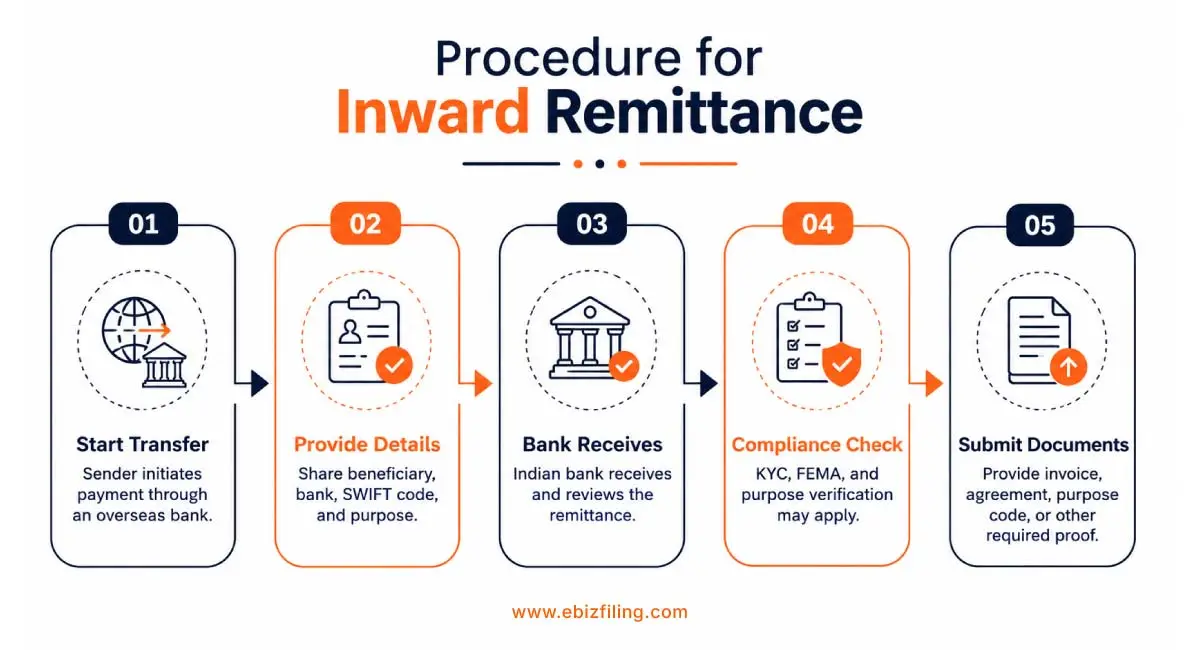
1. Remitter Initiates the Transfer
The sender approaches their overseas bank or uses an approved banking channel to transfer money to the beneficiary’s Indian bank account.
The sender may need the following details:
- Beneficiary’s name
- Beneficiary’s bank account number
- Bank name and branch
- Bank address
- SWIFT or BIC code
- Purpose of remittance
Any additional details requested by the sending bank
Once the transfer is initiated, the sender should retain the transaction confirmation or remittance reference number.
2. Indian Bank Receives the Remittance
After the money reaches the beneficiary’s bank in India, the bank may conduct KYC, FEMA and other compliance checks before crediting or converting the funds.
The beneficiary may be asked to provide documents supporting the purpose of the payment.
Depending on the transaction, these may include:
- Invoice
- Agreement or contract
- Purpose code
- Details of the foreign remitter
- Amount and currency details
- Export-related documents
- Investment-related documents
- Other declarations requested by the bank
The exact documentation depends on why the money is being received.
Purpose Code for Inward Remittance
A purpose code identifies the nature of a foreign exchange transaction.
For example, RBI’s reporting framework contains different receipt purpose codes for foreign investment, export proceeds, transportation services, travel-related receipts, loans and several other categories.
The beneficiary should select the correct purpose based on the actual transaction. Providing an incorrect purpose may lead to additional questions or compliance checks by the bank.
FIRC and e-FIRC for Inward Remittance
For certain foreign inward remittances, particularly transactions connected with exports or foreign investment, documentary evidence of the inward remittance may be relevant. Documentation requirements for inward and outward foreign remittance vary according to the nature and purpose of the transaction.
RBI’s reporting framework provides for electronic reporting of Foreign Inward Remittance Certificates in applicable export transactions through the Export Data Processing and Monitoring System (EDPMS).
Whether an FIRC, e-FIRC or another bank advice is required depends on the nature of the transaction and the applicable reporting requirement.
If an Indian company receives foreign investment and issues shares to a non-resident investor, it may be required to file Form FC-GPR with the RBI through the applicable reporting framework.
Bank Charges for Inward Remittance
There is no single fixed charge applicable to every inward remittance.
The final amount received can depend on factors such as the receiving bank’s charges, correspondent bank charges, currency conversion and the exchange rate applied by the bank.
Therefore, statements such as a fixed deduction of Re. 1 per dollar or a standard exchange-rate difference should not be treated as universally applicable. The beneficiary should check the applicable charges and exchange rate with their bank.
How Long Does an Inward Remittance Take?
The processing time can vary depending on the banks involved, the country of origin, currency, intermediary banks and compliance checks.
If additional documents or clarification regarding the purpose of remittance are required, the bank may take additional time before crediting the funds.
What is Outward Remittance?
Outward remittance refers to the transfer of money from India to a person or entity located outside India for a permitted purpose. It represents the outward side of inward and outward foreign remittance transactions carried out through authorised channels.
Outward remittances are governed by FEMA and the applicable RBI directions. Not every foreign remittance requires prior RBI approval. Authorised Dealer banks can process permitted transactions within prescribed limits, while prohibited transactions or transactions requiring specific approval are treated according to the applicable FEMA rules.
What is the Liberalised Remittance Scheme?
The Liberalised Remittance Scheme, commonly known as LRS, allows resident individuals to remit money outside India for permitted current account and capital account transactions.
The current LRS limit is USD 250,000 per resident individual per financial year.
The limit covers several purposes, including:
- Private visits abroad
- Gifts and donations
- Overseas employment
- Emigration
- Maintenance of relatives abroad
- Business travel
- Medical treatment abroad
- Overseas education
- Permitted overseas investments
Certain purposes and circumstances can be subject to specific exceptions, documentation requirements or approvals under FEMA and RBI rules.
Important Note
LRS is primarily a facility for resident individuals. Foreign exchange transactions undertaken by companies, LLPs, firms and other entities are governed by the FEMA provisions applicable to the particular transaction and should not automatically be treated as LRS transactions.
Procedure for Outward Remittance
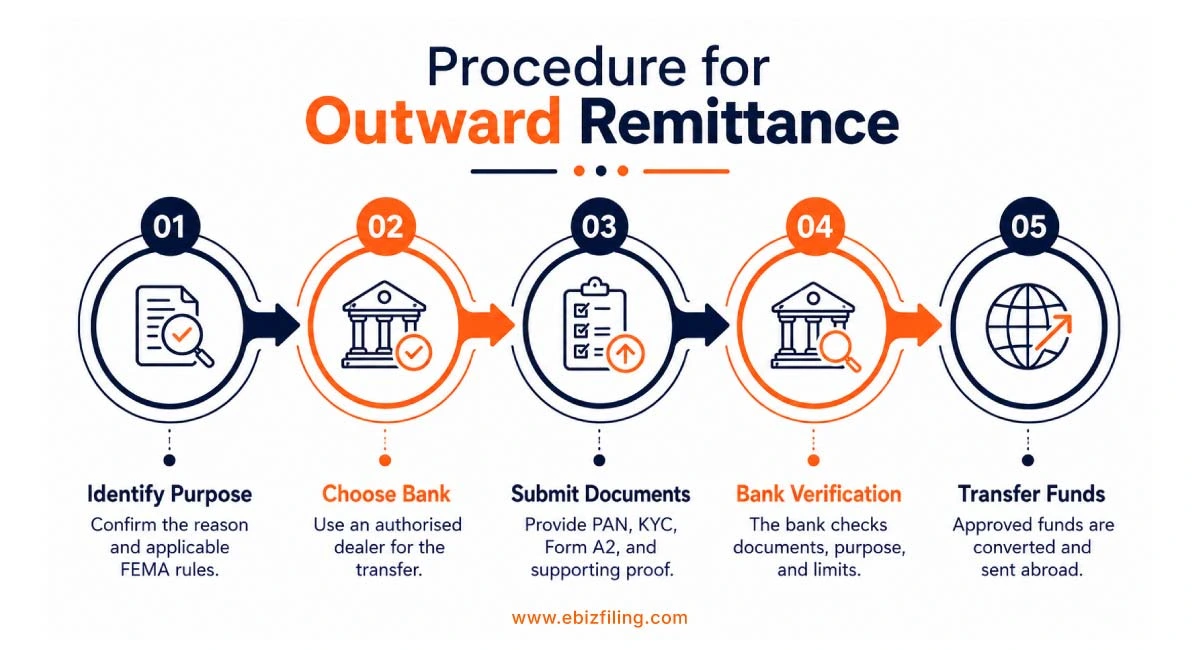
1. Identify the Purpose and Approach an Authorised Dealer
The remitter should first determine why the money is being transferred abroad. The purpose determines the FEMA treatment, applicable purpose code, documentation requirements and whether the transaction falls under LRS or another foreign exchange regulation.
Outward remittance should generally be processed through an Authorised Dealer or another authorised channel permitted to handle foreign exchange transactions.
2. Submit PAN, KYC, Form A2 and Supporting Documents
For LRS transactions, PAN and KYC details are important for banking and tax compliance. The remitter should provide accurate information regarding the beneficiary, purpose and amount being remitted.
For remittances under LRS, the resident individual is required to furnish Form A2, which may be submitted in physical or digital form as permitted by the Authorised Dealer, along with supporting documents applicable to the transaction.These documents may include:
- Passport and PAN
- Beneficiary bank details
- University admission or fee letter
- Medical estimate
- Invoice or agreement
- Investment documents
- Gift declaration
- Travel-related documents
- Other documents requested by the bank
3. Bank Verification and Fund Transfer
The bank verifies the transaction, supporting documents, purpose code, available LRS limit and other applicable requirements. For inward and outward foreign remittance, banks verify the purpose, supporting documents, and applicable regulatory requirements before processing the transaction.
Once the required checks are completed, the bank converts the amount into the relevant foreign currency, where applicable, and transfers the funds to the overseas beneficiary.
Current LRS Limit in India
The LRS limit is USD 250,000 per financial year for each resident individual.
An individual should consider all qualifying LRS remittances made during the financial year when determining the remaining available limit.
Remittances above the prescribed limit may require the transaction to fall within an applicable exception or approval mechanism under FEMA.
TCS on Outward Remittance Under LRS
Tax Collected at Source, or TCS, may also apply to outward remittances under the LRS. Tax implications for inward and outward foreign remittance can differ based on the nature and purpose of the transaction.
Under the current Income Tax provisions, the general threshold for TCS on LRS remittances is Rs. 10 lakh in aggregate during a financial year. TCS generally applies to the amount exceeding the applicable threshold.
The current rates include:
Education or medical treatment: 2% on applicable LRS remittances exceeding the threshold.
Other LRS purposes: 20% on applicable remittances exceeding the threshold.
No TCS is collected on an education remittance where the amount being remitted is a loan obtained from a specified financial institution for pursuing education.
A separate TCS provision applies to the purchase of an overseas tour programme package, which is currently subject to TCS at 2%.
Ebizfiling Support for Foreign Remittance Compliance
Managing inward and outward foreign remittance may involve different FEMA rules, RBI requirements and documentation depending on the purpose of the transaction.
Ebizfiling can assist with:
- Understanding applicable FEMA and RBI requirements
- Identifying documentation needed for the transaction
- Guidance on purpose-specific compliance requirements
- Assistance with regulatory and procedural requirements
- Professional support for businesses handling cross-border transactions
Making a foreign remittance? Let Ebizfiling assist you with Form 15CA filing.
Conclusion
Understanding the procedure for inward and outward foreign remittance can help individuals and businesses avoid unnecessary delays and compliance issues. For inward remittances, the beneficiary should provide accurate bank details, select the correct purpose code and maintain documents supporting the transaction. For outward remittances, the remitter should determine whether the transaction falls under LRS or another FEMA provision, provide the required documents and complete the transaction through an authorised banking channel.
Since foreign exchange rules, tax provisions, and reporting requirements can vary according to the purpose of the transaction, it is advisable to verify the latest requirements with the Authorised Dealer bank before initiating a significant foreign remittance.
Frequently Ask Questions
1. What documents are required for an inward remittance procedure in India?
The inward remittance procedure may require an invoice, agreement, purpose code, remitter details and transaction information. Banks may also ask for export, investment or other supporting documents depending on the purpose of the remittance.
2. Why is a purpose code important for inward foreign remittance?
A purpose code identifies the reason for receiving an inward foreign remittance in India. Banks use it to classify and report foreign exchange transactions, and an incorrect purpose code may result in additional checks or documentation.
3. Is FIRC required for every inward remittance?
No, FIRC or e-FIRC is not required for every inward remittance received in India. Its requirement depends on the nature, purpose and applicable reporting requirements of the transaction.
4. What is the outward remittance procedure in India?
The outward remittance procedure generally involves identifying the purpose, approaching an Authorised Dealer, and submitting PAN, KYC, Form A2 and supporting documents. The bank verifies the transaction before transferring the funds abroad.
5. Is every foreign remittance from India covered under LRS?
No, every foreign remittance from India is not covered under LRS. The scheme mainly applies to resident individuals, while companies, LLPs and other entities must follow the FEMA provisions applicable to their transactions.
6. What is the limit for outward foreign remittance under LRS?
The **outward foreign remittance** limit under LRS is USD 250,000 per resident individual per financial year, subject to applicable FEMA conditions. Eligible LRS transactions made during the year are considered within this overall limit.
7. Is Form A2 required in the foreign remittance process in India?
Yes. Form A2 is required for remittances under LRS and is also obtained by Authorised Dealers for applicable outward cross-border remittances in accordance with RBI directions. It may be submitted physically or digitally, depending on the facility provided by the Authorised Dealer.
8. Do bank charges vary for inward and outward foreign remittance?
Yes, charges for inward and outward foreign remittance may vary depending on the bank, currency conversion, correspondent bank fees and exchange rate. Processing time can also differ based on documentation and compliance checks.
9. How can Ebizfiling help with inward and outward foreign remittance?
Ebizfiling can assist individuals and businesses with inward and outward foreign remittance compliance by providing guidance on FEMA requirements, documentation and applicable procedures. This can help reduce documentation errors and compliance-related issues.
10. Can Ebizfiling assist businesses with foreign remittance compliance?
Yes, Ebizfiling can guide businesses on documentation and regulatory requirements related to inward and outward foreign remittance. The team can assist with understanding FEMA requirements, while final processing remains subject to the concerned Authorised Dealer.





Indian Subsidiary
Register Indian Subsidiary in India with Ebizfiling at affordable prices
About Ebizfiling -


Follow Author
Leave a Reply
Reviews
-

Amruta Thalange
15 Oct 2020It was our first compliance and ITR filing as LLP and had no idea. EBizFiling handholded us to make this thing very easy, without any much queries/hassles and the way we expected. Thanks a lot EBizFiling team... RMTAG Solutions LLP -
Kiara Singh
19 Jan 2018They are very quick when it comes to processing things. Within no time I was given a solution to my problems. Would definitely recommend them.


-
-
August 18, 2026 By Steffy A
Independent Director in India: Eligibility GuideIndependent Director in India: Eligibility and Registration Process Overview Becoming an independent director in India is increasingly recognized as a professional opportunity in corporate governance. Experienced professionals can use their knowledge to contribute to Board-level discussions, business strategy, risk management, […]
-
-
-
June 25, 2026 By Steffy A
All about Independent Director Data Bank India: ExplainedThe Independent Director Data Bank : Zero to Board Member Introduction Dreaming of sitting on a company’s board? The Independent Director Data Bank is your easiest first step to becoming a board member in India. If you’re wondering how to […]
-
-
-
January 2, 2026 By Dhruvi D
Why TRPs should collaborate with ROC & legal experts?Why TRPs should collaborate with ROC & legal experts? It Often Starts With a Filing That Doesn’t Feel Right Most Tax Return Preparers and GST Practitioners begin their day with numbers. Returns, reconciliations, GST filings, income details. That is the […]
-



Hello B.N. Ram,
If you have an FCRA Registration, you can receive charity funds from US Dollars to Indian Rupees at any time. There is no time limit for the same. Contact us at +919643203209 / mail us at info@ebizfiling.com, if you need any additional information or assistance.
Thank you for the query.
There is no set time limit; however, the conversion of money takes time and is dependent on how banks operate.
To know more about this call on +919643203209 or you can mail us at info@ebizfiling.com
Thank you.