

-
October 16, 2026
Mistake in MGT-7 or AOC-4 Filing: What Correction Options Are Available?
Introduction
A Mistake in MGT-7 or AOC-4 Filing may be identified before submission, during MCA processing, or even after the form has already been filed. However, the correction process is not the same in every situation. MGT-7 is the annual return prescribed under Section 92 for companies other than those required to file MGT-7A, while AOC-4 is used for filing financial statements and related documents with the Registrar.
For a detailed understanding of the normal filing process, companies can refer to Ebizfiling’s step-by-step guide to filing MGT-7 and AOC-4 online.
The important point is that an already-filed form cannot always be simply edited, cancelled, or replaced. The appropriate correction route depends on the filing status, nature of the error, and whether the underlying statutory records or financial statements are themselves incorrect.
Quick Insights
- There is no single correction process for every mistake in MGT-7 or AOC-4 filing.
- Errors identified before submission should be corrected before filing.
- If MCA sends the form for resubmission, the defects should be corrected through that resubmission process.
- There is no general statutory “revised MGT-7” route for every error discovered after successful filing.
- AOC-4 errors should be separated into filing-level mistakes and errors in the underlying financial statements.
- Voluntary revision of financial statements under Section 131 requires Tribunal approval and applies only in specified circumstances.
- Reopening of accounts under Section 130 is a separate process for serious circumstances such as fraud or mismanagement affecting the reliability of financial statements.
How to Rectify a Mistake in MGT-7 or AOC-4 Filing?
The correction process should start with identifying the exact error instead of immediately filing the form again.
A practical review should generally follow these steps:
- Review the filed MGT-7 or AOC-4.
- Check the SRN and MCA filing status.
- Identify the exact incorrect field, attachment, or disclosure.
- Compare the filed form with the company’s statutory records.
- Determine whether the source records themselves are incorrect.
- Check whether MCA has marked the form for resubmission.
- Identify the appropriate post-filing route if the form has already been taken on record.
- Obtain statutory or professional approvals where required.
- Complete the relevant MCA, ROC, or Tribunal process.
- Maintain supporting records explaining the correction.
What Should Be Checked Before Correcting MGT-7 or AOC-4?
Before taking any corrective action, compare the filing with the actual source records.
For MGT-7, Check:
- Share capital details
- Shareholding information
- Member details
- Directors and Key Managerial Personnel
- Registered office particulars
- AGM information
- Indebtedness details
- Statutory registers
- Attachments
- Professional certification
MGT-7 captures prescribed annual-return details under Section 92 and Rule 11 of the Companies (Management and Administration) Rules.
For AOC-4, Check:
- Financial figures entered in the form
- Financial statements attached
- Financial year
- AGM date
- Auditor particulars
- Board’s Report
- Auditor’s Report
- Other attachments
- Consistency between the form and adopted financial statements
This comparison helps determine whether the Mistake in MGT-7 or AOC-4 Filing exists only in the electronic form or also in the company’s statutory records.
What Should Be Done Based on the MCA Filing Status?
The filing status is one of the most important factors in deciding the correction route.
|
Filing Status |
Appropriate Starting Point |
|
Form not yet submitted |
Correct the form and attachments before filing |
| Form pending for processing |
Check the existing filing status before initiating another action |
|
Form sent for resubmission |
Correct the defects mentioned by MCA and resubmit |
| Form successfully filed |
Identify the exact post-filing issue and applicable route |
|
Underlying financial statements incorrect |
Examine the statutory provisions governing revision or reopening |
A form specifically returned for resubmission should be dealt with through that workflow. This should not be confused with voluntarily attempting to revise a filing that has already been successfully taken on record.
What to Do If MCA Sends MGT-7 or AOC-4 for Resubmission?
If MCA has returned the form for resubmission, first review the remarks against the SRN.
The company should:
- Identify the defects mentioned by MCA;
- Correct the affected fields;
- Replace incorrect or incomplete attachments, where necessary;
- Recheck DSC and professional certification;
- Compare the revised data with source records; and
- Resubmit within the period permitted for that filing.
A Mistake in MGT-7 or AOC-4 Filing that is already under resubmission should generally be addressed through that resubmission process rather than through an unrelated duplicate filing.
For companies dealing with wider annual ROC compliance, Ebizfiling’s Company Compliance Services can also support ongoing corporate filing requirements.
Can a Filed MGT-7 Be Revised After Discovering an Error?
There is no general statutory mechanism that allows every successfully filed MGT-7 to simply be replaced through a “revised MGT-7.”
MGT-7 is the prescribed annual return under Section 92 and Rule 11. The current rules prescribe MGT-7 and MGT-7A but do not establish a universal revised-return mechanism for every post-filing error.
Therefore, where a Mistake in MGT-7 or AOC-4 Filing relates specifically to MGT-7, check:
- Whether the underlying statutory register is correct;
- Whether incorrect information was copied into MGT-7;
- Whether another event-based MCA filing is incorrect or missing;
- Whether the error affects share capital, members, directors, or other statutory particulars; and
- Whether an appropriate MCA or ROC corrective route is available for that particular issue.
A fresh MGT-7 should not be filed merely assuming that it will automatically replace the earlier annual return.
Steps to Correct an Error in an Already-Filed MGT-7
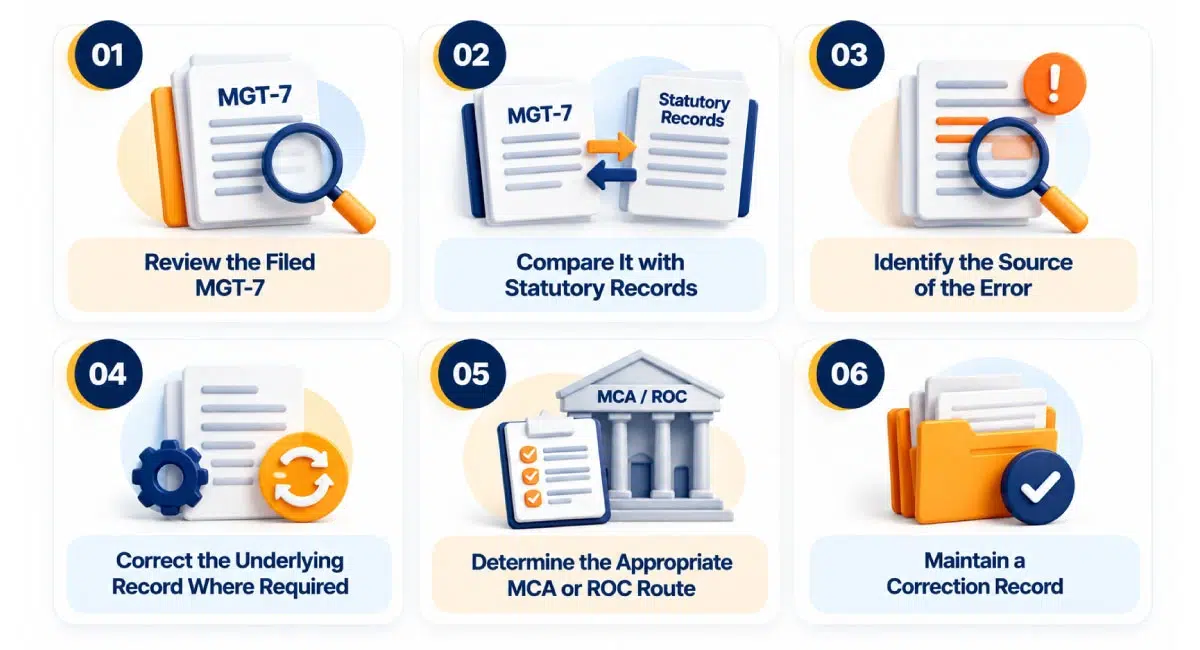
Step 1: Review the Filed MGT-7
Download the filed annual return and identify the exact incorrect disclosure.
Step 2: Compare It with Statutory Records
Check the register of members, shareholding records, director details, share capital records, Board documents, and AGM records.
Step 3: Identify the Source of the Error
Determine whether the mistake exists only in MGT-7 or whether another statutory record or MCA filing is also incorrect.
Step 4: Correct the Underlying Record Where Required
If the company’s source record itself requires correction, address that record under the applicable legal requirements before determining the consequential MCA action.
Step 5: Determine the Appropriate MCA or ROC Route
There is no universal post-filing correction route for all MGT-7 errors. The next action depends on the nature and materiality of the discrepancy.
Step 6: Maintain a Correction Record
Keep supporting documentation showing:
- What was originally filed;
- What was incorrect;
- Why the discrepancy occurred; and
- What action was subsequently taken.
For companies preparing MGT-7 and AOC-4 through MCA V3, Ebizfiling also has a detailed MCA V3 update for AOC-4 and MGT-7 filing requirements.
Can AOC-4 Be Corrected After Filing?
It depends on what exactly is incorrect.
The first question should be:
Is the error only in AOC-4, or are the underlying financial statements themselves incorrect?
This distinction is important because the legal route can be completely different.
What If AOC-4 Has a Filing-Level Error?
A filing-level error may include:
- An incorrect form field;
- A wrong attachment;
- An incorrect date;
- Mismatch between form data and the adopted documents; or
- Another e-form-related discrepancy.
In such cases, the company should review:
- The filing status
- The SRN
- The affected field or attachment
- The source document
- The corrective process available for that particular filing
A second AOC-4 should not be assumed to automatically cancel or replace the first filing.
What If the Financial Statements Filed with AOC-4 Are Incorrect?
Where the financial statements or Board’s Report themselves require statutory revision, the issue goes beyond correcting an AOC-4 field.
Section 131 of the Companies Act, 2013 provides a specific mechanism where the directors believe that:
- The financial statements do not comply with Section 129; or
- The Board’s Report does not comply with Section 134.
The company may revise its financial statements or Board’s Report for any of the three preceding financial years after obtaining Tribunal approval, subject to the procedure and conditions prescribed under Section 131 of the Companies Act, 2013.
Therefore, where a Mistake in MGT-7 or AOC-4 Filing originates from the underlying financial statements, simply uploading another AOC-4 may not be legally sufficient.
For OPCs, where AOC-4 is paired with MGT-7A rather than MGT-7, Ebizfiling also provides an OPC Annual Filing Service covering both forms.
How Does Section 131 Help Correct Financial Statement Errors?
Section 131 deals with voluntary revision of financial statements or the Board’s Report.
The process broadly involves:
- Identifying non-compliance with Section 129 or Section 134.
- Recording why revision is required.
- Taking appropriate Board-level action.
- Making the prescribed application to the Tribunal.
- Obtaining Tribunal approval.
- Revising only the matters requiring correction and necessary consequential changes.
- Filing the Tribunal order with the Registrar.
- Completing the consequential ROC filing requirements.
Section 131 also restricts revision to once in a financial year, and the reasons for revision must be disclosed in the Board’s Report.
Therefore, Section 131 is not a general editing facility for every Mistake in MGT-7 or AOC-4 Filing.
When Does Section 130 Apply to Incorrect Financial Statements?
Section 130 deals with reopening of accounts on the order of a competent court or Tribunal.
It is not an ordinary correction mechanism.
Accounts may be reopened where an eligible authority or person applies and the court or Tribunal finds that:
- Earlier accounts were prepared fraudulently; or
- The company’s affairs were mismanaged during the relevant period in a manner that casts doubt on the reliability of the financial statements.
A company cannot simply reopen its own accounts under Section 130.
Therefore, a routine Mistake in MGT-7 or AOC-4 Filing should not automatically be treated as a Section 130 matter.
Section 130 vs Section 131: Which Provision Applies?
|
Basis |
Section 130 |
Section 131 |
|
Purpose |
Reopening and recasting of accounts | Voluntary revision of financial statements or Board’s Report |
| Typical Reason | Fraud or mismanagement affecting reliability |
Non-compliance with Section 129 or Section 134 |
|
Initiated Through |
Application by specified authority/person | Application by the company |
| Approval Required | Court or Tribunal order |
Tribunal approval |
|
Scope |
Reopening/recasting as ordered |
Limited correction and consequential changes |
The two provisions therefore deal with very different circumstances.
Which Correction Route Applies to MGT-7 or AOC-4 Errors?
|
Error Situation |
Appropriate Starting Point |
|
Error found before submission |
Correct before filing |
| MCA sends the form for resubmission |
Follow MCA remarks and resubmit |
|
Filed MGT-7 contains incorrect information |
Review source records and determine the appropriate MCA/ROC route |
| AOC-4 has a filing-level discrepancy |
Check filing status and available corrective route |
|
Financial statements or Board’s Report require revision |
Examine Section 131 |
| Accounts involve fraud or serious reliability concerns |
Examine Section 130 |
The actual route depends on the facts behind the Mistake in MGT-7 or AOC-4 Filing.
What Documents Should Be Checked Before Correcting MGT-7 or AOC-4?
Keep the following documents and records ready:
- Filed MGT-7 or AOC-4
- SRN and filing acknowledgement
- MCA resubmission remarks, where applicable
- Statutory registers
- Shareholding records
- Director and KMP details
- Adopted financial statements
- Board’s Report
- Auditor’s Report
- AGM notice and minutes
- Relevant Board resolutions
- Related MCA filings
- Professional certification
- Written explanation of the identified mistake
If annual filings themselves are pending or multiple ROC forms need to be coordinated, Ebizfiling’s Company Annual Filing Service includes AOC-4, MGT-7, ADT-1, shareholder lists, directors’ reports, and related annual filing support.
What Mistakes Should Companies Avoid While Correcting MGT-7 or AOC-4?
Filing the Same Form Again Without Checking the Legal Route
A second filing should not be assumed to cancel automatically or replace the earlier filing.
Correcting the MCA Form but Ignoring the Underlying Records
If statutory registers or financial records are themselves incorrect, changing only the e-form may create additional inconsistencies.
Treating MGT-7 and AOC-4 Corrections as the Same
MGT-7 deals with the annual return, while AOC-4 deals with financial statements and related documents. The correction considerations can therefore differ.
Revising Financial Statements Without Checking Section 131
Where the financial statements or Board’s Report themselves require statutory revision, Section 131 should first be examined.
Assuming Every Error Automatically Attracts a Fixed Penalty
The consequences depend on the actual statutory default involved. A Mistake in MGT-7 or AOC-4 Filing should not automatically be linked to a specific penalty without checking the provision applicable to that default.
What Happens If an MGT-7 or AOC-4 Filing Error Is Not Corrected?
The impact depends on the nature and materiality of the error.
An unresolved Mistake in MGT-7 or AOC-4 Filing may result in:
- Differences between MCA records and statutory registers;
- Incorrect public disclosures;
- Difficulty in future ROC filings;
- Due-diligence queries;
- Auditor or stakeholder concerns;
- Regulatory queries; or
- Statutory consequences where the incorrect filing also results in a separate legal default.
The issue should therefore be evaluated according to the actual error instead of assuming that every mistake has the same consequence.
Found an Error in MGT-7 or AOC-4? Get the Right Correction Support
A Mistake in MGT-7 or AOC-4 Filing can create inconsistencies in MCA records, statutory disclosures, financial statements, and future ROC filings. The correct way to address the issue depends on whether the form is under resubmission, already filed, or linked to an error in the underlying company records.
Ebizfiling helps businesses review the filed form, check the SRN and filing status, compare the information with statutory registers and financial records, and identify the appropriate correction route based on the nature of the error. Where required, our team can also assist with supporting documents, MCA or ROC-related filings, and coordination with the applicable CA, CS, or other professional.
Get expert help from Ebizfiling to review the filing error and follow the correct MCA or ROC correction route.
Conclusion: What Is the Correct Way to Fix MGT-7 or AOC-4 Filing Errors?
A Mistake in MGT-7 or AOC-4 Filing should first be identified and classified before any correction is attempted.
If the error is found before submission, it should be corrected before filing. If MCA has specifically returned the form for resubmission, the identified defects should be handled through that resubmission process.
For an already-filed MGT-7, there is no general rule allowing every mistake to be corrected simply by filing a revised MGT-7. The company should instead review the source records and determine the appropriate MCA or ROC route.
For AOC-4, it is also necessary to distinguish between a filing-level discrepancy and an error in the financial statements themselves. Where the financial statements or Board’s Report require statutory revision, Section 131 may apply, while Section 130 deals with the separate process of reopening accounts in specified serious circumstances.
Frequently Asked Questions
1. Can a second MGT-7 be filed to replace an annual return that has already been taken on record?
There is no general statutory mechanism under Section 92 that allows a company to file a second MGT-7 simply and treat it as a replacement for the earlier annual return. The company should first identify the incorrect disclosure, underlying statutory record, and appropriate MCA/ROC corrective route.
2. What should be done when MGT-7 shows incorrect shareholding but the register of members is correct?
The company should preserve the correct register of members and identify how the incorrect figure entered MGT-7. It should also check related share-capital and event-based filings before determining the appropriate MCA/ROC action. The underlying statutory register should not be altered merely to match an incorrect annual return.
3. Can an AOC-4 filing error be corrected without revising the financial statements?
Potentially, if the adopted financial statements themselves are correct and the problem is limited to an e-form field, attachment, or filing detail. The company should first check the SRN and processing status. Section 131 is relevant when the financial statements or Board’s Report themselves require statutory revision.
4. When is Tribunal approval mandatory for correcting financial statements filed through AOC-4?
Tribunal approval is required under Section 131 where directors believe the financial statements do not comply with Section 129 or the Board’s Report does not comply with Section 134 and voluntary revision is required. Section 131 is not intended for ordinary clerical corrections in the AOC-4 e-form.
5. How many previous financial years can be revised under Section 131?
Section 131 permits voluntary revision of financial statements or the Board’s Report for any of the three preceding financial years, subject to Tribunal approval. The revision must address the identified non-compliance and consequential changes and cannot be used as an unrestricted mechanism to rewrite previously filed accounts.
6. Can financial statements be revised more than once in the same financial year under Section 131?
No. Section 131 specifically provides that revised financial statements or a revised Board’s Report cannot be prepared or filed more than once in a financial year. Companies should therefore identify all relevant corrections carefully before proceeding with the Tribunal-approved revision process.
7. What happens after the Tribunal approves revision of financial statements under Section 131?
After Tribunal approval, the company must comply with the applicable filing requirements for the Tribunal order and complete the prescribed process for revised financial statements or the revised Board’s Report with the Registrar. The company should follow the applicable Companies Act provisions, rules, MCA forms, and directions contained in the Tribunal order.
8. Is Section 130 available for correcting an incorrect figure discovered after AOC-4 filing?
Not ordinarily. Section 130 concerns reopening of accounts where a court or Tribunal finds that earlier accounts were prepared fraudulently or company affairs were mismanaged in a way that casts doubt on their reliability. A routine accounting, attachment, or data-entry error does not automatically fall under Section 130.
9. Can Ebizfiling review whether an MGT-7 error requires correction of another MCA filing first?
Yes. Ebizfiling can review the filed MGT-7, SRN, statutory registers, shareholding and director records, and related event-based filings to identify the source of the mismatch. This helps determine whether the issue originates in MGT-7 itself or in another statutory record or MCA filing requiring attention.
10. Can Ebizfiling assist when an AOC-4 error may require Section 131 action?
Yes. Ebizfiling can help review the filed AOC-4, adopted financial statements, Board’s Report, auditor-related records, and nature of the error. Where the underlying financial statements may require statutory revision, the matter can be assessed with the applicable professionals before proceeding with the appropriate Tribunal and ROC process.




Apply for Pvt Ltd Annual Filing
Don’t miss your ROC deadlines! Get your Pvt Ltd Annual Filing done smoothly with EbizFiling, expert help, zero stress.
About Ebizfiling -



October 19, 2026 By Srishti M
October 15, 2026 By Srishti M
TDS and TCS Compliance Calendar November 2026: Compliance Guide Introduction The TDS and TCS Compliance Calendar November 2026 covers important tax deduction, collection, payment, certificate and reporting requirements applicable during the month. It helps businesses, government offices and other responsible […]
October 14, 2026 By Srishti M
GST Compliance Calendar November 2026: Key Due Dates & Filings Introduction The GST Compliance Calendar November 2026 highlights the major GST return filing, tax payment, invoice reporting and year-end adjustment deadlines applicable during the month. It covers regular taxpayers, QRMP […]