

-
September 23, 2026
-
BySteffy A
What is form ITR-1 filing And How to File ITR-1 Sahaj Form?
Overview
Filing your income tax return becomes much easier when you choose the correct ITR form. For most salaried individuals in India, form ITR-1 filing, also known as Sahaj Form, is the simplest option. However, many taxpayers still get confused about whether they are eligible to file it.
In this guide, we will explain what ITR-1 is, who can file it, who cannot, and how to file it step by step.
What is form ITR-1 filing?
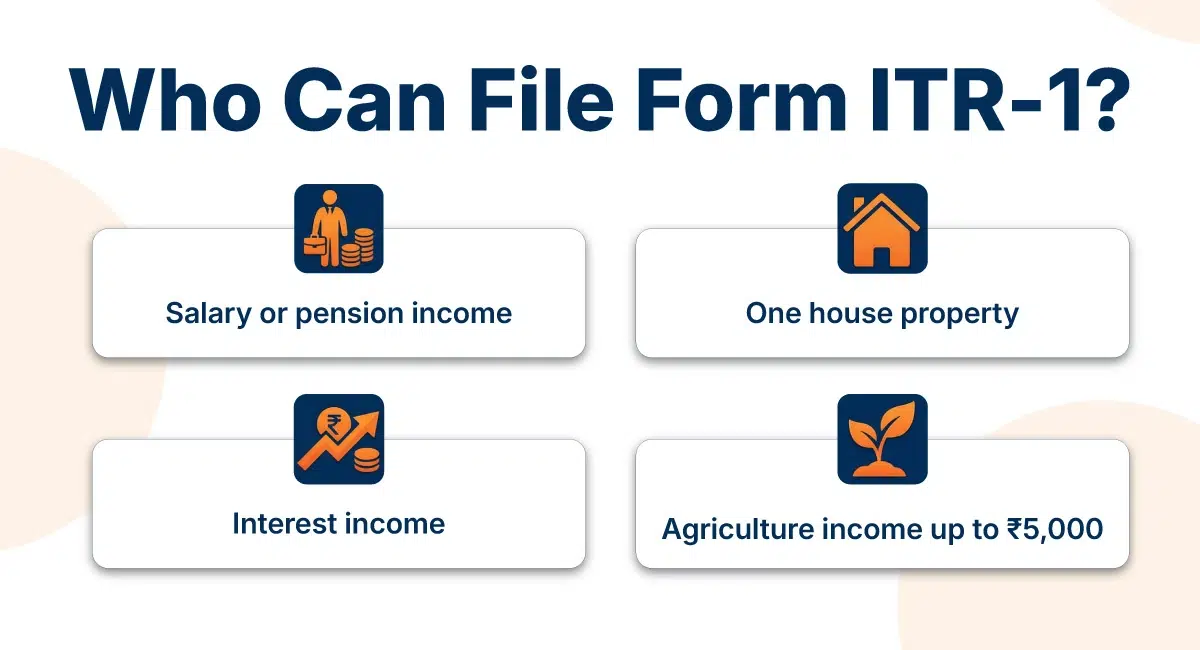
ITR-1 is an income tax return form designed for resident individuals whose total income is up to ₹50 lakh.
You can use form ITR-1 filing if your income comes from:
- Salary or pension
- One house property
- Other sources, such as interest income
- Agricultural income up to ₹5,000
This form is meant for small taxpayers with simple income structures.
Amendments made in the form ITR-1 filing
The form ITR-1 filing has undergone the following modifications:
- You can declare and receive relief for income from retirement benefit accounts kept in a notified country in accordance with Section 89A under the schedule titled “Salary.”
- The “Nature of employment” option is now required for pensioners (Central government, state government, public sector unit, and others).
- At the time of withdrawal or redemption, as required by Section 89A, you may now seek relief for the taxes paid on the income from the retirement benefit account kept in a notified country.
Documents Required for form ITR-1 filing
Before starting your filing, keep these documents ready:
- Form 16 from your employer
- Form 26AS and AIS
- PAN and Aadhar details
- Bank statements or passbook
- Investment proofs for deductions (80C, 80D, etc.)
- Interest certificates from banks
Having these documents ready helps you avoid errors and delays.
Eligibility Criteria for form ITR-1 filing
|
Condition |
Eligible forform ITR-1 filing |
|
Income up to ₹50 lakh |
Yes |
|
Salary or pension income |
Yes |
|
One house property |
Yes |
|
Capital gains (shares/crypto) |
No |
|
Business or freelance income |
No |
|
More than one house property |
No |
Who Can File Form ITR-1 (Sahaj)?
form ITR-1 filing can be filed by resident individuals whose income is simple and within the prescribed limit. It is mainly suitable for salaried taxpayers
Who Cannot File Form ITR-1? (Real Scenarios)
You should not file form ITR-1 if any of the following applies to you:
- Eligible resident individual may use ITR-1 where long-term capital gains under section 112A do not exceed ₹1.25 lakh. Short-term capital gains, crypto income and capital gains outside the permitted section 112A limit require the appropriate alternative return form.
- You are a freelancer, consultant, or business owner
- You own up to two house properties
- Your income exceeds ₹50 lakh
- You are a director in a company
- You hold foreign assets or foreign bank accounts
- Your agricultural income exceeds ₹5,000
You can instead be required to file ITR-2, ITR-3, or ITR-4, in such instances.
How to File Form ITR-1 (Sahaj) Form Online?
1. Login to The portal
To start with, go to the Income Tax e-filing portal and enter your PAN and password. Once you have logged in, visit the e-File section where you choose Income Tax Return and then, File Income Tax Return. Select the appropriate Assessment Year and continue.
2. Select Mode and Type
Choice Online Mode to proceed. In case you have saved a return, then you can resume it. Otherwise, begin a new filing. Then, choose your status as an individual.
Now the system will assist you in making the right choice of form ITR-1 filing or simply choose form ITR-1 (Sahaj) when you are certain.
3. Fill in Income and Deduction Details
After you start, make sure to revise the pre-filled information. Enter in any details that are missing about your income, deductions, or bank information. Ensure that everything is correct and proceed.
4. Check Tax Calculation
After entering all details, the system will calculate your tax. If there is any tax payable, you can choose to pay it immediately or later. If no tax is due or a refund is expected, you can proceed directly.
5. Preview and Submit the Return
Before final submission, preview your return to ensure everything is correct. Enter your place, accept the declaration, and proceed for validation.
6. Complete Verification
The final step is to verify your return. You can do this using Aadhaar OTP, net banking, or other available methods. Once verified, your ITR filing is successfully completed.
7. Confirmation
After successful e-verification, you will receive an acknowledgement number along with a confirmation message on your registered email and mobile number.
ITR-1 Form Filing Due Dates
The due date for filing ITR-1 (Sahaj) depends on the taxpayer category. The applicable due dates are:
- 31 July 2026: For resident individuals who are not required to get their accounts audited under the Income-tax Act.
- 31 December 2026: For filing a belated return for AY 2026-27.
Why Choose Ebizfiling for form ITR-1 filing?
At Ebizfiling, we make income tax filing simple and stress-free for individuals across India.
- We help you select the correct income tax returns based on your income.
- Our services ensure accurate filing with proper deduction claims.
- Get step-by-step guidance for salaried and first-time filers.
- Ensure timely ITR filing and avoid unnecessary penalties.
- Experience smooth document review and hassle-free final submission.
Take CA Consultation from Ebizfiling and file your ITR with confidence.
Read : 7 Mandatory Disclosures in ITR-1 & ITR-4 for AY 2025–26 (Old Regime)
Read: ITR Filing Online vs Tax Consultant
Read : Forms Sahaj(ITR 1) and Sugam(ITR 4)
Conclusion
For various taxpayer categories, the Income Tax Department has established different ITR forms (ITR-1 to ITR-7). Out of all these types, form ITR-1 filing is renowned as being the easiest. It is the ITR form that is used the most frequently and is designed for small taxpayers who have salary and other sources of income.
FAQs
1. Do I have to correct my filing, Form ITR-1 after making a filing?
Yes, provided you find any error in the return you have already filed, then you can submit a revised return. The Income Tax Department enables taxpayers to rectify mistakes like wrong income information, omission of deductions, or wrong bank details. The amended return should be submitted within the stipulated time. When filling out form ITR-1, it is always advisable to review details carefully to avoid unnecessary revisions.
2. How does ITR-1 and ITR-2 differ among those who are salaried?
ITR-1 is designed for individuals with simple income sources like salary, one house property, and other income such as interest. ITR-2 is applicable when you have capital gains, foreign income, or more than one house property. Choosing the correct form is important, as selecting the wrong one may lead to rejection or notices.
3. Is Aadhaar OTP required when filing ITR-1?
Yes, Aadhaar OTP is one of the most common methods for e-verifying your return. After submitting ITR-1, verification is mandatory. You can also verify using net banking, bank account EVC, or by sending a signed ITR-V to CPC Bengaluru. Without verification, the return is considered invalid.
4. Is it possible to file ITR-1 when I have income from freelance work?
No, if you earn income from freelancing or any business or professional activity, you cannot use ITR-1. Such income falls under Profits and Gains of Business or Profession and requires filing ITR-3 or ITR-4 depending on the case. ITR-1 is only suitable for individuals with simple income sources.
5. What is pre-filled information in form ITR-1 filing?
Pre-filled data refers to information automatically populated in your ITR form based on sources like Form 26AS, AIS, PAN records, and previous returns. This includes salary, TDS, bank interest, and personal details. While it simplifies filing, you must verify all information before submission.
6. Do you have the right to claim home loan interest in ITR-1 filing?
Yes, you can claim a deduction on home loan interest under Section 24 while filing ITR-1 if you own a single house property. The maximum deduction allowed for self-occupied property is ₹2 lakh per year, which helps reduce taxable income.
7. What will be the consequences of not filing ITR-1 on time?
If you miss the due date, you can still file a belated return within the allowed time, but a late filing fee under Section 234F may apply. You may also lose certain benefits such as carrying forward losses. Filing on time helps avoid penalties and ensures compliance.
8. Are minors authorized to do form ITR-1 filing in India?
Generally, a minor’s income is clubbed with the parent’s income. However, if a minor earns through skills or talent (such as acting or sports), they may need to file a separate return. In such cases, eligibility to use ITR-1 depends on the type and amount of income.
9. What makes Ebizfiling ensure accurate form ITR-1 filing?
Ebizfiling follows a structured process where income details, tax credits, and deductions are thoroughly verified before submission. It cross-checks AIS, Form 26AS, and supporting documents to minimize errors and ensure compliance.
10. Why should I prefer Ebizfiling when filing ITR-1 for the first time?
Tax rules can be confusing for first-time taxpayers. Ebizfiling simplifies the process by guiding you through each step, helping you choose the correct form, and ensuring accurate reporting of income and deductions, making filing smooth and hassle-free.





Income Tax Return
Filing of Income Tax return is necessary if you have earned any income. File your ITR with EbizFiling
About Ebizfiling -



Reviews
Harshit Gamit
19 Apr 2018My GST process was made easier with Ebizfiling. I really appreciate the hard work by your team. Keep up the same in the future. Good Luck!
Jaydipkumar Babriya
18 Apr 2022Excellent service with a high level of professionalism. They not only applied for trademark, got it registered but also provided guidance and advisory thereof. That's amazing experience!! Really deserve 5 out of 5!!
Akshay Sharma
18 Apr 2022I took a TM service for my Tea Brand, wonderful service with humble staff, and provided solutions on time. Recommended for all
October 21, 2026 By Srishti M
Tax Planning for NRI Returning to India Before Becoming ROR Introduction Tax planning for NRI returning to India should start before the person becomes Resident and Ordinarily Resident, also known as ROR. Under the Income-tax Act, 2025, residential status decides […]
September 30, 2026 By Srishti M
September 29, 2026 By Srishti M
Income Tax Compliance Calendar October 2026: Filing Guide Introduction The Income Tax Compliance Calendar October 2026 highlights important income tax obligations applicable to taxpayers, businesses and entities covered under audit and transfer pricing provisions. October 2026 includes key compliance […]