


-
September 8, 2026
-
BySteffy A
Form ADT-1 Filing: Due Date, Documents, Fees and Process
Introduction
Appointment of a statutory auditor is an important compliance requirement for companies registered under the Companies Act, 2013. Once an auditor is appointed or reappointed under Section 139(1), the company is required to inform the Registrar of Companies about the appointment within the prescribed period. Form ADT-1 Filing is the prescribed process used for this purpose.
The responsibility to intimate the Registrar rests with the company. Before making the appointment, the company must also obtain the auditor’s written consent and a certificate confirming eligibility under the applicable provisions of the Companies Act. Section 139(1) requires the notice of appointment to be filed with the Registrar within 15 days of the meeting in which the auditor is appointed.
Understanding Form ADT-1 Filing is therefore important for companies that want to keep their auditor records accurate and avoid delayed filing consequences.
Quick Insights
- Form ADT-1 Filing is used to inform the ROC about the appointment or reappointment of a statutory auditor.
- The form is generally required to be filed within 15 days of the meeting in which the auditor is appointed.
- The company must obtain the auditor’s written consent and eligibility certificate before appointment.
- Form ADT-1 Filing is linked to Section 139(1) of the Companies Act, 2013 and Rule 4(2) of the Companies (Audit and Auditors) Rules, 2014.
- Delayed filing may lead to additional filing fees and statutory consequences under the Companies Act.
What is Form ADT-1 Filing?
Form ADT-1 Filing is the formal process through which a company gives notice to the Registrar regarding the appointment of its statutory auditor. Rule 4(2) of the Companies (Audit and Auditors) Rules, 2014 prescribes Form ADT-1 for the notice required under Section 139(1).
The form records important information about the company and its auditor. This allows the Registrar to maintain an official record of the statutory auditor appointed by the company.
The responsibility for completing Form ADT-1 Filing lies with the company and not with the auditor. However, before the appointment is made, the proposed auditor must provide written consent and a certificate stating that the appointment complies with the prescribed conditions. The certificate must also confirm whether the auditor satisfies the eligibility criteria provided under Section 141.
Companies that need professional assistance with the appointment process can also explore our appointment of statutory auditors service, which covers auditor appointment-related compliance support.
Legal Provisions Governing Form ADT-1 Filing
Form ADT-1 Filing primarily derives from Section 139 of the Companies Act, 2013, read with Rule 4 of the Companies (Audit and Auditors) Rules, 2014.
Under Section 139(1), a company appoints an individual or firm as its auditor at the first Annual General Meeting. Subject to the applicable provisions, the auditor holds office from the conclusion of that meeting until the conclusion of the sixth Annual General Meeting.
Before the appointment is made, the company must obtain:
- Written consent from the proposed auditor
- A certificate confirming that the appointment meets the prescribed conditions
- Confirmation that the auditor satisfies the criteria under Section 141
After the appointment, Form ADT-1 Filing is used to provide the prescribed notice to the Registrar within the statutory timeline.
Companies should also consider auditor rotation requirements. Section 139(2) prescribes rotation requirements for listed companies and other prescribed classes of companies.
Who is Required to File Form ADT-1?
A company appointing an auditor under Section 139(1) is required to give notice of that appointment to the Registrar. Since the explanation to Section 139 states that “appointment” includes reappointment, Form ADT-1 Filing is also relevant when an eligible statutory auditor is reappointed.
The requirement should, however, be distinguished from the appointment of the first auditor of a non-government company.
Section 139(6) separately provides that the Board of Directors must appoint the first auditor within 30 days from the date of registration of the company. If the Board fails to make the appointment, it must inform the members, who are required to appoint the auditor within 90 days at an Extraordinary General Meeting. The first auditor then holds office until the conclusion of the first AGM.
Form ADT-1 is not expressly mandated under Section 139(6) for the appointment of the first auditor of a non-government company. The statutory ADT-1 notice requirement under Rule 4(2) relates to the notice contemplated under Section 139(1).
For a more detailed understanding of this distinction, readers can refer to our guide on the company’s first auditor and the procedure to appoint an auditor.
Form ADT-1 Filing Due Date
The normal due date for Form ADT-1 Filing is within 15 days from the meeting in which the auditor is appointed. This timeline is specifically provided under Section 139(1) of the Companies Act, 2013.
For example, if shareholders appoint or reappoint an auditor at an AGM held on 30 September, the company should calculate the statutory 15-day filing period from the date of that meeting.
The deadline should not be calculated from the date on which the auditor signs the engagement letter, begins audit work, or signs the financial statements. The relevant statutory event is the meeting in which the auditor is appointed.
Companies handling multiple annual filings can use a structured ROC compliance calendar to keep track of event-based and annual compliance deadlines.
Ebizfiling’s current compliance calendar also identifies ADT-1 as an event-based filing connected with auditor appointment or reappointment.
Documents and Records Required for Form ADT-1 Filing
Before starting Form ADT-1 Filing, the company should keep the relevant auditor appointment documents and corporate records ready.
Important records generally include:
- Auditor Consent: Written consent from the proposed auditor accepting the appointment.
- Eligibility Certificate: A certificate confirming that the proposed auditor satisfies the applicable appointment conditions and eligibility requirements.
- Appointment Resolution: A copy of the relevant resolution approving the appointment or reappointment.
- Appointment Details: Information relating to the date, tenure, category, and terms of appointment.
- Supporting Records: Any additional documents required by the current MCA webform or filing instructions.
Section 139(1) specifically requires written consent and the prescribed certificate to be obtained before the appointment is made.
Before completing Form ADT-1 Filing, companies should ensure that the dates, auditor’s name, professional details, tenure, and resolution particulars are consistent across all supporting records.
Details Required in Form ADT-1
The company should keep accurate information ready before beginning the filing process. Form ADT-1 Filing generally requires company details, information relating to the appointment meeting, and professional details of the auditor.
Relevant information may include:
- Corporate Identity Number
- Name and registered office details of the company
- Date of the meeting
- Nature of auditor appointment
- Name of the individual auditor or audit firm
- PAN details
- Membership number or firm’s registration number
- Address and contact information
- Period of appointment
- Other information requested in the current form
Details entered in the form should match the company’s resolutions, auditor consent, eligibility certificate, and statutory records.
Step-by-Step Process for Form ADT-1 Filing Online
Companies can complete Form ADT-1 Filing through the MCA filing system. The exact portal interface and submission workflow may change, so businesses should follow the instructions displayed on the current MCA portal at the time of filing. MCA continues to provide company filing and compliance services through its online platform.
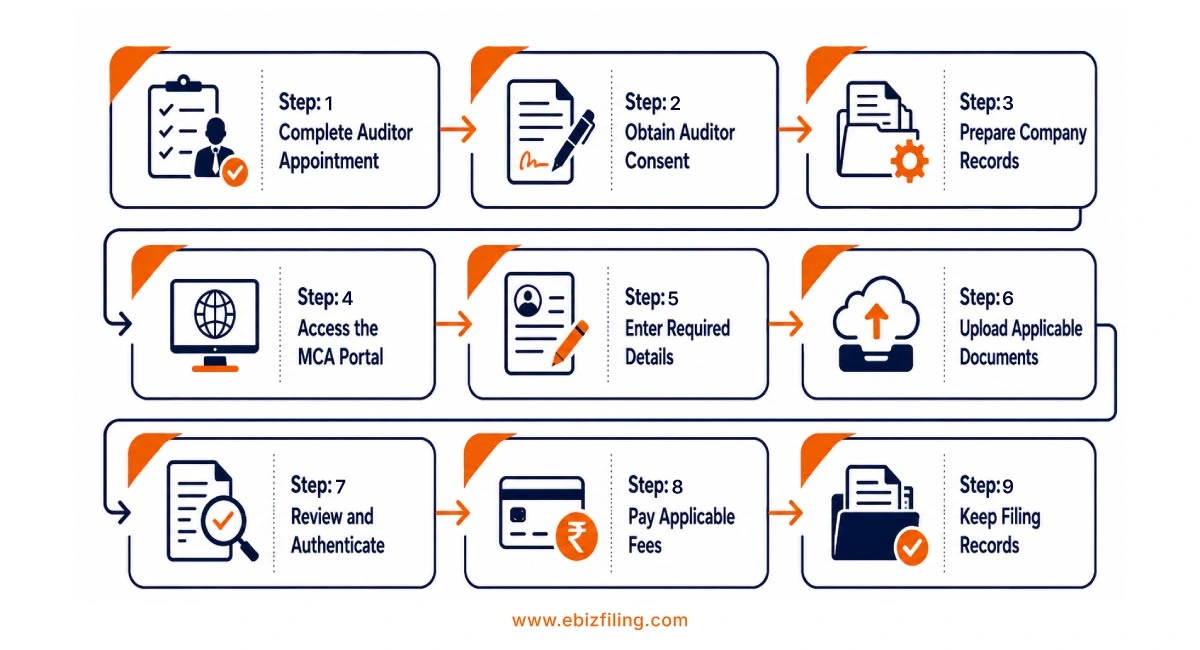
Step 1: Complete Auditor Appointment
Hold the applicable meeting and obtain the necessary approval for the appointment or reappointment of the statutory auditor.
Step 2: Obtain Auditor Consent
Obtain written consent from the proposed auditor along with the certificate confirming compliance with the applicable appointment conditions and Section 141 eligibility requirements.
Step 3: Prepare Company Records
Keep the resolution, auditor details, meeting particulars, consent, certificate, and other supporting records ready before starting Form ADT-1 Filing.
Step 4: Access the MCA Portal
Log in to the MCA portal using the appropriate account and locate the relevant ADT-1 filing facility.
Step 5: Enter Required Details
Fill in the company’s information, auditor details, appointment date, tenure, meeting particulars, and other required fields.
Step 6: Upload Applicable Documents
Attach the documents required under the current filing instructions. Every attachment should be complete, readable, and consistent with the information entered in the form.
Step 7: Review and Authenticate
Check all information carefully before submission. Complete the required authentication and certification process, wherever applicable.
Step 8: Pay Applicable Fees
Complete the prescribed MCA payment process after submission.
Step 9: Keep Filing Records
Save the Service Request Number, acknowledgement, payment record, and copy of the submitted form. These records can be useful during future compliance reviews.
Companies managing ADT-1 together with other annual ROC requirements can consider professional company annual return filing support. Ebizfiling’s annual filing service covers company filings and includes ADT-1 among the relevant compliance forms.
Form ADT-1 Filing Fees and Additional Fees
The fee applicable to Form ADT-1 Filing is determined under the MCA’s applicable fee framework and can depend on the filing particulars of the company. MCA provides an online fee enquiry facility and advises users to refer to the relevant filing instructions for applicable charges.
Companies should check the fee generated on the MCA portal at the time of submission rather than relying on old fee charts available online.
Where the form is submitted after the prescribed period, an additional fee may also become payable according to the applicable filing rules. Timely filing therefore helps the company avoid unnecessary additional filing costs.
For businesses handling several statutory filings together, Ebizfiling also provides ROC filing for private limited companies covering annual ROC compliance and related company filings.
What Happens if Form ADT-1 Filing is Delayed?
If Form ADT-1 Filing is not completed within the prescribed timeline, the company may have to pay applicable additional filing fees when regularising the filing.
There is also a broader statutory consequence. Section 147(1) deals with contraventions of Sections 139 to 146 of the Companies Act. It provides that the company may be liable to a fine of not less than ₹25,000, which may extend to ₹5 lakh. Every officer of the company who is in default may be liable to a fine of not less than ₹10,000, which may extend to ₹1 lakh.
Companies should therefore not treat delayed ADT-1 merely as a matter of paying an additional filing fee. The underlying compliance requirement arises from Section 139.
If a filing has been missed, the company should verify the actual appointment date, review the relevant records, check the current MCA fee implications, and complete the pending compliance with correct information.
Mistakes While Filing Form ADT-1
Several filing problems can be avoided through a careful review before submission. Common errors during Form ADT-1 Filing include:
- Entering the wrong meeting or appointment date
- Using an incorrect auditor membership number
- Entering the wrong audit firm registration number
- Selecting an incorrect category of appointment
- Providing an incorrect tenure
- Failing to obtain written auditor consent
- Not obtaining the required eligibility certificate
- Uploading incomplete or inconsistent documents
- Entering auditor details that do not match supporting records
- Missing the prescribed 15-day filing timeline
Companies should compare the form with the appointment resolution and auditor documents before final submission.
If an auditor has resigned rather than being appointed or reappointed, different compliance requirements may apply. Our guide on auditor resignation and related formalities explains the related process, including Form ADT-3.
Why Timely ADT-1 Filing Matters
Timely auditor-related filing helps ensure that the company’s ROC records correctly reflect the statutory auditor appointed by its members. It also reduces the risk of additional filing fees, compliance gaps, and inconsistencies between company records and information available with the Registrar.
Businesses should include ADT-1 in their post-AGM compliance checklist whenever an appointment or reappointment under Section 139(1) takes place. Responsibility for preparation and submission should be assigned soon after the meeting so that the statutory 15-day period is not missed.
Need Help with Form ADT-1 Filing?
Managing auditor appointment compliance can become difficult when deadlines, documents, and MCA filing requirements are involved. Ebizfiling can assist your company with Form ADT-1 Filing, document preparation, auditor appointment compliance, and other ROC-related filings.
With professional compliance support from Ebizfiling, businesses can reduce filing errors, keep statutory records updated, and complete required filings within the applicable timeline.
Get expert assistance with your company compliance requirements at Ebizfiling.
Conclusion
Form ADT-1 Filing is an important ROC compliance requirement connected with the appointment or reappointment of a statutory auditor under Section 139(1) of the Companies Act, 2013. The company must obtain the auditor’s written consent and eligibility certificate and notify the Registrar within 15 days of the meeting in which the appointment takes place.
Companies should verify appointment details, supporting records, filing fees, and the current MCA filing requirements before submission. Timely and accurate compliance helps maintain proper statutory records and reduces the risk of additional fees or consequences arising from non-compliance.
Frequently Asked Questions
1. Can a company appoint more than one statutory auditor?
Yes. Section 139(3)(b) of the Companies Act, 2013 allows the members of a company to resolve that its audit will be conducted by more than one auditor. Such auditors are commonly referred to as joint auditors. Each appointed auditor must independently satisfy the applicable eligibility and disqualification requirements.
2. Can an LLP be appointed as the statutory auditor of a company?
Yes. For Section 139, the term “firm” includes a Limited Liability Partnership. However, where an LLP or firm is appointed as auditor, only partners who are Chartered Accountants are authorised to act and sign on behalf of the firm under Section 141(2).
3. What happens if a statutory auditor becomes disqualified after appointment?
If an auditor incurs any disqualification specified under Section 141(3) after being appointed, the auditor must vacate the office. Under Section 141(4), such vacation is treated as a casual vacancy in the office of the auditor, which must then be dealt with according to Section 139.
4. How is a casual vacancy caused by an auditor's resignation filled?
For a non-Government company, the Board must fill a casual vacancy within 30 days. If the vacancy arises because of the auditor’s resignation, the appointment made by the Board must also be approved by the company at a general meeting convened within three months of the Board’s recommendation. The appointed auditor then holds office until the conclusion of the next AGM.
5. Is special notice required to appoint someone other than the retiring auditor?
Generally, yes. Under Section 140(4), special notice is required for a resolution at an AGM to appoint a person other than the retiring auditor or to expressly provide that the retiring auditor will not be reappointed. An exception applies where the retiring auditor has completed the applicable five-year or ten-year tenure under the mandatory rotation provisions of Section 139(2).
6. Can a statutory auditor be removed before completion of the term?
Yes, but the company cannot remove the auditor through an ordinary change of appointment. Under Section 140(1), removal before expiry of the auditor’s term requires prior approval of the Central Government and a special resolution of the company. The auditor must also be given a reasonable opportunity of being heard.
7. Can a statutory auditor also provide internal audit or accounting services to the same company?
No. Section 144 prohibits a statutory auditor from directly or indirectly providing specified services to the company, its holding company, or its subsidiary company. These include accounting and bookkeeping, internal audit, financial information system implementation, actuarial services, investment advisory services, investment banking, outsourced financial services, and management services.
8. Can a company appoint an auditor who has exceeded the statutory audit limit?
No. Under Section 141(3)(g) of the Companies Act, 2013, a person who is already holding appointment as auditor of more than the prescribed number of companies is disqualified from being appointed as auditor of another company. The applicable exclusions and limits should be checked before accepting the appointment.
9. Can Ebizfiling help verify auditor eligibility before Form ADT-1 Filing?
Yes. Ebizfiling can assist with reviewing auditor appointment documentation and checking whether the proposed appointment is supported by the required consent, eligibility certificate, and company resolutions before Form ADT-1 Filing.
10. Can Ebizfiling assist when a company needs to change or replace its auditor?
Yes. Ebizfiling’s current auditor appointment service lists document preparation and appointment or resignation of auditor among its service offerings. Companies can use this support for preparing the relevant corporate documentation and completing applicable auditor-related filings, while the exact legal procedure will depend on whether the change results from resignation, removal, expiry of tenure, or another type of vacancy.





Appointment of Auditor
Easily conduct auditor’s appointment procedure in your company. Get it done through EbizFiling.com
About Ebizfiling -



Reviews
Amit Tripathi
01 Jun 2018Easy and Fast Thanks for the Help, Very Nice Services will contact for other services too.
DEEPAK BAGRA
08 Sep 2018I find the service, working approach and commitments very professional. Their progress updates are commendable. I really liked working with them.
Hemang Malhotra
08 Oct 2018I was new as an Entrepreneur when I had seen their post on social media. I contacted them regarding proprietorship and realized they their pricing is incomparable in the market also their services are really prompt. Thank you, Ebizfiling.
July 9, 2026 By Steffy A
AML obligations for Practicing CS under FIU-IND Framework Introduction AML obligations for Practicing CS are becoming increasingly important in today’s evolving regulatory environment, where the role of Practicing Company Secretaries has expanded beyond traditional compliance functions into areas involving corporate […]
June 26, 2026 By Steffy A
Why Online Legal Services Are Growing in India? Introduction The legal industry is evolving rapidly as technology reshapes how legal assistance is delivered. In India, online legal services are growing because they address historical challenges such as court backlogs, complex […]
June 26, 2026 By Steffy A
Why More Businesses Are Choosing Outsourcing Legal Work? Introduction Businesses are increasingly turning to outsourcing legal work to manage compliance, contracts, and regulatory responsibilities more efficiently. Through Legal Process Outsourcing, companies can reduce operational costs while gaining access to experienced […]