


-
September 12, 2026
-
BySiddhi R
Cost Inflation Index for Capital Gain Calculation in India
Introduction
Cost Inflation Index (CII) helps adjust the cost of an asset for inflation while calculating eligible capital gains. Since the value of money changes over time, CII provides a more realistic cost of acquisition or improvement. The Central Government notifies the index every financial year, and for FY 2026-27, the CII is 384.
However, after the capital gains changes effective from 23 July 2024, indexation is no longer available for all long-term capital assets and can be used only where permitted under the Income-tax provisions.
Key Highlights
- Cost Inflation Index adjusts eligible capital asset costs for inflation while calculating capital gains.
- FY 2001-02 is the base year for CII, with an index value fixed at 100.
- The Cost Inflation Index for FY 2026-27 has been officially notified at 384.
- From 23 July 2024, indexation is generally unavailable for many long-term capital assets.
- Where indexation is allowed, it may increase acquisition cost and reduce taxable capital gains.
What is Cost Inflation Index?
The Cost Inflation Index (CII) is an index notified by the Central Government for measuring inflation for capital gains purposes.
It helps determine the inflation-adjusted cost of acquiring or improving an eligible capital asset. This adjusted amount is known as the indexed cost of acquisition or the indexed cost of improvement.
The base year for CII is FY 2001-02, for which the index value is 100.
The base year was shifted from FY 1981-82 to FY 2001-02 through the Finance Act, 2017. For eligible capital assets acquired before 1 April 2001, the cost of acquisition may generally be taken as the actual cost or the fair market value as on 1 April 2001, at the taxpayer’s option. In the case of land or building, the fair market value is subject to the applicable stamp duty value restriction.
To understand how gains from the sale of different capital assets are taxed, read our detailed guide on Capital Gain Tax in India.
Why is Cost Inflation Index Used?
Suppose a property was purchased many years ago for ₹30 lakh and is later sold for ₹80 lakh. The difference of ₹50 lakh may appear to be the economic gain. However, a part of this increase may simply be due to inflation. Where indexation is legally available, CII increases the eligible purchase cost according to inflation.
As a result, the taxable long-term capital gain may be reduced. In simple terms, the Cost Inflation Index helps distinguish actual appreciation in the value of an asset from the increase attributable to inflation.
How Does Cost Inflation Index Work?
The indexed cost of acquisition can generally be calculated using the following formula:
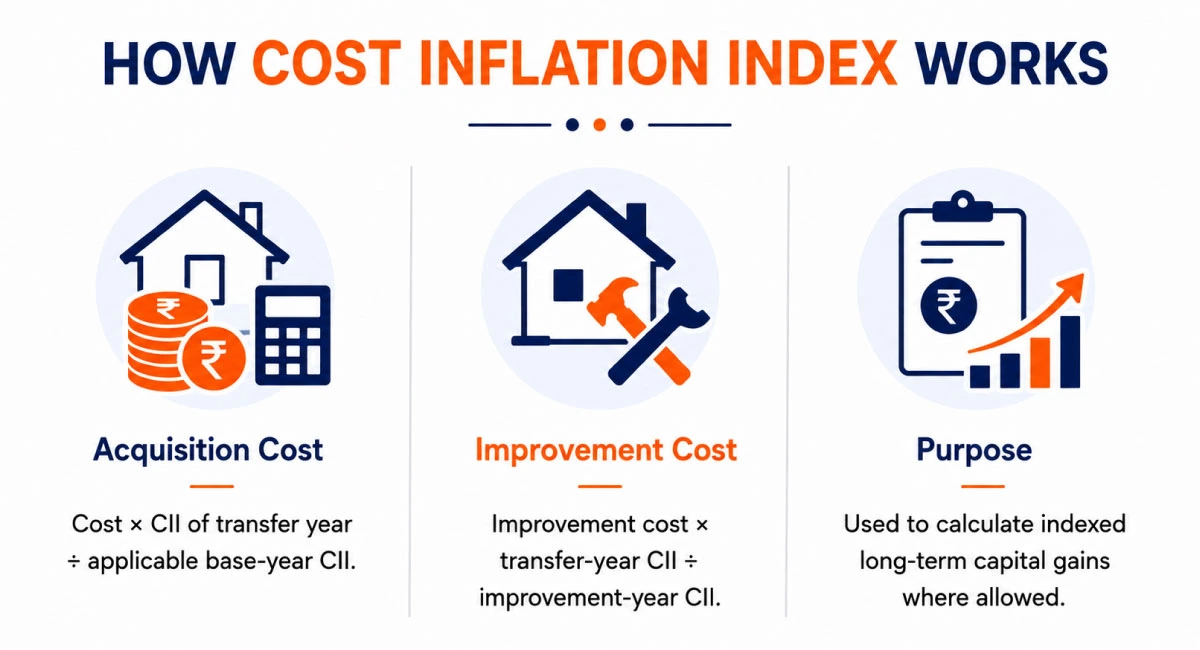
Indexed Cost of Acquisition = Cost of Acquisition × CII of Year of Transfer ÷ CII of First Year in Which the Asset Was Held, or FY 2001-02, whichever is later
Where indexation of improvement cost is permitted:
Indexed Cost of Improvement = Cost of Improvement × CII of Year of Transfer ÷ CII of Year of Improvement
The resulting indexed cost is used while calculating long-term capital gains only where the relevant provisions allow indexation.
Example of Cost Inflation Index Calculation
Consider an asset purchased during FY 2013-14 for ₹31,00,000 and sold during FY 2018-19 for ₹61,25,000.
The CII for FY 2013-14 was 220.
The CII for FY 2018-19 was 280.
Indexed Cost of Acquisition
₹31,00,000 × 280 ÷ 220
= approximately ₹39,45,455
Long-Term Capital Gain
Sale Price: ₹61,25,000
Less: Indexed Cost of Acquisition: ₹39,45,455
Long-Term Capital Gain: ₹21,79,545
This example explains how CII was traditionally used to adjust the purchase cost for inflation.
Taxpayers should remember that whether indexation can actually be claimed depends on the type of asset and the date of transfer under the current capital gains provisions.
Changes in Capital Gains and Indexation Rules from 23 July 2024
The Finance (No. 2) Act, 2024 significantly changed the taxation of capital gains.
For transfers from 23 July 2024, the general long-term capital gains regime was changed to 12.5% without indexation for most assets. For Tax Year 2026-27 onwards, the corresponding provisions are contained in Section 197 of the Income-tax Act, 2025.
The earlier general system of paying tax at 20% after indexation was therefore discontinued for many capital assets.
There is, however, an important relief for certain property transactions.
For a resident individual or Hindu Undivided Family transferring a long-term capital asset, being land or building or both, acquired before 23 July 2024, the law provides protection where tax calculated under the new provisions exceeds the tax that would have been payable under the earlier indexed method. In such qualifying cases, the taxpayer can effectively compare the new 12.5% tax calculation without indexation with the earlier 20% tax calculation using indexation.
Therefore, CII remains relevant even after the 2024 amendments, but its application is now more limited than before.
Long-Term and Short-Term Capital Asset Rules
The earlier blog rule stating that an asset becomes long-term after 36 months is no longer correct as a general rule.
For transfers on or after 23 July 2024, the holding-period structure has largely been simplified to 12 months or 24 months.
Generally:
- Listed securities become long-term when held for more than 12 months.
- Other capital assets generally become long-term when held for more than 24 months.
- Immovable property such as land or buildings, continues to require a holding period of more than 24 months.
- Unlisted shares generally require a holding period of more than 24 months.
- Certain assets are subject to special provisions and may be treated differently irrespective of their period of holding.
To understand how profits from share investments are taxed based on the holding period, read our detailed guide on Short Term Capital Gain Tax (STCG) and Long Term Capital Gain Tax on Shares.
Can Cost Inflation Index Reduce Taxable Capital Gains?
CII can reduce taxable capital gains when indexation is available because it increases the eligible acquisition cost to account for inflation.
For example, without indexation:
- Sale Price = ₹80 lakh
- Original Cost = ₹30 lakh
- Capital Gain = ₹50 lakh
If the indexed cost increases to ₹45 lakh:
- Sale Price = ₹80 lakh
- Indexed Cost = ₹45 lakh
- Capital Gain = ₹35 lakh
The taxable capital gain is therefore reduced from ₹50 lakh to ₹35 lakh.
However, after the changes effective from 23 July 2024, taxpayers should not automatically apply CII to every long-term capital asset. Indexation should be claimed only where the relevant tax provisions permit it.
Cost Inflation Index Chart from FY 2001-02 to FY 2026-27
The following is the updated Cost Inflation Index chart:
|
Sl. No. |
Financial Year |
Cost Inflation Index |
|
1 |
2001-02 |
100 |
|
2 |
2002-03 |
105 |
|
3 |
2003-04 |
109 |
|
4 |
2004-05 |
113 |
|
5 |
2005-06 | 117 |
| 6 | 2006-07 |
122 |
|
7 |
2007-08 | 129 |
| 8 | 2008-09 |
137 |
|
9 |
2009-10 | 148 |
| 10 | 2010-11 |
167 |
|
11 |
2011-12 | 184 |
| 12 | 2012-13 |
200 |
|
13 |
2013-14 | 220 |
| 14 | 2014-15 |
240 |
|
15 |
2015-16 | 254 |
| 16 | 2016-17 |
264 |
|
17 |
2017-18 | 272 |
| 18 | 2018-19 |
280 |
|
19 |
2019-20 | 289 |
| 20 | 2020-21 |
301 |
|
21 |
2021-22 | 317 |
| 22 | 2022-23 |
331 |
|
23 |
2023-24 | 348 |
| 24 | 2024-25 |
363 |
|
25 |
2025-26 | 376 |
| 26 | 2026-27 |
384 |
The Cost Inflation Index for FY 2026-27 has been officially notified at 384 through CBDT Notification No. 85/2026 dated 15 July 2026. The Income Tax Department’s updated CII table also reflects the index values from FY 2001-02 onward.
Get Support for Capital Gains Tax Filing
Capital gains tax calculation can involve different rules based on the type of asset, holding period, indexation eligibility, and available exemptions. Ebizfiling can assist you with accurate computation and proper tax filing as per the applicable provisions.
- Capital Gain Calculation: Get help calculating taxable capital gains based on your asset details and transaction value.
- Indexation Review: Understand whether indexation is available and how it applies to your capital asset.
- Exemption Guidance: Get assistance in identifying applicable capital gains exemptions under the Income-tax Act.
- ITR Filing Support: File your Income Tax Return with accurate reporting of eligible capital gains.
File Your ITR with Ebizfiling
Conclusion
The Cost Inflation Index has traditionally played an important role in calculating inflation-adjusted capital gains. It allows the acquisition or improvement cost of an eligible asset to be adjusted according to inflation, which can reduce the taxable capital gain.
However, the role of CII has changed after the capital gains amendments effective from 23 July 2024. Indexation is no longer generally available for every long-term capital asset. Taxpayers should therefore first determine the type of asset, holding period, acquisition date, transfer date, residential status, and applicable capital gains provision before using CII.
Frequently Asked Questions
1. How does the Cost Inflation Index affect capital gain calculation?
The Cost Inflation Index adjusts the eligible cost of acquisition or improvement for inflation. Where indexation is permitted, a higher indexed cost can reduce the amount of long-term capital gain subject to tax.
2. What is the Cost Inflation Index 2026-27?
The Cost Inflation Index 2026-27 is 384. This CII value is relevant for eligible transactions where capital gains indexation is permitted under the applicable Income-tax provisions.
3. How do I use the Cost Inflation Index formula for an asset purchased in an earlier year?
The Cost Inflation Index formula is: Cost of Acquisition × CII of Year of Transfer ÷ CII of the first year in which the asset was held, or FY 2001-02, whichever is later. This determines the indexed cost of acquisition where indexation is permitted.
4. Can I use the CII index in India for every long-term capital asset?
No. Following the changes effective from 23 July 2024, capital gains indexation is not generally available for every long-term capital asset. The applicable rules depend on the asset, acquisition date, transfer date, and taxpayer category.
5. How is the indexed cost of acquisition different from the original purchase cost?
The original purchase cost is the actual amount paid to acquire the asset. The indexed cost of acquisition adjusts that eligible cost for inflation using the applicable CII values, wherever indexation is permitted.
6. Can CII be applied to the cost of improvements made to a capital asset?
Yes, where indexation is permitted, eligible improvement costs may also be adjusted using the CII of the year in which the improvement was made and the CII of the year of transfer.
7. Why is FY 2001-02 important in the Cost Inflation Index chart?
FY 2001-02 is the base year in the Cost Inflation Index chart, with a CII value of 100. Special cost determination rules may apply to eligible capital assets acquired before 1 April 2001.
8. Can Ebizfiling help determine whether indexation applies to my property sale?
Yes. Ebizfiling can help review the asset type, purchase date, sale date, holding period, and applicable tax provisions to determine whether indexation can be considered while calculating your capital gains.
9. Can Ebizfiling help report capital gains while filing an ITR?
Yes. Ebizfiling can assist with capital gain calculation and reporting while filing your Income Tax Return based on the information and documents provided and the applicable tax provisions.
10. Why is CII 384 relevant for capital gains calculation?
CII 384 is the notified Cost Inflation Index for FY 2026-27. It may be used for eligible capital gain calculations involving indexation, subject to the applicable provisions of the Income-tax Act.





Income Tax Returns
Filing of Income Tax return is necessary if you have earned any income. File your ITR with EbizFiling
About Ebizfiling -



Reviews
Aditya Dufare
24 Aug 2021Prompt service.They value your time. Professional and experienced staff to guide you. offer services at very competitive price. I would like to continue with them in future. must try.
Surya Kiran
13 Sep 2017Excellent service. Special thanks to Abhishek Gor (Asst Compliance Manager). Thanks Abhishek for your service. I'll definitely recommend ebizfiling to all.
Rishab Khanna
05 Sep 2018If you ever think of starting your own business, Ebizfiling is where you should go for all your company related processes. They make it easier for you and mess-free.
September 30, 2026 By Srishti M
September 29, 2026 By Srishti M
Income Tax Compliance Calendar October 2026: Filing Guide Introduction The Income Tax Compliance Calendar October 2026 highlights important income tax obligations applicable to taxpayers, businesses and entities covered under audit and transfer pricing provisions. October 2026 includes key compliance […]
September 18, 2026 By Srishti M
Professional Tax Registration Cancellation Process Explained Introduction Professional Tax is a state-level tax applicable to individuals and businesses engaged in professions, trades, callings, or employment, subject to the provisions prescribed under respective state laws. Businesses liable under applicable Professional Tax […]