

-
October 15, 2026
TDS and TCS Compliance Calendar November 2026: Compliance Guide
Introduction
The TDS and TCS Compliance Calendar November 2026 covers important tax deduction, collection, payment, certificate and reporting requirements applicable during the month. It helps businesses, government offices and other responsible deductors or collectors keep track of their monthly and quarterly obligations under the revised Income-tax framework.
November 2026 includes regular TDS and TCS payments for the previous month, Government book-adjustment reporting, issuance of quarterly non-salary TDS certificates and challan-cum-statement requirements for specified transactions. Proper reconciliation of deduction details, challans, PAN data and certificates can help reduce interest exposure, reporting errors and tax credit mismatches.
Quick Insights
- November TDS and TCS Compliance: Includes monthly tax payments, Government book-adjustment reporting, and certificate-related obligations.
- Form 137: Relevant for specified Government Accounts Officers where TDS or TCS is credited through book adjustment instead of a regular challan.
- Form 131: Used for quarterly non-salary TDS certificates under the revised Income-tax Rules, replacing the earlier Form 16A framework.
- Form 141: Applies to specified PAN-based TDS transactions and consolidates the earlier challan-cum-statement forms used for such deductions.
- Accurate Reconciliation: Matching PAN details, deduction amounts, challans, and transaction data helps avoid credit mismatches, correction filings, and compliance notices.
Important Due Dates in TDS & TCS Compliance Calendar November 2026
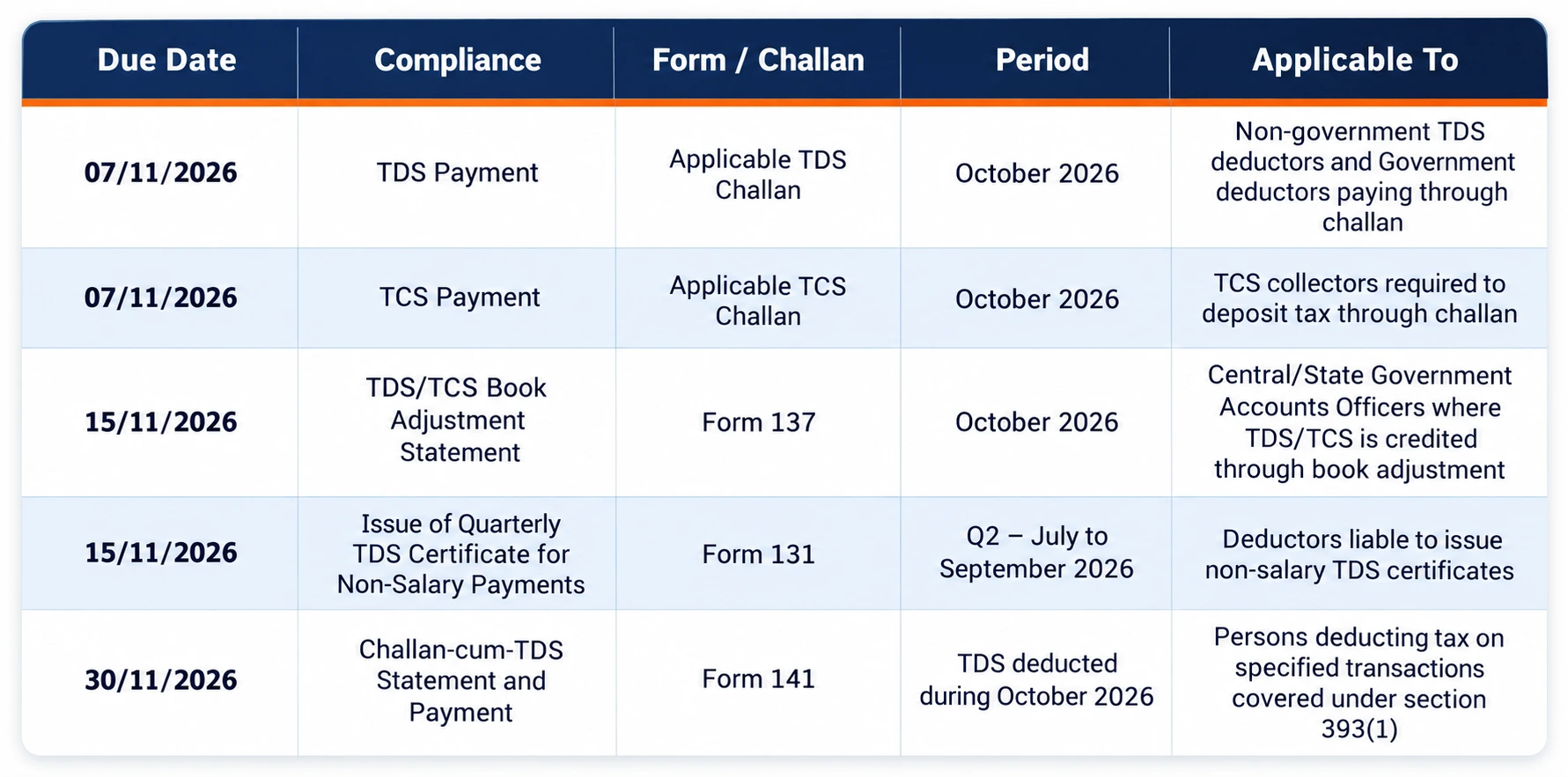
Disclaimer: Under the Income-tax Act, 2025 and Income-tax Rules, 2026, effective from 1 April 2026, several TDS/TCS forms have been renumbered or consolidated under the revised compliance framework. Form 131 replaces earlier Form 16A for TDS certificates on payments other than salary, while Form 137 replaces earlier Form 24G for TDS/TCS book adjustment statements. Further, Form 141 consolidates earlier Forms 26QB, 26QC, 26QD and 26QE for specified PAN-based TDS transactions occurring on or after 1 April 2026. Transactions and compliances relating to periods governed by the earlier Income-tax Act, 1961 may continue to use the old forms, as applicable.
Notes:
- TDS Payment: Deductors generally need to deposit TDS deducted during October 2026 by 7 November 2026. Government deductors making payment through challan also follow the prescribed challan timeline, while tax credited through book adjustment follows separate Government-accounting requirements.
- TCS Payment: Tax collected at source during October 2026 must generally be deposited by 7 November 2026 by applicable TCS collectors.
- TDS/TCS Book Adjustment Statement (Form 137): Central and State Government Accounts Officers must furnish Form 137 for TDS/TCS credited to the Central Government without production of a challan. For October 2026, the statement is due by 15 November 2026. Form 137 replaces earlier Form 24G under the new framework.
- Quarterly TDS Certificate for Non-Salary Payments (Form 131): Deductors must issue Form 131 for eligible non-salary TDS deductions relating to Q2 of FY 2026-27, covering July to September 2026, by 15 November 2026. Form 131 replaces earlier Form 16A under the Income-tax Rules, 2026.
- Challan-cum-TDS Statement and Payment (Form 141): Persons deducting tax on specified transactions covered under section 393(1) must furnish Form 141 for deductions made during October 2026 by 30 November 2026. Form 141 consolidates the earlier Forms 26QB, 26QC, 26QD and 26QE.
- Applicability of Old and New Forms: Where the relevant transaction, payment or credit occurred on or before 31 March 2026, the applicable forms under the Income-tax Act, 1961 continue to apply. For relevant transactions occurring on or after 1 April 2026, the forms prescribed under the Income-tax Act, 2025 and Income-tax Rules, 2026 apply.
Penalty, Interest and Consequences of Non-compliance
|
Compliance / Default |
Penalty, Interest or Consequence |
|
Failure to deduct/collect or deposit TDS/TCS on time |
Under section 398(3)(a) of the Income-tax Act, 2025, interest is generally 1% per month or part thereof for failure to deduct/collect tax and 1.5% per month or part thereof where tax is deducted/collected but not deposited on time. The deductor/collector may also be treated as an assessee in default, with recovery, penalty or prosecution consequences in applicable cases. |
|
Delay in Form 137 – TDS/TCS Book Adjustment Statement |
Form 137 is a statement covered by the Government book-adjustment reporting framework. Failure to furnish the prescribed statement within time may attract a penalty of ₹500 for every day of continuing default under section 465(2), subject to the applicable statutory provisions. |
|
Failure to issue Form 131 – Non-Salary TDS Certificate |
Failure to furnish the prescribed TDS certificate within the required period may attract a penalty of ₹500 for every day during which the failure continues under section 465(2) of the Income-tax Act, 2025. |
|
Delay in Form 141 filing or payment |
Form 141 is the challan-cum-statement for specified TDS transactions under section 393(1). Delay in depositing the deducted tax can attract interest under section 398. Continued default may also result in assessee-in-default, recovery, penalty or other proceedings, depending on the nature of the failure. |
|
Incorrect or delayed TDS/TCS reporting |
Incorrect or delayed prescribed TDS/TCS statements can attract statutory fee or penalty depending on the form involved. For quarterly statements under section 397(3)(b), section 461 provides for penalty ranging from ₹10,000 to ₹1,00,000, subject to the relief available where tax, fee and interest are paid and the delayed statement is furnished within the prescribed one-month relaxation period. |
Stay Ahead of November 2026 TDS and TCS Compliance with Ebizfiling
TDS and TCS compliance is not limited to depositing tax. Businesses also need to ensure the correct section, rate, PAN details, challan mapping, statement reporting and certificate issuance are handled properly. Even a small mismatch can affect tax credit, trigger correction filings or lead to interest and penalty exposure.
Ebizfiling helps businesses manage these requirements through end-to-end support for TDS and TCS payments, challan reconciliation, statement filing, correction returns, certificate compliance and transaction-level review under the Income-tax Act, 2025 and Income-tax Rules, 2026.
Our team can also assist with revised forms such as Form 131, Form 137 and Form 141, helping businesses understand which filing applies and how the new reporting framework affects their compliance process.
Make your November 2026 TDS and TCS compliance more organised with professional support from Ebizfiling.
Conclusion
The TDS and TCS Compliance Calendar November 2026 includes payment, reporting, certificate and book-adjustment requirements that apply to different categories of deductors and collectors.
Businesses should reconcile deduction and collection records, verify PAN and challan details, check the applicable form and review any correction requirements before filing. Proper preparation can help prevent credit mismatches, avoidable interest and repeated compliance follow-ups.
For a wider view of statutory deadlines during the month, explore our Compliance Calendar November 2026, covering GST, Income Tax, TDS and TCS, PF and ESI, LLP, OPC and Company compliances.
Suggested Reads:
Compliance Calendar October 2026
TDS and TCS Compliance Calendar October 2026
GST Compliance Calendar November 2026
Company Compliance Calendar November 2026
Frequently Asked Questions
1. What should a business do if TDS is deducted under the wrong section?
The deductor should review the nature of payment and the applicable TDS provision. If the wrong section has already been reported in the TDS statement, a revised or correction statement may be required so that the deduction is reflected correctly against the deductee.
2. Why is TDS credit not reflected in Form 168 even after the tax has been deposited?
TDS credit may not appear in Form 168 (Annual Information Statement) due to incorrect PAN details, challan mismatches, errors in the TDS statement, or pending return processing. The deductor should verify the reported details and file a correction statement where necessary. Form 168 applies under the Income-tax Rules, 2026.
3. Can PAN or TAN errors in a TDS challan be corrected through the regular e-Filing challan correction service?
No. The Income Tax Department states that PAN, TAN and name cannot be corrected through the regular online challan correction facility. TDS/TCS challan corrections must generally be handled through TRACES or the Assessing Officer, depending on the issue.
4. What should a deductor do if the amount in the challan does not match the amount reported in the TDS statement?
The deductor should reconcile the challan with the TDS statement and identify whether the mismatch relates to the amount, challan reference, assessment year or deductee allocation. The appropriate correction should then be made through the prescribed TDS correction process before the mismatch affects tax credit.
5. Can Form 131 (TDS Certificate) be issued manually instead of generating it through TRACES?
No. Form 131, which replaces Form 16A under the revised Income-tax framework, is generated through TRACES after processing the applicable TDS statement. The deductor must download the certificate, authenticate it using a digital signature or authorised manual signature, and issue it to the deductee within the prescribed timeline. A manually prepared certificate cannot replace the prescribed TRACES-generated certificate.
6. What should be done if Form 131 contains incorrect TDS details?
The deductor should first file the appropriate revised TDS statement, such as Form 140 or Form 144, as applicable. Once the revised statement is processed, the corrected Form 131 can be downloaded from TRACES and issued to the deductee.
7. Is TAN mandatory when a resident individual purchases immovable property from an NRI seller under Form 141 Schedule E?
No. Effective 1 October 2026, a resident individual or HUF purchasing immovable property from a non-resident seller is not required to obtain TAN solely for this transaction. The buyer can deduct and report applicable TDS using PAN-based Form 141 Schedule E under Section 393(2) of the Income-tax Act, 2025. The applicable TDS rate must be determined separately based on the relevant tax provisions.
8. When is Form 137 relevant to a Government office?
Form 137 applies where a Central or State Government office credits TDS or TCS to the Central Government through book adjustment without producing a challan. It is filed by the relevant Accounts Officer and does not apply to ordinary non-government deductors.
9. Can Ebizfiling help resolve TDS credit or challan mismatches?
Yes. Ebizfiling can assist with reviewing PAN, TAN, challan and deduction details, identifying the reason for a TDS credit mismatch and coordinating the required correction or revised statement based on the nature of the error.
10. How can Ebizfiling help businesses manage regular TDS and TCS compliance?
Ebizfiling can support businesses with TDS/TCS payment review, challan reconciliation, statement filing, correction returns, certificate-related compliance and transaction-level checks so that reporting remains consistent with the applicable TDS and TCS requirements.





Stay Ahead of TDS Filing Deadlines
Get reliable assistance with TDS Return Filing to track important due dates, report deductions correctly, and meet applicable tax compliance requirements on time.
About Ebizfiling -



October 14, 2026 By Srishti M
GST Compliance Calendar November 2026: Key Due Dates & Filings Introduction The GST Compliance Calendar November 2026 highlights the major GST return filing, tax payment, invoice reporting and year-end adjustment deadlines applicable during the month. It covers regular taxpayers, QRMP […]
October 13, 2026 By Srishti M
October 12, 2026 By Srishti M