


-
September 16, 2026
-
BySteffy A
Section 156 of the Income Tax Act, 2025: Rebate Rules and Limits
Introduction
Section 156 of the Income Tax Act, 2025 provides an income tax rebate for resident individuals who satisfy the prescribed income conditions. The provision applies from 1 April 2026 under the Income tax Act, 2025. It reduces the income tax calculated on total income. It does not reduce gross total income or taxable income. The Section 156 income tax rebate depends on the applicable tax regime and the total income of the individual. A resident individual may receive a rebate of up to ₹12,500 under Section 156(1) or a ₹60,000 income tax rebate under Section 156(2)(a). Marginal relief may also be available where the total income of an individual is slightly above ₹12 lakh.
What Is Section 156 of the Income Tax Act, 2025?
Section 156 allows an eligible resident individual to reduce the permitted rebate from the income tax calculated before allowing the rebate. Tax is first calculated according to the applicable income tax rates. The available rebate is then deducted from the calculated tax.
Therefore, the rebate under Income Tax Act 2025 is different from an income deduction or exemption. A deduction reduces taxable income, whereas a rebate directly reduces the income tax payable. Income may remain taxable even when the final tax liability becomes nil because of Section 156 of the Income Tax Act rebate.
Who Can Claim Rebate Under Section 156?
The income tax rebate for resident individuals is available when the following conditions are satisfied:
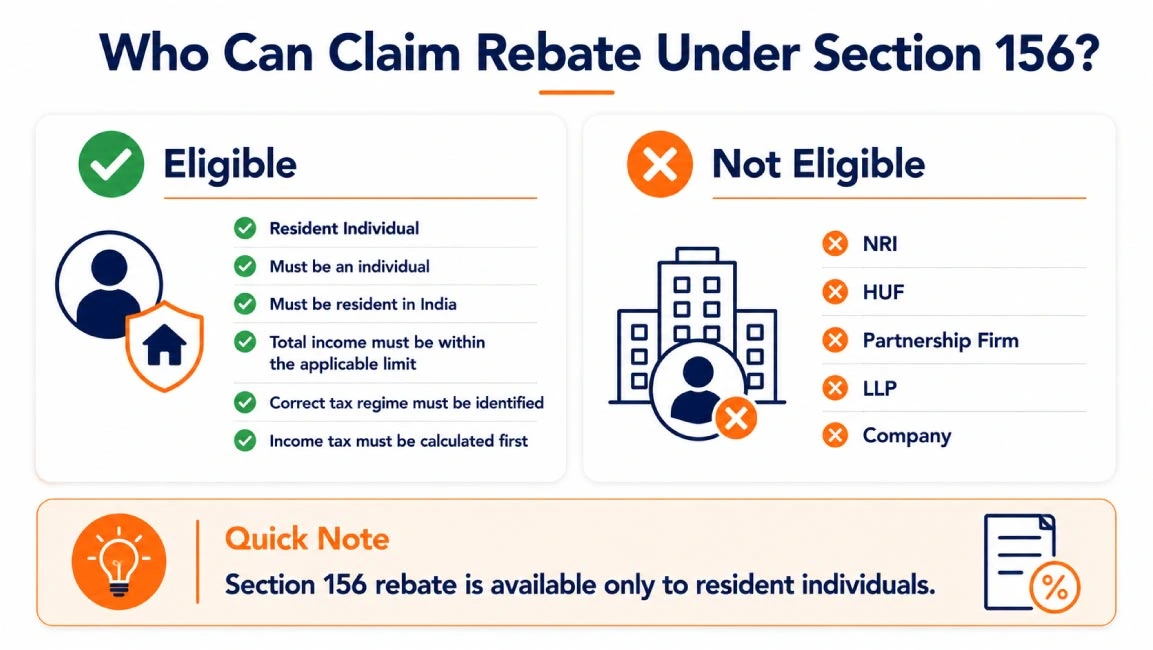
- The taxpayer must be an individual.
- The individual must be resident in India.
- Total income must be within the applicable limit.
- The applicable tax regime must be identified.
- Income tax must be calculated before claiming the rebate.
NRIs, Hindu Undivided Families, partnership firms, LLPs and companies cannot claim the rebate because Section 156 of the Income Tax Act is specifically available to resident individuals.
Section 156 Rebate Limits
The following table explains the applicable income limits and maximum rebate amounts:
|
Tax treatment |
Total income limit |
Maximum rebate |
|
Section 156(1) – Old tax regime |
Up to ₹5 lakh | ₹12,500 |
| Section 156(2)(a) – New tax regime under Section 202(1) | Up to ₹12 lakh |
₹60,000 |
|
Section 156(2)(b) – Marginal relief under the new tax regime |
Above ₹12 lakh, subject to conditions |
Marginal relief |
Under Section 156(1), the rebate is 100% of the income tax payable or ₹12,500, whichever is lower.
Under Section 156(2)(a), the rebate is 100% of the income tax payable or ₹60,000, whichever is lower.
Rebate Under Section 156(1)
Section 156(1) applies to a resident individual whose total income for the relevant tax year does not exceed ₹5 lakh.
The available rebate is the lower of:
- 100% of the income tax payable; or
- ₹12,500.
The rebate cannot be higher than the actual amount of income tax payable.
For example, suppose the income tax calculated for a resident individual is ₹10,000. The available rebate will be ₹10,000 because it is lower than the maximum rebate of ₹12,500.
The final income tax payable after allowing the rebate will be nil.
The ₹5 lakh limit is checked using total income and not gross salary, gross receipts or gross total income. Eligible deductions must first be considered to determine the taxpayer’s total income.
Rebate Under Section 156(2)(a)
Section 156(2)(a) provides the income tax rebate under new tax regime rates contained in Section 202(1).
It applies where:
- The taxpayer is a resident individual.
- Total income is chargeable under Section 202(1).
- Total income does not exceed ₹12 lakh.
The available rebate is ₹60,000 or 100% of the eligible income tax payable, whichever is lower.
Tax Calculation on ₹12 Lakh
The tax on total income of ₹12 lakh under the normal rates of Section 202(1) can be calculated as follows:
|
Income slab |
Tax rate |
Tax amount |
|
Up to ₹4 lakh |
Nil | Nil |
| ₹4 lakh to ₹8 lakh | 5% |
₹20,000 |
|
₹8 lakh to ₹12 lakh |
10% |
₹40,000 |
|
Tax payable before marginal relief |
₹60,000 |
The official tax slabs also provide a nil rate up to ₹4 lakh, 5% between ₹4 lakh and ₹8 lakh, and 10% between ₹8 lakh and ₹12 lakh.
The income tax rebate up to ₹12 lakh can reduce the calculated tax of ₹60,000 to nil, provided all the conditions of Section 156 of the Income Tax Act are satisfied.
Is Income Up to ₹12 Lakh Tax-Free?
It is not technically correct to describe ₹12 lakh as the basic exemption limit.
Under Section 202(1), income is first taxed according to the prescribed slab rates. The Section 156 of the Income Tax Act rebate is then reduced from the calculated tax.
For example, the income tax calculated on total income of ₹12 lakh is ₹60,000. The ₹60,000 income tax rebate may reduce the final tax liability to nil.
Therefore, an eligible resident individual may have no final income tax payable on total income of up to ₹12 lakh. However, the income itself is not exempt from tax.
The nil tax liability arises because of the rebate and not because ₹12 lakh is the basic exemption limit.
Marginal Relief Under Section 156(2)(b)
A resident individual is not eligible for the flat rebate under Section 156(2)(a) when total income exceeds ₹12 lakh. However, marginal relief may be available under Section 156(2)(b).
Marginal relief is available where:
- Total income exceeds ₹12 lakh; and
- Income tax payable exceeds the amount by which total income exceeds ₹12 lakh.
The marginal relief formula is:
Marginal relief = Income tax payable before marginal relief − Income exceeding ₹12 lakh
Example of Marginal Relief
Suppose the total income of a resident individual is ₹12,10,000.
The income exceeding ₹12 lakh is:
₹12,10,000 − ₹12,00,000 = ₹10,000
The income tax under Section 202(1) will be:
- Tax up to ₹12 lakh: ₹60,000
- Tax on the next ₹10,000 at 15%: ₹1,500
- Total tax before relief: ₹61,500
The marginal relief will be:
₹61,500 − ₹10,000 = ₹51,500
The tax payable after marginal relief will therefore be:
₹61,500 − ₹51,500 = ₹10,000
Applicable cess will be calculated on the remaining tax of ₹10,000.
Marginal relief ensures that the additional tax payable does not exceed the additional income earned above ₹12 lakh.
Does Section 156 Apply to Special-Rate Income?
Certain types of income may be taxed separately at special rates instead of the normal rates provided under Section 202(1).
Examples may include:
- Certain short-term and long-term capital gains
- Lottery winnings
- Online gaming income
- Income from virtual digital assets
Under Section 156(3), the rebate available under Section 156(2) cannot exceed the tax payable at the normal slab rates under Section 202(1). Therefore, tax calculated separately under a special-rate provision is not covered by the rebate to that extent. Normal-rate income and special-rate income should be calculated separately before claiming the rebate.
Section 156 Rebate and ITR Filing Support
Ebizfiling assists resident individuals in calculating their taxable income and claiming the correct rebate under Section 156 of the Income Tax Act, 2025.
Our income tax experts can help with:
- Identifying the applicable tax regime under Section 202(1)
- Calculating the rebate of up to ₹12,500 or ₹60,000
- Checking eligibility for marginal relief above ₹12 lakh
- Reviewing normal-rate and special-rate income
- Preparing and filing the income tax return online
Proper tax calculation can help avoid incorrect rebate claims, tax mismatches, and unnecessary notices.
File your income tax return with Ebizfiling and get professional assistance with tax calculation, rebate eligibility and online ITR filing.
Conclusion
Section 156 of the Income Tax Act provides tax relief to eligible resident individuals after income tax has been calculated. A rebate of up to ₹12,500 is available where total income does not exceed ₹5 lakh. For income chargeable under Section 202(1), a rebate of up to ₹60,000 is available where total income does not exceed ₹12 lakh. Marginal relief protects individuals whose income slightly exceeds ₹12 lakh from a sudden increase in tax liability. Before claiming the rebate, taxpayers should check their residential status, total income, applicable tax regime, and whether any part of their income is taxable at special rates.
Suggested Reads:
Section 87A Capital Gains in 2026
Frequently Asked Questions
1. Can a resident individual claim both the ₹12,500 and ₹60,000 rebates under Section 156?
The rebate applicable to the individual’s tax regime must be applied. No double tax benefit is available, and the rebate cannot exceed the eligible income tax payable. The applicable rebate under Section 156 of the Income Tax Act depends on the tax regime and the individual’s total income.
2. Is the Section 156 income tax rebate available to an NRI who earns income in India?
No. The Section 156 of the Income Tax Act rebate is available only to an individual who qualifies as a resident in India for the relevant tax year. An NRI treated as a non-resident for income tax purposes cannot claim this rebate.
3. Is the ₹60,000 income tax rebate available if total income is exactly ₹12 lakh?
Yes. A resident individual whose total income is chargeable under Section 202(1) and does not exceed ₹12 lakh may claim 100% of the eligible tax payable or a ₹60,000 income tax rebate, whichever is lower.
4. Can a salaried individual with income above ₹12 lakh still have nil tax liability?
A salaried individual may have nil tax liability if eligible deductions, including the standard deduction where applicable, bring the total income within the ₹12 lakh limit. The income tax rebate up to ₹12 lakh is checked using total income and not gross salary.
5. How is marginal relief calculated when income exceeds ₹12 lakh?
Marginal relief is available where the tax payable exceeds the amount by which total income is more than ₹12 lakh. The relief equals the difference between the tax payable before marginal relief and the amount by which total income exceeds ₹12 lakh.
6. Can the rebate under Income Tax Act 2025 be claimed against tax on lottery or gaming income?
The rebate under Income Tax Act 2025 may not fully reduce tax payable on income charged at special rates. Under Section 156(3), the rebate under Section 156(2) is restricted to tax payable according to the normal rates provided under Section 202(1).
7. Can capital gains affect eligibility for the Section 156 of the Income Tax Act rebate?
Yes. Capital gains form part of total income and may affect whether the individual remains within the applicable income limit. Where capital gains are taxed at special rates, the rebate treatment must be examined separately under the relevant tax provision.
8. Is the Section 156 rebate deducted before or after health and education cess?
The eligible rebate is first reduced from the income tax calculated. Health and education cess is then applied to the tax remaining after the rebate. If the tax becomes nil after the rebate, no cess is payable.
9. How can Ebizfiling help determine who can claim rebate under Section 156 of the Income Tax Act?
Ebizfiling can review the taxpayer’s residential status, total income, tax regime and nature of income to determine who can claim rebate under Section 156 of the Income Tax Act. Its tax experts can also calculate the applicable rebate and marginal relief before filing the income tax return.
10. Can Ebizfiling assist when a Section 156 of the Income Tax Act rebate causes an ITR mismatch?
Yes. Ebizfiling can assist with reviewing the tax computation, correcting the rebate claim and filing an appropriate response where a mismatch or tax adjustment appears in the return. It also provides professional support for online ITR filing and income tax notice responses.




File Your Income Tax Return With Confidence
Get expert assistance with accurate and timely Income Tax Return filing and stay compliant with tax laws.
About Ebizfiling -



October 12, 2026 By Srishti M
Company Compliance Calendar November 2026: Key Due Dates & Filings Introduction The Company Compliance Calendar November 2026 highlights important annual return, dematerialisation and income tax compliances that companies may need to complete during the month. November 2026 is particularly […]
October 10, 2026 By Srishti M
October 10, 2026 By Srishti M
Compliance Calendar November 2026: Key Statutory Due Dates Introduction The compliance calendar November 2026 covers important statutory obligations under GST, Income Tax, TDS/TCS, Company Law, LLP regulations, EPF and ESI. It helps businesses identify the filings, payments and regulatory requirements […]