
Section 186 of the Income Tax Act, 2025: Cash Receipt Limit
Introduction
Section 186 of the Income Tax Act, 2025 restricts a person from receiving ₹2 lakh or more through cash or any other non-permitted mode. The restriction applies based on the total amount received from one person in a day, a single transaction, or transactions connected with one event or occasion.
Therefore, individuals and businesses must examine the complete nature of a payment instead of checking only the value of each cash instalment. The section allows high-value receipts through specified banking and prescribed electronic modes.
What is Section 186 of the Income Tax Act, 2025?
Section 186 of the Income Tax Act, 2025 deals with the mode through which certain high-value transactions must be undertaken.
Under this provision, no person may receive an amount of ₹2 lakh or more except through a permitted payment mode. The restriction applies in any of the following situations:
- The aggregate amount received from one person in one day is ₹2 lakh or more.
- The amount received for a single transaction is ₹2 lakh or more.
- The amount received for transactions connected with one event or occasion from one person is ₹2 lakh or more.
The rule applies to the recipient of the payment. Therefore, businesses, professionals, and other persons accepting payments must ensure that their payment collection processes comply with the prescribed limit.
Difference Between Section 269ST and Section 186
Section 186 of the Income tax Act, 2025 is the corresponding provision to Section 269ST of the Income tax Act, 1961. It applies to relevant receipts made on or after 1 April 2026.
|
Point of Comparison |
Section 269ST of the Income tax Act, 1961 |
Section 186 of the Income Tax Act, 2025 |
|
Section Number |
Section 269ST |
Section 186 |
|
Provision Title |
Mode of undertaking transactions |
Mode of undertaking transactions |
|
Applicable Law |
Income-tax Act, 1961 |
Income Tax Act, 2025 |
|
Applicable Period |
Applied under the old law up to 31 March 2026 |
Applicable under the new law from 1 April 2026 |
|
Receipt Limit |
Restricted receipt of ₹2 lakh or more through cash or another non-permitted mode |
Continues to restrict receipt of ₹2 lakh or more through cash or another non-permitted mode |
|
One-Person Daily Limit |
Total receipts from one person in one day were considered together |
The same daily aggregation rule continues |
|
Single Transaction Limit |
Receipts relating to one transaction were aggregated, even when received in instalments |
The same single-transaction rule continues |
|
Event or Occasion Limit |
Payments relating to one event or occasion from one person were considered together |
The same event or occasion test continues |
|
Permitted Payment Modes |
Account payee cheque, account payee bank draft, electronic clearing system and prescribed electronic modes |
Account payee cheque, account payee bank draft, electronic clearing system through a bank account and other electronic modes prescribed under Rule 48 of the Income tax Rules, 2026. |
|
Government and Bank Exemption |
Receipts by the Government, banking companies, post office savings banks and co-operative banks were exempt |
The same exemptions continue |
|
Related Loan or Deposit Provision |
Transactions covered under Section 269SS were excluded |
Transactions covered under Section 185 are excluded |
|
Other Exemptions |
Central Government could notify exempt persons, classes of persons or receipts |
The Central Government retains the same notification power |
|
Penalty Provision |
Penalty was governed by Section 271DA |
Penalty is governed by Section 451 |
|
Penalty Amount |
Penalty could equal the amount received in violation |
The Assessing Officer may impose a penalty equal to the amount received in violation |
|
Reasonable Cause Relief |
Relief was available where the recipient proved good and sufficient reasons |
Section 470 provides relief where the recipient proves that there was a reasonable cause |
|
Major Practical Change |
Original restriction under the 1961 Act |
The core ₹2 lakh restriction remains unchanged. However, Rule 48 of the Income tax Rules, 2026 expressly includes specified CBDC wallet and cross-border CBDC payment modes. |
Under Section 451, the penalty for violating Section 186 of the Income Tax Act, 2025 may equal the amount received in contravention. However, Section 470 provides that the penalty should not be imposed where the person proves that there was a reasonable cause for the failure.
In simple terms, Section 186 of the Income Tax Act continues the core framework of the earlier Section 269ST. The ₹2 lakh threshold and the three tests relating to a person in a day, a single transaction and one event or occasion remain unchanged. However, Rule 48 of the Income tax Rules, 2026 now includes specified CBDC wallet modes among the prescribed electronic payment modes.
Businesses should also understand how the latest Income Tax changes affect high-value receipts, digital payments and related reporting obligations.
Cash Receipt Limit Under Section 186
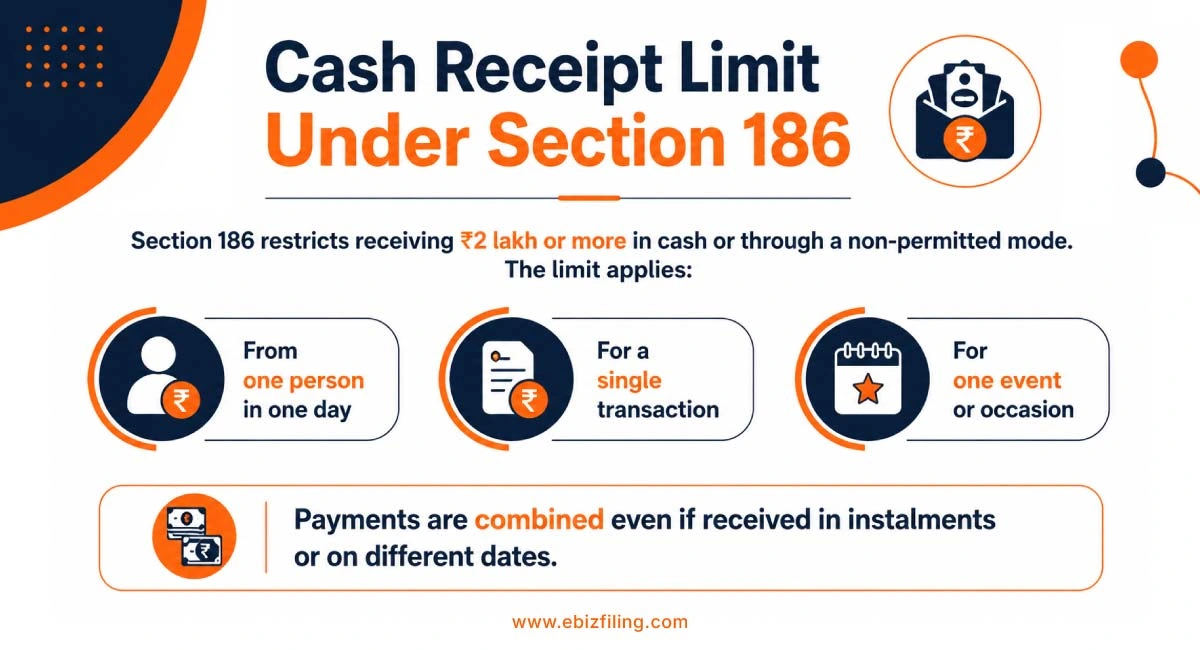
The threshold under Section 186 of the Income Tax Act, 2025 is ₹2 lakh or more. Accordingly, a person cannot receive exactly ₹2 lakh through cash or another non-permitted mode unless an exemption applies. Any amount covered by one of the three tests must be received through a permitted banking or electronic mode.
The three limits under the section operate independently. A transaction can violate the provision even when it does not cross the daily limit but crosses the single transaction or event-based limit.
₹2 Lakh or More From One Person in a Day
The first restriction applies when the total amount received from one person during a single day reaches ₹2 lakh or more.
The receipts must be added together even when they relate to separate invoices or payments.
Example:
A business receives ₹1,20,000 in cash from a customer in the morning and another ₹90,000 from the same customer in the evening. The aggregate receipt is ₹2,10,000. Therefore, receiving the aggregate amount of ₹2.10 lakh in cash would violate Section 186 of the Income Tax Act, 2025.
₹2 Lakh or More for a Single Transaction
The second restriction applies to the total amount connected with one transaction. Dividing the payment into smaller instalments or receiving it on separate days does not avoid the restriction when all the payments relate to the same transaction.
Example:
A customer purchases machinery worth ₹3 lakh. The customer pays ₹1,50,000 in cash on one day and the remaining ₹1,50,000 on another day. Since both payments relate to one transaction, receiving the total amount in cash would violate the section.
₹2 Lakh or More for One Event or Occasion
The third restriction covers payments connected with one event or occasion. It prevents a person from dividing one event-related payment into several smaller transactions.
Example:
An event organiser provides services worth ₹4 lakh for a wedding. The same customer pays four cash instalments of ₹1 lakh on different dates. Since all payments relate to one event or occasion, the total amount must be considered together.
Permitted Payment Modes Under Section 186
A person may receive ₹2 lakh or more through the following permitted modes:
- Account Payee Cheque: Payment must be credited directly to the recipient’s bank account.
- Account Payee Bank Draft: The draft must be payable only to the named recipient.
- Electronic Clearing System: Payment may be received electronically through a bank account.
Other Prescribed Electronic Modes: Rule 48 of the Income tax Rules, 2026 permits payments through credit cards, debit cards, net banking, IMPS, UPI, RTGS, NEFT, BHIM Aadhaar Pay, Tier-III Full-KYC CBDC wallets, P-CBDC and wholesale or cross-border CBDC modes.
Using traceable banking modes can help businesses maintain accurate records while preparing a business income tax return.
Exemptions Under Section 186 of the Income Tax Act, 2025
The ₹2 lakh receipt restriction does not apply to:
- Government Receipts: Any receipt by the Government.
- Banking Companies: Receipts accepted by banking companies.
- Post Office Savings Banks: Amounts received by post office savings banks.
- Co-operative Banks: Receipts accepted by co-operative banks.
- Section 185 Transactions: Transactions of the nature referred to in Section 185.
Notified Persons or Receipts: Persons, classes of persons, or types of receipts notified by the Central Government.
Penalty for Violation of Section 186
Section 451 provides the penalty for receiving an amount in violation of Section 186 of the Income Tax Act. The Assessing Officer may impose a penalty equal to the amount received in contravention.
For example, if a person receives ₹3 lakh in violation of Section 186 of the Income Tax Act, the penalty may also be ₹3 lakh. Thus, the penalty can equal 100% of the amount received in contravention.
However, Section 470 provides relief from the penalty where the recipient proves that there was a reasonable cause for the failure. Whether reasonable cause exists will depend on the facts, supporting documents and circumstances of the case.
Tax Consultancy for Section 186 Compliance
Ebizfiling helps individuals and businesses understand and comply with Section 186 of the Income Tax Act, 2025.
Our tax professionals can assist with:
- Reviewing high-value cash receipts and transactions
- Checking whether Section 186 applies to a transaction
- Explaining permitted banking and electronic payment modes
- Identifying possible non-compliance and penalty risks
With professional tax consultancy support, businesses can manage high-value receipts correctly and reduce the risk of non-compliance.
Conclusion
Section 186 of the Income tax Act, 2025 restricts the receipt of ₹2 lakh or more through cash or another non-permitted mode. The limit must be checked separately under the daily, single-transaction, and event-or-occasion tests. Businesses should avoid splitting payments artificially, encourage customers to use permitted payment modes, and maintain clear transaction records. Proper controls are important because the penalty may equal the amount received in contravention.
Frequently Asked Questions
1. Can a seller accept ₹1.25 lakh and ₹90,000 in cash from the same customer on the same day?
No. The total cash received from the customer during the day would be ₹2.15 lakh. Therefore, the receipt would breach the cash transaction limit under Section 186 of the Income Tax Act, even if the amounts relate to separate invoices.
2. Can a customer pay ₹3 lakh in cash instalments on different dates?
No, where all instalments relate to the same transaction. Under Section 186 of the Income Tax Act, 2025, dividing one payment across different dates does not avoid the restriction applicable to a single transaction.
3. Are separate cash payments for catering, decoration and venue treated individually?
Not always. If the same service provider receives separate cash payments from the same customer for catering, decoration and venue services connected with one wedding or event, the payments must be aggregated. However, payments made to different independent vendors are checked separately for each recipient, subject to the daily and single-transaction limits under Section 186.
4. Can exactly ₹2 lakh be accepted in cash?
No. The restriction covers an amount of ₹2 lakh or more. Therefore, accepting exactly ₹2 lakh in cash is also prohibited unless the receipt falls within a specific exemption.
5. Does Section 186 apply when two different customers each pay ₹1.5 lakh in cash?
The daily person-wise limit is checked separately for each customer. However, the business must aggregate all cash or other non-permitted receipts connected with the same customer, single transaction, event, or occasion. If the non-permitted receipts from either customer reach ₹2 lakh under any applicable test, Section 186 of the Income Tax Act may be violated.
6. Is a bearer cheque valid for receiving ₹2 lakh or more?
No. A bearer cheque is not a permitted mode under Section 186 of the Income Tax Act. An amount covered by the provision should be received through an account payee cheque, an account payee bank draft, an electronic clearing system through a bank account or another prescribed electronic mode.
7. Can a business accept ₹1.80 lakh in cash and the remaining amount through UPI?
Yes. A business may receive ₹1.8 lakh in cash and the remaining amount through UPI, provided the total amount received through cash or another non-permitted mode remains below ₹2 lakh under each applicable test. All receipts connected with the same person, transaction, event, or occasion should be examined and properly documented.
8. Who faces the penalty when a prohibited cash payment is accepted?
The restriction primarily applies to the person receiving the amount. Therefore, the recipient may face a penalty under Section 451 equal to the amount received in violation, subject to reasonable-cause relief under Section 470.
9. How should a business track receipts from one customer across different invoices?
The business should maintain customer-wise ledgers, link instalments with original invoices and identify receipts connected with the same transaction or event. Ebizfiling can review such transaction records and help determine whether any of the limits under Section 186 of the Income Tax Act have been breached.
10. What should a business do after receiving a notice for a high-value cash transaction?
The business should examine invoices, bank records, customer ledgers, payment dates, and the reason for accepting cash. Ebizfiling can assist with reviewing the transaction, assessing reasonable-cause grounds and preparing an appropriate reply to the Income Tax notice.

File Your ITR with Confidence
Stay compliant with income tax laws through accurate Income Tax Return filing by experienced experts.
About Ebizfiling -



September 16, 2026 By Riyansh S
Section 87A Capital Gains in 2026: The Rs. 12 Lakh Trap Explained Introduction “No tax up to Rs. 12 lakh” is useful shorthand for the new tax regime, but it is not a blanket exemption. For AY 2026-27, an eligible […]
September 16, 2026 By Srishti M
Residential Status of LLP Designated Partner: LLP Act vs Tax Residency Introduction The Residential Status of LLP Designated Partner matters when a designated partner spends substantial time outside India. The LLP Act residency requirement and an individual’s income-tax residential status […]
September 16, 2026 By Srishti M
Wheat Export Policy 2026: DGFT Makes Specified Wheat and Wheat Flour Exports Free Introduction The wheat export policy 2026 has changed significantly after the Central Government revised the export status of specified wheat and wheat-flour products from “Prohibited” to “Free.” […]