

Internal and External Reasons for Company Strike-Off
What You Should Know
Transparency, in our opinion , is essential to business success. But sometimes work trips come to an end. The Reasons for Company Strike-Off by which the Registrar of Companies (RoC) removes a company’s name from the official register is referred to as “Strike-Off” under Section 248 of the Companies Act, 2013. Understand the exact reasons for Company Strike-Off is the first step with Ebizfiling to protect your professional image and avoiding severe legal consequences, despite whether this occurs voluntarily or as a penalty.
Types of Company Strike-Off under Section 248
There are two types of Reasons for Company Strike-Off under Section 248 of the Companies Act of 2013:
1. Voluntary Strike-Off
When a business wishes to stop its operations lawfully, it undertakes a voluntary strike-off. This often occurs when the firm has ceased operations, is no longer operational, or the promoters are unwilling of carry on.
You can also visit the page on how Voluntary Strike-off is different from Involuntary strike-off? to know more information.
2. Compulsory Strike-Off
When a corporation doesn’t comply with the law, the Registrar of Companies conducts a Compulsory strike-off. This might occur if the business has not opened for operation, has stayed dormant, has not filed taxes, or has ignored RoC notifications.
Reasons For Company Strike-Off
If specific conditions are satisfied, the Registrar of Companies filing has the legislative authority to remove a company’s name from the Register of Companies under Section 248 of the Companies Act of 2013. Regulatory interference, laziness, or continuous non-compliance are the usual Reasons for Company Strike-Off. In general, the explanations may be separated into internal and external components.
Internal Reasons for Company Strike-Off
Internal Reasons for Company Strike-Off arise from the company’s management, operations, and governance structures.
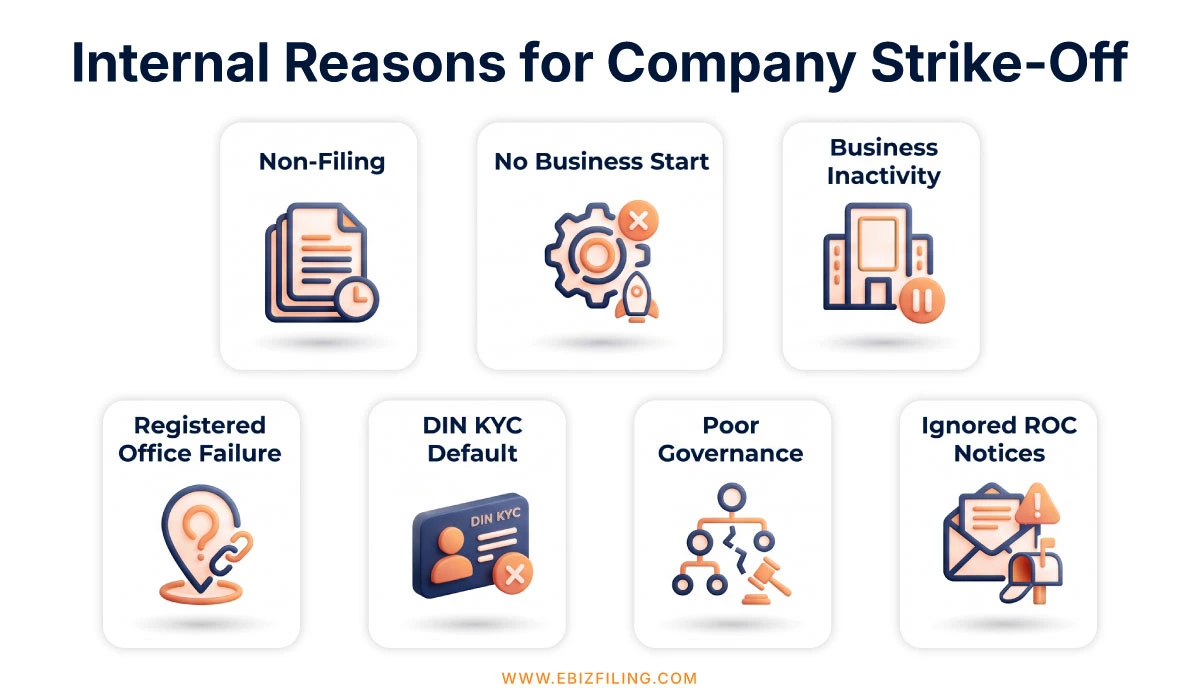
Common internal reasons for company strike-off such as non-filing, inactivity, and compliance issues.
1. Continuous non-filing of annual returns and financial statements
One of the most typical reasons for strike-off is a failure to file yearly returns (MGT-7) and financial statements (AOC-4) for two consecutive fiscal years. Filing these paperwork is required regardless of profit or turnover. Persistent non-filing results in a statutory default, causing the ROC to assume that the firm is not active.
2. Failure to Begin Business
If a company does not begin operations within one year of establishment, the ROC may initiate removal actions. This clause forbids shell companies from being on the books without engaging in legitimate commercial activity.Proper planning during company registration services in India helps avoid such situations.
3. Prolonged Business Inactivity
A company may be deemed inactive if it has no meaningful revenue, accounting transactions, or operational activity for two consecutive fiscal years. In certain situations, the ROC may proceed with revival of strike-off if dormant status is not sought.
4. Failure to maintain the registered office
A functional registered office that is able to receive official correspondence is a requirement for any corporation. The office is deemed non-operational if ROC notifications are returned undeliverable or if physical verification shows that the office does not exist.
5. Director DIN and KYC non-compliance
Directors must fulfil annual DIN KYC compliance. If DINs are deactivated owing to non-compliance, the company is unable to file statutory forms. This leads to accumulating defaults, increasing the likelihood of strike-off.
6. Poor corporate governance procedures
Failing to convene board meetings, keep statutory registers, document minutes, or fulfill disclosure requirements are all signs of poor governance. Internal compliance flaws significantly raise regulatory risk even if they might not Reasons for Company Strike-Off immediately.
7. Ignoring deadlines and statutory notices
Negligence is defined as repeatedly failing to respond to defect reports, show-cause notifications, or compliance reminders. The absence of a response supports the ROC’s conclusion that the business is no longer in operation.
External Reasons for Company Strike-Off
Reasons for Company Strike-Off motivations include governmental scrutiny, data integration systems, and third-party acts.
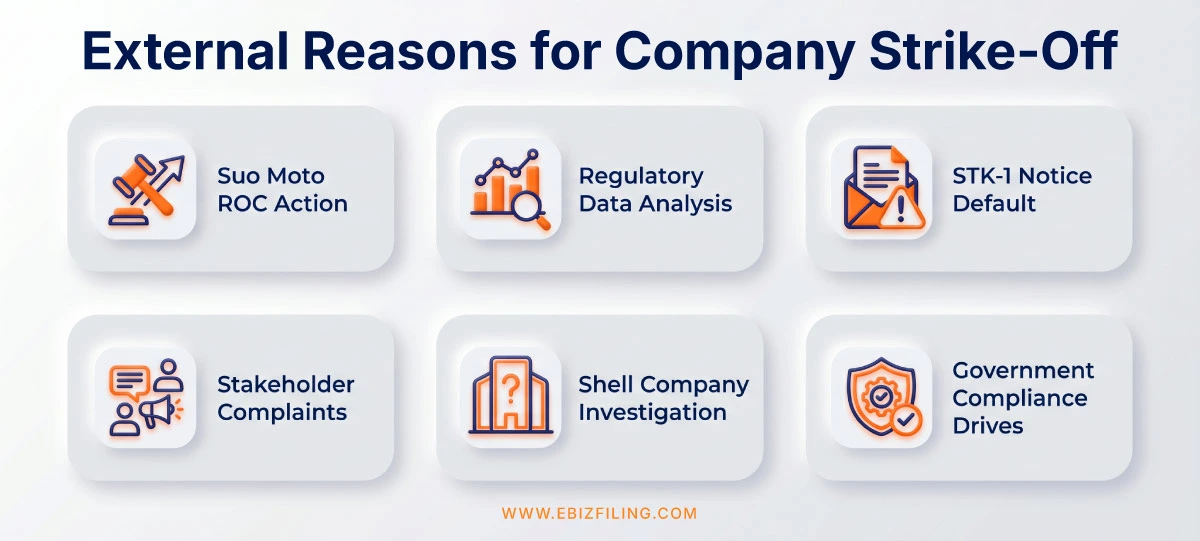
Key external reasons for company strike-off initiated by ROC or regulatory authorities
1. Suo moto Action by ROC
The ROC may commence strike-off procedures on its own initiative after detecting prolonged non-compliance via internal monitoring systems.
2. Regulatory Data Analysis and Integration
Modern regulatory frameworks include data from the MCA, GST authority, and income tax departments. If irregularities or lengthy inactivity are discovered across platforms, it may result in an investigation and removal.
3. Failure to Respond to the ROC Notice (STK-1)
Before striking off, the ROC notifies the firm and its directors. If the company fails to answer within the timeframe specified, the ROC may issue a public notice and proceed with removal.
4. Complaints from creditors or stakeholders
Stakeholders, including creditors and owners, may notify authorities if a corporation is inactive or suspected of wrongdoing. Such allegations may provoke a regulatory review.
5. Investigation of Shell Companies
When authorities suspect that a corporation is being used for illegal purposes, such as money laundering or accommodation entries, strike-off may be launched as part of an enforcement action.
6. Government Compliance Drives
Periodically, authorities conduct large-scale compliance efforts to clean up the corporate registration by deleting inactive or non-compliant organizations. Companies with looming defaults are especially vulnerable to such measures. maintain GST Returns through proper filing.
Ways to prevent company Strike-off with Ebizfiling
A private limited firm received a strike-off notice from the ROC after failing to file ROC annual reports for two years. The directors asked Ebizfiling for assistance.
Our CS team created required documents, submitted the pending AOC-4 and MGT-7/MGT-7A forms, examined the company’s MCA status, verified pending forms, and assisted in responding to the ROC notification.
The corporation prevented strike-off and regularized its compliance with prompt action.
CS Khusbu Suthar from Ebizfiling suggest: “Don’t wait for a notice of ROC strike-off. Regularize any outstanding yearly filings for your firm as soon as you can. The simplest approach to maintain your business’s activity and compliance is to file AOC-4, MGT-7/MGT-7A, and Director KYC on time.”
Our services
Our services such as Director KYC, Close a Company, and compliance review are all helped by ebizfiling.
Conclusion
A preventive approach to compliance is necessary to deal with the different Reasons for Company Strike-Off. Ebizfiling is your reliable partner whether you need to protect your business from a mandatory notice or are seeking a peaceful departure through a voluntary strike-off. Maintain your business brand while remaining responsible and compliant.
FAQs on Reasons for Company Strike-Off
1. What is the reason on the ROC strikes off a company in India?
The ROC can dissolve a company on reasons for Company Strike-Off when it does not commence business within a year of incorporation, inactive and has not filed annual returns, or on ignoring ROC notices. The ROC may strike off such companies as provided in Section 248 of the Companies Act, 2013. Ebizfiling assists companies to validate their MCA position, detect any pending ROC filing and act promptly before the strike-off procedure goes through the ultimate phase.
2. Does the failure to file AOC-4 and MGT-7 result in strike-off of a company?
Yes, one of the most frequent reasons for Company Strike-Off is the constant non-filing AOC-4 and MGT-7 or MGT-7A form filing. Annual filing is compulsory even when there is no turnover or business activity in the company. Ebizfiling helps in the pending annual fillings, filing of financial statements, annual filing of returns and regularization of compliance to ensure that the company avoids the action of the ROC.
3. What do you think to done after a company has given a strike-off notice by ROC?
Once a company is notified of a strike-off, it should not disregard the notice. The directors should examine the purpose of the notice, examine pending compliances, prepare a correct response and file overdue forms when necessary. Ebizfiling assists in preparation of ROC notice replies, submitting pending returns, reviewing MCA records, and advising the company on the further legal action to take to avoid being removed.
4. Does an inactive company have an option to avoid compulsory strike-off?
Yes, a dormant company may escape a compulsory strike-off by regularising its outstanding filings or seeking dormant company status where it is eligible. Unless the company makes any move, the ROC can consider the company as dormant. Ebizfiling assists business owners to make decisions on whether to still operate the business, seek to have the company placed under dormant, or still file the pending ROC registration or to voluntarily strike-off.
5. Is voluntary strike-off preferable to ROC strike-off in OPC?
Voluntary Reasons for Company Strike-Off in OPC is more often appropriate in case the company does not have any business, has no debts, and the promoters wish to close the business legally. The delay in ROC action can lead to compliance default, director problems, and legal entanglements. Ebizfiling offers voluntary Reasons for Company Strike-Off documentation support, board resolutions, statement of accounts, form filing, and ROC follow-up.
6. Will directors have issues in case of strike off of their company?
Yes, the directors can have Reasons for Company Strike-Off because of non-compliance over long term. There may be DIN issues, disqualification of directors, fines or a challenge in commencing future businesses in certain instances. Ebizfiling assists directors to check their DIN KYC status, their pending filings and their records of compliance so that personal and professional risks can be minimized.
7. What is STK-1 notice in company strike-off?
STK-1 is a notice that the ROC sends prior to strike-off proceedings. It provides the company and directors with a chance to react and justify why the company is not to be evicted. Ebizfiling assists companies to draft an appropriate response to STK-1 notices, upload the necessary documentation and finalize outstanding ROC filings where necessary.
8. Is it possible to revive a company that has been struck off by ROC?
No, it is not true that a revival of struck-off company can be brought back by submitting an application to the National Company Law Tribunal but within legal terms and time. The restoration is typically required when the company possesses assets, liabilities, and ongoing business, or has legal issues. Ebizfiling may lead the companies through checking compliance, awaiting filing and professional support in restoration related documentation.
9. What does Ebizfiling do to avert strike-off of companies?
Ebizfiling is used to prevent the company being struck off by ensuring the MCA status of the company, overdue filings, filling pending AOC-4 and MGT-7/MGT-7A and assisting in the Director KYC, the ROC notice replies, and overall company compliance. This assists business to be active, comply with the laws, and avoid unwarranted ROC action.
10. How can a company in India, which is a private limited company, be closed?
Closing a private limited company voluntarily is the safest way to close a company, rather than letting it become dormant. The company must also pay off debts, draw up necessary papers, make the relevant resolutions and submit the relevant forms to the ROC. Ebizfiling can help in end-to-end company closure support, such as documentation, professional review, and form filling, and compliance guidance to prevent Reasons for Company Strike-Off.





Avoid Company Strike-Off Before It’s Too Late
Identify the reasons for company strike-off early and stay compliant with expert ROC filing support.
About Ebizfiling -



May 5, 2026 By Steffy A
MSME Tax Planning Strategies After Budget 2026 India The Need for MSME Tax Planning After Budget 2026, many MSME owners believe that handling taxes now involves more than just submitting returns. Understanding how to make the most of the benefits […]
May 5, 2026 By Prachi C
Section 80C of Income Tax Old vs New Law Changes 2026 The Section 80C of Income Tax Act plays an important role in tax planning in India. It’s importance has changed after the introduction of the new tax regime under […]
May 4, 2026 By Steffy A
Meal Voucher Tax Exemption up to ₹1.05L for salaried People Understand crucial changes in the meal voucher tax exemption One of the most crucial changes in the Income-tax Act 2025 in India is the meal voucher tax exemption. This alteration […]