


-
June 1, 2026
-
BySteffy A
TDS Return Due Dates 2026 Under Income Tax Act, 2025
Introduction
TDS return due dates are easy to miss when a business is already busy handling salaries, vendor payments, GST work, accounts, and everyday operations. Most businesses don’t intentionally delay filings. Usually, the problem starts when deadlines are forgotten, challan details don’t match properly, or return filing gets postponed until the last few days. That’s when notices, late fees, and correction work start creating extra pressure.
With the updated Income Tax rules 2026 and the new compliance structure under the Income Tax Act 2025, businesses also need to stay updated with revised TDS Forms and filing timelines. Missing TDS return due dates can lead to penalties, interest, and unnecessary back-and-forth later while fixing mismatches or notices.
Whether you are an employer, company, firm, or professional deducting tax at source, keeping track of TDS return due dates helps avoid last-minute stress and makes TDS compliance much easier to manage throughout the year.
In this blog, Ebizfiling will help you understand TDS return due dates for FY 2026-27, quarter-wise filing deadlines, new TDS forms under the Income Tax Act, 2025, common filing mistakes, penalties for non-compliance, and practical ways businesses can manage TDS return filing more smoothly.
What is TDS Return and Why is it Necessary?
A TDS return is a quarterly statement filed with the Income Tax Department that shows how much tax was deducted at source and deposited by the deductor during a particular quarter. It includes details of payments such as salary, contractor payments, professional fees, rent, commission, interest, and other transactions where TDS is applicable.
In simple terms, whenever a business, employer, company, or professional deducts tax before making payment to someone, those deduction details must be reported to the department through a TDS return. This is why understanding TDS return due dates becomes important for every deductor handling regular payments and tax deductions.
The responsibility of the deductor does not end with just deducting tax. They are also required to:
- Deposit the deducted TDS with the government within the prescribed timeline
- File quarterly TDS returns correctly
- Issue TDS certificates to employees, vendors, or deductees
- Maintain proper challan and deduction records
To file TDS returns, deductors must also have a valid TAN (Tax Deduction and Collection Account Number). Without TAN, TDS compliance and return filing cannot be completed properly.
Since TDS return due dates also involves timely deductions, return filing, and proper reporting, many businesses prefer taking guidance from experienced tax consultancy service like Ebizfiling to avoid errors and manage compliance more efficiently.
Many businesses usually focus only on tax deduction and forget about return filing timelines. However, missing TDS return due dates or filing incorrect details can lead to notices, penalties, challan mismatches, and correction filings later. Proper and timely filing helps ensure that deductees receive correct tax credit in their records and businesses avoid unnecessary compliance issues.
Keeping track of TDS return due dates also makes overall TDS compliance smoother and reduces last-minute filing pressure during every quarter.
TDS Return Due Dates 2026: Quarter-Wise Deadlines
Unlike TDS payment, which is done monthly, a TDS return is filed every quarter. Each quarter has a fixed deadline, and missing it can lead to penalties. The quarterly filing deadlines under the Income Tax Act, 2025 are as follows:
|
Quarter |
Period |
TDS Forms |
Due Date |
|
Q4 FY 2025-26 |
Jan 2026 – Mar 2026 | Form 138 / 140 / 144 |
31st May 2026 |
|
Q1 FY 2026-27 |
Apr 2026 – Jun 2026 | Form 138 / 140 / 144 |
31st July 2026 |
|
Q2 FY 2026-27 |
Jul 2026 – Sep 2026 | Form 138 / 140 / 144 |
31st October 2026 |
|
Q3 FY 2026-27 |
Oct 2026 – Dec 2026 | Form 138 / 140 / 144 |
31st January 2027 |
|
Q4 FY 2026-27 |
Jan 2027 – Mar 2027 | Form 138 / 140 / 144 |
31st May 2027 |
Disclaimer:
The above TDS return due dates and forms are based on the compliance framework applicable under the Income Tax Act, 2025 and may change through future government notifications or amendments.
These TDS return due dates follow Income Tax Rules 2026. They apply to most businesses and deductors, so you must file your TDS return on time. This ensures proper credit to individuals. Even a small delay leads to fees. So, prepare your data early and avoid last-minute filing.
Types of TDS Forms Under Income Tax Act, 2025
|
Form |
Nature of Payment |
When to Use |
Who Files It |
Purpose |
|
Form 138 |
TDS on Salary | TDS deducted from employee salary | Employer |
Reports salary and TDS details |
|
Form 140 |
TDS on Non-Salary (Resident Payments) | TDS on rent, interest, contractor, commission, or professional payments | Businesses, firms, and specified individuals |
Reports resident payments and TDS deducted |
|
Form 144 |
TDS on Non-Resident Payments | TDS on payments made to non-residents | Any deductor paying non-residents |
Reports foreign payments and TDS details |
Disclaimer:
With the introduction of the Income Tax Act, 2025, multiple TDS provisions have been consolidated under Section 393. As a result, the existing TDS return forms have been replaced with new forms such as Form 138, Form 140, and Form 144.
The above table is based on the new compliance framework applicable under the Income Tax Act, 2025 effective from 1st April 2026. Under the revised framework, old TDS return forms have been renamed/replaced as follows: Form 24Q is replaced by Form 138, Form 26Q is replaced by Form 140, and Form 27Q is replaced by Form 144.
TDS Penalties for Late Filing and Non-Compliance
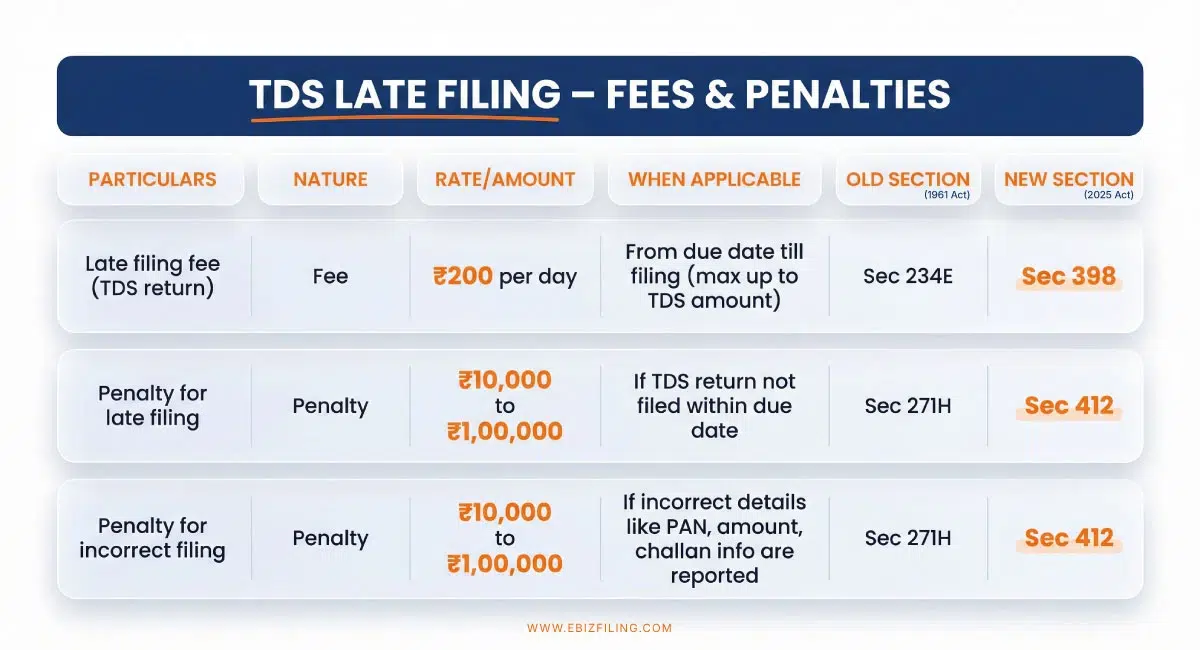
TDS Return Filing Errors That Trigger Notices
Many businesses receive notices even after depositing tax properly because mistakes are made while filing TDS return due dates. Small reporting errors can create reconciliation mismatches and trigger compliance issues later.
Common filing mistakes include:
- Incorrect PAN of deductee
- Wrong challan details
- CIN mismatch
- Short deduction of TDS
- Incorrect section code
- Filing under incorrect TDS Forms
- Mismatch between deposited tax and return data
- Delay in filing returns
If these issues are not corrected on time, businesses may receive notices, defaults, or demand communications from the department. To avoid such problems, businesses should regularly review challan details, deductee records, and filing data before submitting TDS returns.
How to Fix TDS Return Filing Errors?
Errors in a TDS return are generally corrected by filing a correction statement. The type of correction depends on the issue involved, such as PAN correction, challan correction, deductee update, or amount mismatch.
Businesses can reduce filing issues by:
- Verifying PAN details carefully
- Reconciling challan information before filing
- Checking deduction rates properly
- Reviewing deposited tax details
- Filing correction statements immediately after identifying errors
Delaying corrections often increases the chances of notices and reconciliation complications. Proper review and timely correction help businesses maintain smooth TDS compliance throughout the year.
Why Businesses Need Expert Support for TDS Return Filing
Ebizfiling helps businesses manage TDS return due dates work without the usual last-minute confusion and filing pressure. In many companies, TDS compliance starts becoming stressful when deadlines are close, challans don’t match, or correction notices suddenly appear. Handling deductions, return filing, certificates, corrections, and regular follow-ups together can take a lot of time during busy working months.
That’s where proper support actually makes a difference. From online TDS return filing and challan reconciliation to correction statements and notice support, Ebizfiling helps businesses keep their TDS compliance organised and on track throughout the year. So instead of worrying about missed deadlines and filing issues later, businesses can focus more on their daily work while the compliance side stays properly managed.
Conclusion
A lot of businesses think TDS return due dates filing is just another routine task until a late fee, notice, or mismatch suddenly shows up. In reality, most TDS issues happen because return filing gets delayed in between regular business work and deadlines quietly get missed.
Keeping track of TDS return due dates helps businesses avoid that last-minute pressure. When returns, challans, and records are handled regularly, TDS compliance becomes much smoother and far less stressful during the year.
Suggested reads:
Key changes in Income Tax Act 2025
Top changes impacting salaried taxpayers
Income Tax Rules major renumbering of forms
Frequently Asked Questions
1. If TDS is deducted on 31st March, does the return still get filed in Q4 only?
Yes. Any TDS deducted between January and March is reported in the Q4 return only. Even if deduction happens on the last day of March, it will still be included in the same quarterly filing.
2. What happens if the challan amount entered in Form 140 is wrong?
If the challan amount does not match the deposited tax, the return may show defaults later. In most cases, businesses need to file a correction statement to fix the mismatch properly.
3. Can a company file TDS return due dates without booking expenses in accounts?
Technically, TDS can be deposited and reported, but differences between books and TDS returns may create reconciliation issues later during audit or assessment proceedings.
4. Why do businesses receive short deduction notices even after deducting TDS?
This usually happens when the wrong TDS section or lower deduction rate is used while filing the return. Sometimes PAN-related issues also trigger short deduction defaults.
5. Is separate TDS return filing required for salary and contractor payments?
Yes. Salary deductions and non-salary deductions are reported through different forms because both categories are covered under different reporting requirements and deduction provisions.
6. Can TDS return be filed after the due date if tax is already deposited on time?
Yes, the return can still be filed after the due date. But late filing fees may continue to apply until the return is actually submitted successfully.
7.Why is PAN verification important before filing a TDS return?
One incorrect PAN can create problems for both deductor and deductee. Tax credit may not appear correctly, and later correction filing usually takes extra time and follow-up work.
8.Can a NIL TDS return be filed voluntarily?
Some businesses still prefer filing NIL returns for internal compliance tracking, especially when TAN is active and regular TDS filing was done in earlier quarters.
9. How does Ebizfiling help when TDS return due dates data and challan details do not match?
Ebizfiling reviews the challan details, CIN information, deduction entries, and filing data carefully to identify where the mismatch happened and helps businesses correct the issue properly.
10. Why do businesses prefer Ebizfilingfor regular TDS return filing support?
Many businesses struggle more with tracking deadlines and corrections than actual filing. Ebizfiling helps manage returns, corrections, notices, and compliance follow-ups regularly so things do not pile up later.





Never Miss a TDS Return Due Date in 2026
Stay compliant with the latest TDS filing deadlines under the Income Tax Act, 2025 and avoid unnecessary penalties.
About Ebizfiling -



September 21, 2026 By Srishti M
UPI MDR Charges 2026: 0.4% MDR on Payments Above ₹2,000 Introduction UPI MDR Charges 2026 introduce an important change for selected merchant payments made through the Unified Payments Interface. From 15 October 2026, a Merchant Discount Rate (MDR) of 0.4% […]
September 21, 2026 By Srishti M
EPFO Employees’ Enrollment Campaign 2026: Guide Overview The EPFO Employees’ Enrollment Campaign 2026 is a special, time-bound opportunity for employers to bring eligible employees under EPF coverage where they were left out during the prescribed historical period. Officially known as […]
September 21, 2026 By Steffy A