

GSTR-7 filing applicability, requirements and process under GST

GSTR-7 Filing: Applicability, Process and Late Fee

Overview

GSTR-7 filing is a GST compliance requirement for registered persons who are required to deduct tax at source under Section 51 of the Central Goods and Services Tax Act, 2017. The return reports payments or amounts credited to suppliers, GST TDS deducted, the applicable tax breakup, and amendments relating to earlier periods.


Accurate GSTR-7 filing is important because the details furnished by the deductor enable the deductee to claim the corresponding GST TDS amount in the electronic cash ledger after validation.


This guide explains the applicability, GST TDS threshold, filing procedure, correction mechanism, late fee, GSTR-7A, and other important rules relating to GSTR-7 filing.


Summary

  • GSTR-7 filing applies to registered persons required to deduct GST TDS under Section 51 of the CGST Act.
  • GST TDS generally applies when taxable supplies under a contract exceed ₹2.5 lakh, excluding GST and cess shown on the invoice.
  • GSTR-7 contains deductee details, taxable amounts, TDS deducted, amendments, interest, and late-fee information.
  • Errors in an earlier return can generally be corrected through amendment details in a subsequent GSTR-7.
  • Delayed filing can attract a late fee, while failure to deposit deducted GST TDS can also attract interest.


What Is GSTR-7 Filing?

GSTR-7 filing refers to furnishing Form GSTR-7 by a registered person who is required to deduct tax at source under Section 51 of the CGST Act. Rule 66 of the CGST Rules requires such a registered deductor to furnish Form GSTR-7 electronically through the common portal.


Unlike GSTR-1 or GSTR-3B, Form GSTR-7 is not a regular return for all GST-registered taxpayers. It specifically reports GST TDS deducted under Section 51.


Businesses that want to understand the wider return framework can read about the different types of GST returns in India.


Who Is Required to File GSTR-7?

GSTR-7 filing applies to registered persons who are required to deduct GST TDS under Section 51.


The specified categories include:

  • A department or establishment of the Central Government or State Government
  • A local authority
  • A governmental agency
  • Other persons or categories of persons notified by the Government on the recommendations of the GST Council

Persons required to deduct tax under Section 51 are also subject to compulsory GST registration under Section 24 of the CGST Act.

Looking for Reliable, Ongoing
GST Compliance Support?

Manage recurring GST filings, accounting, and business compliance with Ebizfiling's professional assistance.

Get Compliance Support

When Is GST TDS Required to Be Deducted?

GST TDS generally applies where the total value of taxable supplies under a contract exceeds ₹2,50,000.


For determining this threshold, the value of supply excludes CGST, SGST, UTGST, IGST, and cess indicated separately on the invoice.


The applicable GST TDS is generally:

  • 1% CGST and 1% SGST/UTGST for an applicable intra-State transaction
  • 2% IGST for an applicable inter-State transaction

Section 51 also provides an important exception. GST TDS is not required where the location of the supplier and the place of supply are in a State or Union Territory different from the State or Union Territory in which the recipient is registered.


Before entering deductee details during GSTR-7 filing, the GSTIN should be checked carefully. Ebizfiling’s guide on the GST registration number format explains how a GSTIN is structured.

Unsure About the GST Amount
or Applicable Tax Rate?

Calculate GST-inclusive and exclusive values and verify applicable rates before preparing your records.

Calculate Your GST

Is Nil GSTR-7 Filing Required?

No. GSTR-7 filing is generally not required for a tax period in which no GST TDS deduction has been made. CBIC’s GST TDS guidance clarifies that Form GSTR-7 is required for a tax period in which a deduction has actually been made.


This is different from certain other GST returns where a nil return may still have to be furnished despite there being no taxable transactions during the period.


What Details Are Required for GSTR-7 Filing?

A deductor should reconcile its payment and TDS records before beginning GSTR-7 filing.


Important information includes:

  • GSTIN and legal name of the deductor
  • GSTIN of the deductee
  • Amount paid or credited to the deductee
  • Amount on which GST TDS was deducted
  • IGST, CGST, SGST, or UTGST deducted
  • Amendments relating to earlier tax periods
  • TDS liability and payment information
  • Interest or late fee, where applicable

Incorrect deductee details can delay or affect the credit of GST TDS.


Businesses managing several GST obligations can also use the GST compliance checklist to review recurring compliance requirements.


How to Complete GSTR-7 Filing on the GST Portal?

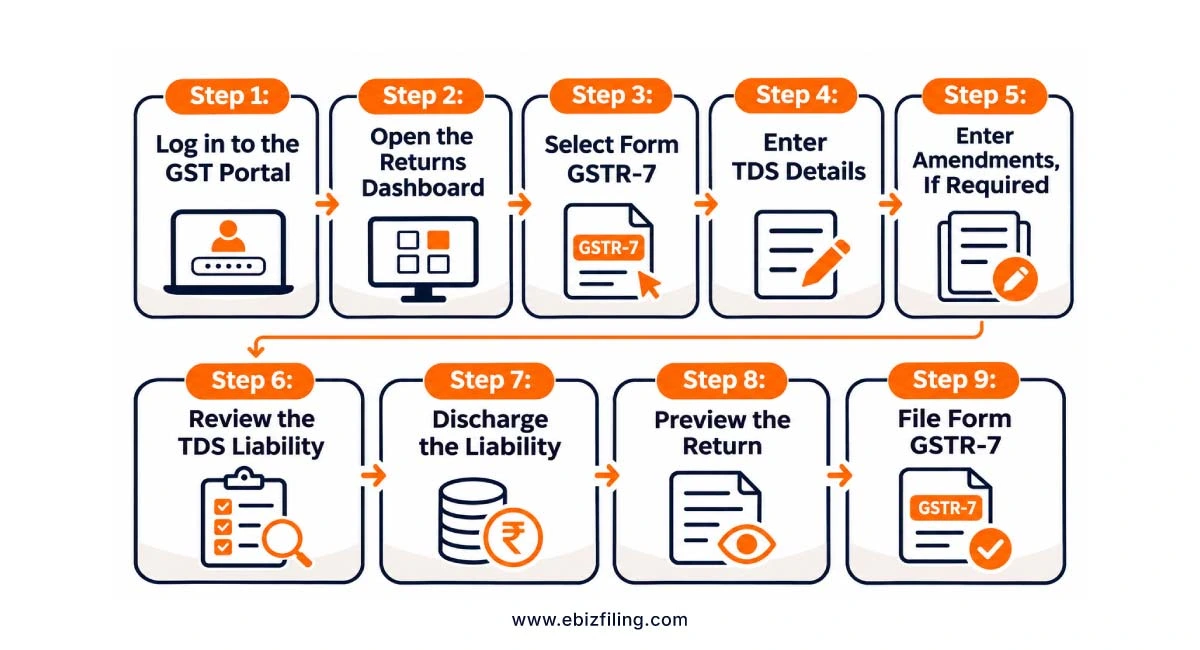
The GSTR-7 filing process is completed electronically through the GST portal.


Steps to log in to the GST portal for return filing and compliance


Step 1: Log in to the GST Portal

Log in using the credentials of the registered GST TDS deductor.


Step 2: Open the Returns Dashboard

Go to: Services > Returns > Returns Dashboard


Select the applicable financial year and return period.


Step 3: Select Form GSTR-7

Open Form GSTR-7 for the relevant tax period.


Step 4: Enter TDS Details

Enter the GSTIN of each deductee, the amount paid or credited, and the corresponding CGST, SGST, UTGST, or IGST deducted.


Step 5: Enter Amendments, If Required

Where previously reported TDS details require correction, enter the revised information in the relevant amendment table.


Step 6: Review the TDS Liability

Check the liability generated from the information reported in the return.


Step 7: Discharge the Liability

Pay the applicable TDS liability, interest, and late fee through the prescribed GST payment mechanism.


Step 8: Preview the Return

Review the return summary carefully and verify the GSTINs, taxable amounts, and tax breakup before filing.


Step 9: File Form GSTR-7

Complete GSTR-7 filing using the authentication method available to the authorised signatory on the GST portal.


The acknowledgement and filed return should be retained for compliance records. For additional information on GST return procedures, read Ebizfiling’s complete guide to GST return filing.

Need Professional Assistance
with GSTR-7 Filing?

Simplify GST return preparation and filing with dedicated support from Ebizfiling's tax experts.

Get Expert Help

Can GSTR-7 Be Revised After Filing?

A filed GSTR-7 cannot simply be reopened and revised.


If an error is discovered after GSTR-7 filing, the deductor can generally correct the relevant details through the amendment tables provided in a subsequent GSTR-7, subject to the applicable GST rules and portal functionality.


Corrections may relate to:

  • Incorrect deductee GSTIN
  • Incorrect amount paid or credited
  • Incorrect TDS amount
  • Incorrect tax breakup
  • Earlier reported information requiring amendment

The deductor should verify the original transaction carefully before reporting the corrected information.


How Does GSTR-7 Filing Affect the Deductee?

The information furnished through GSTR-7 filing is made available electronically to the deductee.


Rule 66 provides for the details reported by the deductor to be made available to the deductee for claiming the amount of tax deducted in the electronic cash ledger after validation.


GST TDS credit should therefore not be confused with regular input tax credit. The amount is credited to the electronic cash ledger rather than the electronic credit ledger.


For further guidance, read about common mistakes to avoid while filing GST returns.


What Is Form GSTR-7A?

Form GSTR-7A is the GST TDS certificate made available electronically to the deductee through the GST common portal.


Section 51(3) provides for issuance of a tax deduction certificate in the prescribed form and manner. Rule 66(3) specifies that the certificate is made available in Form GSTR-7A on the basis of the GSTR-7 furnished by the deductor.


Therefore, accurate GSTR-7 filing is important because the information reported in the return forms the basis for the electronically generated TDS certificate.


What Is the Late Fee for Delayed GSTR-7 Filing?

Delayed GSTR-7 filing can attract a late fee under Section 47 of the CGST Act.


For returns relating to June 2021 onwards, Notification No. 22/2021-Central Tax rationalised the Central Tax late fee by waiving the amount exceeding ₹25 per day, subject to a maximum Central Tax late fee of ₹1,000 per return.


A corresponding late fee may apply under the relevant State GST or Union Territory GST law.


Where equivalent CGST and SGST provisions apply, the combined late fee may therefore generally amount to ₹50 per day, subject to the applicable caps and any subsequent waiver or relaxation.


Older references to the original ₹100-per-day Central Tax late fee should therefore not be used for these periods without considering the reduced late-fee notification.


Is Interest Payable for Delayed Payment of GST TDS?

Yes. Under Section 51(6) of the CGST Act, where a deductor fails to pay GST TDS to the Government after deducting it under Section 51(1), the deductor is required to pay interest in accordance with Section 50(1), in addition to the tax deducted. The actual interest liability depends on the unpaid amount, the applicable statutory rate, and the period of delay.


What Are the Common Errors in GSTR-7 Filing?

Errors in GSTR-7 filing can affect both the deductor’s compliance and the deductee’s ability to claim the correct TDS amount.


Common mistakes include:

  • Entering an incorrect deductee GSTIN
  • Deducting GST TDS when the statutory contract threshold is not crossed
  • Including GST and cess shown separately on the invoice while determining the TDS base
  • Applying the wrong CGST, SGST, UTGST, or IGST breakup
  • Reporting an incorrect amount paid or credited
  • Failing to correct inaccurate earlier-period details
  • Delaying payment after GST TDS has been deducted

Reconciliation of contracts, payments, GSTINs, and GST TDS amounts before filing can reduce errors and subsequent amendments.


GST TDS Deducted? Let Ebizfiling Handle Your GSTR-7 Filing!

Managing GST TDS involves more than deducting tax. Incorrect deductee GSTINs, mismatched TDS amounts, missed amendments and delayed filing can create compliance issues and affect your suppliers’ TDS credits.


With Ebizfiling’s GST Return Filing Services, get professional assistance with GST TDS reconciliation, verification of deductee details, GSTR-7 preparation, amendment reporting and return filing. Our team helps you meet your filing obligations while reducing avoidable reporting errors.


Don’t Let GST TDS Errors Affect Your Compliance! Call Us: +91 9643203209

Need GST Registration to Meet
Your TDS Compliance Requirements?

Get expert assistance with GST registration and the documentation required for compliance.

Apply for GST Registration

Conclusion

Accurate GSTR-7 filing is important for every registered person required to deduct GST TDS under Section 51 of the CGST Act. Deductors should verify the ₹2.5 lakh contract threshold, deductee GSTIN, applicable TDS rate, tax breakup, payment information, and amendment details before filing.


Correct reporting also helps ensure that the deductee receives the proper GST TDS amount in the electronic cash ledger and accurate information through the GST system.


Frequently Asked Questions


1. Is GST TDS applicable when a contract includes both taxable and exempt supplies?

Yes, but only the taxable portion is considered for the Section 51 threshold. GST TDS applies when the value of taxable supplies under a single contract exceeds ₹2.5 lakh, excluding GST and cess shown separately on the invoice.


2. Can GSTR-7 liability be paid using input tax credit?

No. GST TDS liability must be paid through the electronic cash ledger. The electronic credit ledger cannot be used to discharge tax deducted under Section 51.


3. Can a deductor claim a refund of excess or wrongly deducted GST TDS?

Yes, subject to Section 54. However, the deductor cannot claim the refund once the deducted amount has already been credited to the deductee’s electronic cash ledger.


4. Can a deductee claim a refund of unused GST TDS credited to the electronic cash ledger?

Yes. GST TDS credited to the deductee’s electronic cash ledger is treated like cash deposited in that ledger. Any eligible unused balance may be claimed as a refund under the electronic cash ledger refund provisions.


5. Can GST TDS credited to the electronic cash ledger be used for liabilities other than the same tax head?

Yes. CBIC has clarified that TDS credited to the electronic cash ledger is equivalent to cash deposited in that ledger. The registered person may use the available balance for eligible GST liabilities in accordance with the applicable ledger utilisation rules.


6. What happens if GST TDS is deposited under the wrong tax head?

If GST TDS is deposited under the wrong tax head and creates an excess balance in the deductor’s electronic cash ledger, that excess balance may be claimed as a refund in accordance with the applicable refund procedure.


7. Does a person already registered under GST need a separate registration as a TDS deductor?

Yes. CBIC guidance states that a separate registration is required for a person who is liable to deduct GST TDS. The application is made in Form GST REG-07, and registration may be obtained using PAN or TAN, as applicable.


8. What are the key preconditions for filing Form GSTR-7?

The deductor must have an active GSTIN, valid portal credentials, and must have made or credited a payment to the supplier on which GST TDS was deducted. Form GSTR-7 can be filed electronically using the permitted authentication method on the GST portal.


9. Can Ebizfiling assist with correcting GSTR-7 reporting errors?

Yes. Ebizfiling’s GST Return Filing Service can assist with reviewing previously reported details and preparing amendment entries for a subsequent GSTR-7, based on the records and transaction information provided by the deductor.


10. Can Ebizfiling help reconcile GST TDS before GSTR-7 filing?

Yes. Ebizfiling can assist with reconciling contract values, deductee GSTINs, taxable amounts, TDS deductions, and payment records before GSTR-7 filing. The deductor remains responsible for providing complete and accurate source documents.

About Ebizfiling -

EbizFiling is a concept that emerged with the progressive and intellectual mindset of like-minded people. It aims at delivering the end-to-end corporate legal services 0f incorporation, compliance, advisory, and management consultancy services to clients in India and abroad in all the best possible ways.
 
To know more about our services and for a free consultation, get in touch with our team on  info@ebizfiling.com or call 9643203209.
 
Ebizfiling

Author: srishti

Srishti Mukherjee is an Advocate, Legal Researcher, and Legal Content Writer at Ebizfiling, with practical courtroom experience in civil, criminal, and revenue matters before Trial Courts and High Courts. She holds an LL.M. in Constitutional Law and Criminal Law, combining her academic background with hands-on litigation experience, legal drafting, and statutory interpretation. At Ebizfiling, Srishti researches and writes on corporate law, Income Tax, GST, Intellectual Property Rights (IPR), business registration, and regulatory compliance. Her professional interests extend to company law, taxation, and emerging legal developments, where she applies her legal research skills to understand statutory provisions, compliance procedures, and their practical implications for businesses and individuals. Her writing reflects a research-oriented approach supported by practical legal experience. She focuses on simplifying complex legislation, regulatory requirements, filing procedures, and legal documentation into clear, structured, and accessible content. Through her articles, she aims to help startups, businesses, professionals, and taxpayers better understand legal obligations and make informed compliance decisions.

Follow Author

Leave a Reply

Your email address will not be published. Required fields are marked *

  • Rating

Reviews

  • Client review, Ebizfiling

    Harshit Gamit

    19 Apr 2018

    My GST process was made easier with Ebizfiling. I really appreciate the hard work by your team. Keep up the same in the future. Good Luck!

  • Ebizfiling, Ebizfiling.com

    Kshama Vighne

    19 Apr 2022

    Ebizfiling provides excellent service and transparency. Very qualified and knowledgeable staff, very much satisfied with the service. I really want to appreciate ayushi mam for helping me to acquire Form 12AB and 80G at very affordable rates in nearly one months time, also would like to thank anupurna mam for providing excellent service and expertise for resolving my accountancy issues. Thankyou so much, God bless you all abundantly. Highly recommended

  • Ebizfiling

    Nayanshree Barsaiyan

    08 Jul 2019

    My requirement was fulfilled on time. the customer care response is very prompt.

Hi, Welcome to EbizFiling!

Hello there!!! Let us know if you have any Questions.

Thank you for your message.

☎
whatsapp