


How to Reapply for Trademark Application After Withdrawal?
Introduction
A trademark application may be withdrawn for several reasons. The applicant may have selected the wrong class, filed in the wrong proprietor’s name, changed the brand, or decided not to continue with the earlier application.
But what happens if the applicant later wants to protect the same or a revised trademark? A person may generally Reapply for Trademark Application by filing a fresh application. However, the fresh application is separate from the withdrawn application and must independently satisfy the requirements of the Trade Marks Act, 1999 and Trade Marks Rules, 2017.
Before filing again, the applicant should review why the earlier application was withdrawn and check whether the same issue could affect the new filing.
Quick Insights
- A withdrawn trademark application is different from an abandoned or refused application.
- An applicant may generally Reapply for Trademark Application through a fresh filing.
- A fresh application does not automatically retain the filing date of the withdrawn application.
- A new trademark search should be conducted before filing again.
- Proprietor details, trademark class, goods or services and user claim should be reviewed again.
- A fresh trademark application is generally filed through Form TM-A.
- A prior-use claim must be supported by an affidavit and supporting documents.
- The applicable government filing fee must generally be paid again.
- Withdrawal does not automatically create a right to refund the earlier government fee.
Can You Reapply for Trademark Application After Withdrawal?
Yes, a fresh trademark application may generally be filed after an earlier application has been withdrawn.
Section 18 of the Trade Marks Act, 1999 allows a person claiming to be the proprietor of a trademark to apply for its registration.
The Trade Marks Act, 1999 and Trade Marks Rules, 2017 do not expressly provide a general bar on filing a fresh application merely because an earlier trademark application was withdrawn.
Accordingly, a person may generally Reapply for Trademark Application, subject to the normal requirements of registration and any case-specific legal restrictions that may apply.
For example, a court order, settlement, undertaking, earlier trademark rights or another legal proceeding may affect whether the same mark can be filed again.
The fresh application will be examined independently and should not be treated as a continuation or revival of the withdrawn application.
What Does Withdrawal of a Trademark Application Mean?
Withdrawal generally means that the applicant has decided not to continue pursuing the pending trademark application.
Once the application is withdrawn, it should not be treated as an ordinary pending application.
Before deciding to Reapply for Trademark Application, the applicant should first confirm the exact status appearing in the Trade Marks Registry records.
This is important because withdrawal, abandonment and refusal are different procedural outcomes.
Withdrawal vs Abandonment vs Refusal of Trademark Application
These terms should not be treated as interchangeable.
|
Status |
General Meaning |
Practical Consideration |
|
Withdrawn |
Applicant stops pursuing the application | Consider whether a fresh application is appropriate |
| Abandoned | Application ceases because of specified non-compliance or failure to take required action |
Review the reason before filing again |
|
Refused |
Registration is refused by the Registry | Review the refusal grounds and available legal remedy |
A person planning to Reapply for Trademark Application should first identify which status actually applies.
Filing another application without understanding what happened earlier may result in the same issue occurring again.
Why Would Someone Reapply for Trademark Application?
There may be several practical reasons to file a fresh trademark application.
These can include:
- Wrong trademark class selected
- Incorrect proprietor details
- Incorrect goods or services specification
- Material change in the proposed trademark
- Change in business ownership
- Earlier application voluntarily withdrawn
- Incorrect user claim
- Revised filing strategy
- Expansion into additional products or services
The reason for withdrawal should be reviewed before preparing the fresh application.
What Should You Check Before Reapplying?
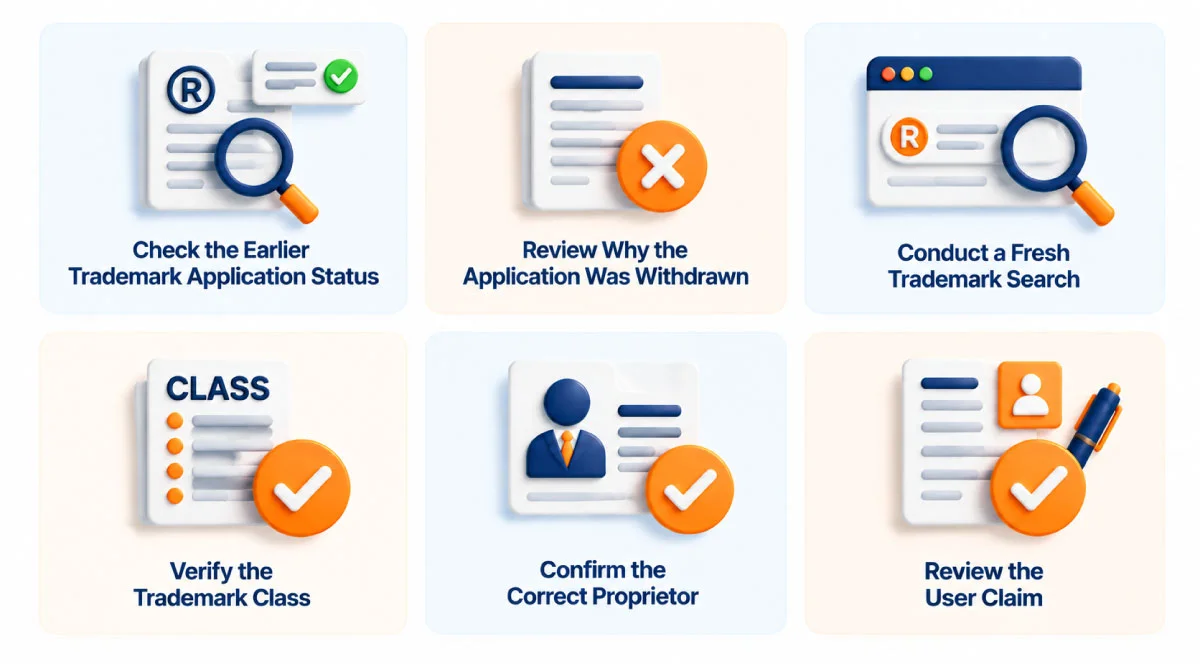
1. Check the Earlier Trademark Application Status
First verify whether the earlier application is:
- Withdrawn
- Abandoned
- Refused
- Objected
- Opposed
- Still pending
Do not assume that every inactive trademark application has the same legal status.
2. Review Why the Application Was Withdrawn
Before you Reapply for Trademark Application, identify the exact reason for the earlier withdrawal.
If the earlier filing contained an ownership, classification or user-claim issue, repeating the same information may create another problem.
3. Conduct a Fresh Trademark Search
Trademark records can change over time.
A mark that appeared available when the earlier application was filed may now face additional registered or pending marks.
Applicants can consider a fresh trademark search and registration review before filing again.
4. Verify the Trademark Class
The new application should identify the correct class or classes based on the actual goods or services.
Businesses can use Ebizfiling’s Trademark Class Finder to review the relevant trademark classes.
5. Confirm the Correct Proprietor
The application should be filed in the name of the person or entity claiming ownership of the trademark.
The proprietor should not be changed merely to overcome an earlier filing issue without considering the actual ownership position.
6. Review the User Claim
Determine whether the mark is:
- Proposed to be used; or
- Already in use
Where use before the filing date is claimed, Rule 25(2) requires an affidavit testifying to such use along with supporting documents.
Step-by-Step Process to Reapply for Trademark Application
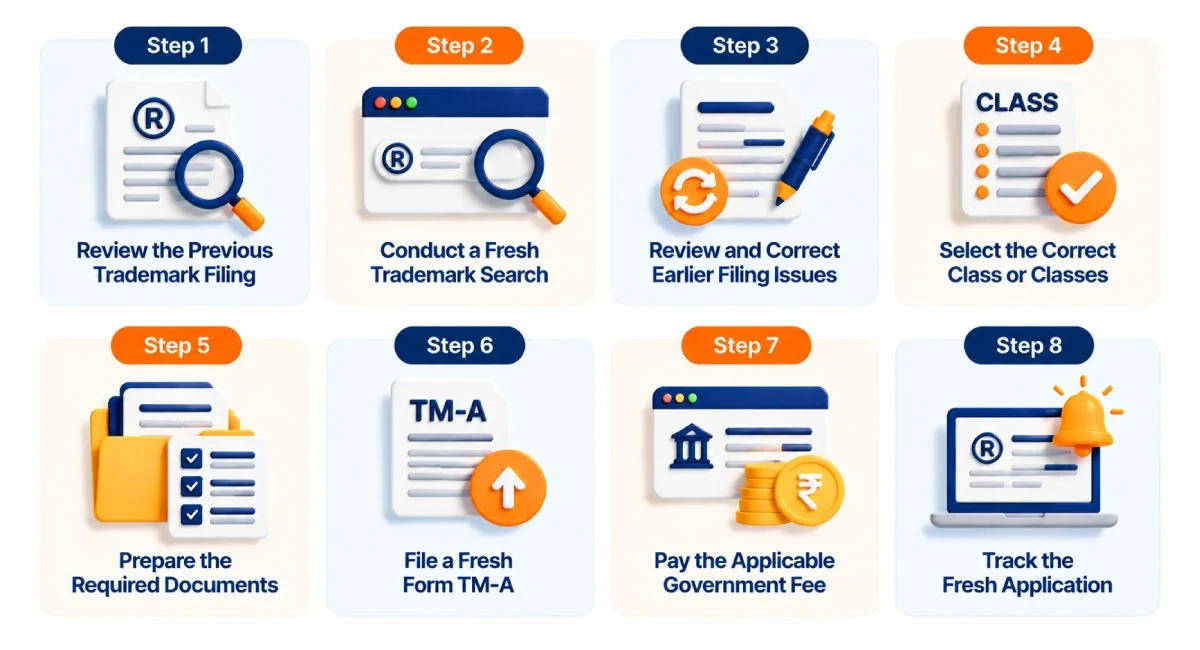
Step 1: Review the Previous Trademark Filing
Check:
- Application number
- Filing date
- Proprietor name
- Trademark
- Class
- Goods or services
- User claim
- Examination history
- Withdrawal status
- Any objection or opposition
This helps identify what should be reviewed before the new filing.
Step 2: Conduct a Fresh Trademark Search
Search for identical and similar registered or pending trademarks.
Do not rely only on a search conducted before the earlier application.
Step 3: Review and Correct Earlier Filing Issues
Check whether the earlier application contained issues relating to:
- Proprietor details
- Trademark representation
- Class
- Goods or services
- User claim
- Supporting documents
Step 4: Select the Correct Class or Classes
The fresh application should include the classes genuinely relevant to the goods or services for which registration is sought.
A trademark may cover multiple classes where appropriate, but government fees apply separately for each class.
Step 5: Prepare the Required Documents
Depending on the filing basis, documents or information may include:
- Applicant details
- Trademark representation
- Goods or services specification
- Prior-use affidavit and supporting evidence, where applicable
- Power of Attorney where an authorised agent is appointed
- Startup or Small Enterprise proof where applicable
Step 6: File a Fresh Form TM-A
Rule 23 provides that a new application for registration of a trademark is made through Form TM-A.
Where a fresh filing is required to Reapply for Trademark Application, the application should correctly state the proprietor, trademark, class, goods or services, user claim and other prescribed particulars.
Step 7: Pay the Applicable Government Fee
The current government e-filing fees for Form TM-A are:
|
Applicant Category |
Government E-Filing Fee |
|
Individual / Startup / Small Enterprise |
₹4,500 per mark per class |
| Other Applicants |
₹9,000 per mark per class |
The applicable government fee must generally be paid again for the fresh application.
Step 8: Track the Fresh Application
The new application will independently proceed through the applicable stages, which may include:
- Examination
- Examination objection
- Hearing, where required
- Trade Marks Journal publication
- Opposition period
- Registration
An earlier filing does not guarantee acceptance of the new application.
Does the Earlier Filing Date Continue After Reapplication?
No automatic continuation should be assumed.
When an applicant files a fresh application to Reapply for Trademark Application, the new application has its own filing particulars.
The filing date of the withdrawn application does not automatically become the filing date of the fresh application.
This can be important because another person may have filed an application or acquired relevant rights between the earlier withdrawal and the new filing.
Any separate statutory priority claim should be considered independently and should not be confused with the filing date of a withdrawn Indian trademark application.
Can You Reapply With the Same Trademark?
A fresh application for the same trademark may generally be considered, but filing again does not guarantee registration.
Before using the same mark again, review:
- Earlier examination objections
- Identical or similar marks
- Third-party rights
- Goods or services covered
- Distinctiveness
- Opposition history
- Court orders, settlements or undertakings, if any
If the earlier issue related to similarity with another trademark, filing the same mark again may result in a similar objection.
Should You Change the Trademark Before Reapplying?
Not necessarily.
Whether a change is appropriate depends on why the earlier application was withdrawn.
A modification may be considered where the earlier trademark raised concerns relating to:
- Lack of distinctiveness
- Descriptive wording
- Similarity with an earlier mark
- Brand redesign
- Commercial repositioning
However, changing one letter, adding a generic word or making a minor visual modification does not automatically resolve a substantive trademark conflict.
Can You Change the Trademark Class When Reapplying?
Yes. A fresh application should use the class or classes applicable to the goods or services covered by the new filing.
If the earlier application contained an incorrect classification, the applicant should review it before filing again.
Rule 37 permits certain corrections or amendments to an application before registration through Form TM-M. However, an amendment cannot substantially alter the trademark or substitute a new specification of goods or services that was not included in the application as originally filed.
Where the required change cannot appropriately be made through amendment, a fresh filing may need to be considered.
Can You Claim the Same Prior-Use Date in the New Application?
Potentially, yes, but only where the claimed date is factually correct and supported by evidence.
Rule 25 requires an applicant claiming use before the application date to file an affidavit testifying to such use along with supporting documents.
Therefore, before you Reapply for Trademark Application, do not simply copy the user date from the earlier application without checking whether appropriate evidence supports it.
Supporting evidence may depend on the circumstances and can include records demonstrating genuine commercial use of the trademark.
Where the trademark has not yet been used, the fresh application may instead be filed on a proposed-to-be-used basis.
Will the Earlier Government Fee Be Adjusted Against the Fresh Application?
Generally, no automatic adjustment should be assumed.
A fresh trademark application attracts the applicable filing fee again.
Withdrawal of the earlier application does not automatically create a general right to a refund or adjustment of the government filing fee paid for that application.
A specific refund situation is provided under Section 133(2) of the Trade Marks Act, 1999.
Where the Registrar has given favourable preliminary advice regarding the distinctiveness of a proposed trademark, an application is filed within three months after that advice, and the Registrar subsequently objects to the mark on the ground that it is not distinctive, the applicant may obtain repayment of the filing fee by withdrawing the application within the prescribed period.
Rule 35 requires the notice of withdrawal for this specific purpose to be given in writing within one month from receipt of the relevant communication.
This is a specific statutory situation and should not be treated as a general refund rule for every withdrawn trademark application.
Can You Restore a Withdrawn Trademark Application Instead of Refiling?
Do not confuse withdrawal of a pending trademark application with restoration of a registered trademark removed for non-renewal.
Rule 60 provides a restoration and renewal mechanism for a registered trademark removed from the Register for non-renewal, subject to the prescribed requirements.
That procedure should not be treated as a general mechanism for restoring every voluntarily withdrawn pending application.
Therefore, before deciding to Reapply for Trademark Application, verify the exact status of the earlier application and the circumstances in which it was withdrawn.
Can a Withdrawn Application Be Amended Instead of Filing Again?
An applicant should not assume that an already withdrawn application can simply be revived and substantially amended through the ordinary amendment procedure.
Rule 37 deals with correction or amendment of an application before registration and places limits on substantial changes.
If an application has already been withdrawn, whether any procedural step remains available depends on its exact status and circumstances.
Where appropriate, a fresh trademark application may need to be considered.
Mistakes When You Reapply for Trademark Application
Applicants should avoid:
- Filing again without checking the earlier application status
- Repeating the same incorrect proprietor
- Selecting the same incorrect trademark class
- Claiming an unsupported first-use date
Assuming the old filing date automatically continues - Assuming every withdrawn application can be restored
- Ignoring earlier examination objections
- Ignoring an earlier opposition
- Assuming withdrawal removes conflicting trademarks
- Assuming earlier government fees will automatically be adjusted
- Filing again without conducting a fresh trademark search
Reviewing these issues before refiling can reduce avoidable problems in the new application.
Documents Required to Reapply for Trademark Application
The exact requirements depend on the applicant and filing basis.
Commonly relevant documents and information may include:
- Applicant’s name and address
- Trademark representation
- Goods or services specification
- Correct trademark class
- Prior-use affidavit and supporting documents, where applicable
- Power of Attorney, where an authorised agent is appointed
- Startup or Small Enterprise evidence where concessional filing status is claimed
How Ebizfiling Can Help You Reapply for Trademark Application
Before filing again, it is important to understand why the earlier application was withdrawn and whether the same issue could affect the fresh filing. Ebizfiling can assist with reviewing the earlier trademark application, conducting a trademark search, identifying the relevant classes, reviewing proprietor and user details, and preparing a fresh application where appropriate.
If the new filing later receives an examination objection, applicants can also review Ebizfiling’s Trademark Objection Reply service. Businesses seeking complete filing assistance can explore Ebizfiling’s Trademark Registration service.
Conclusion
It may generally be possible to Reapply for Trademark Application after an earlier application has been withdrawn. However, the fresh filing should not be treated as an automatic continuation or revival of the withdrawn application. Before filing again, review the previous application status, reason for withdrawal, proprietor details, trademark class, goods or services, prior-use claim and current trademark search results.
A fresh application has its own filing particulars and must independently satisfy the applicable requirements of the Trade Marks Act, 1999 and Trade Marks Rules, 2017. Correcting the earlier issue before you Reapply for Trademark Application can help reduce the risk of repeating the same filing problem.
Frequently Asked Questions
1. Can the same trademark be filed again after the earlier application was withdrawn?
Yes, a fresh application for the same trademark may generally be filed. Section 18 allows a person claiming to be the proprietor of a trademark to apply for registration. The law does not expressly create a general bar merely because an earlier application was withdrawn. However, the fresh application will be examined independently, and any earlier substantive issue may arise again.
2. Can a fresh trademark application be filed in a different proprietor’s name after withdrawal?
Yes, but only where the new applicant can legitimately claim proprietorship of the trademark. Section 18 requires the applicant to claim to be the proprietor of the mark. Withdrawal of an earlier application should not be treated as a reason to shift the trademark to another person or entity without a valid ownership basis.
3. Does the filing date of the withdrawn trademark application carry forward to the new application?
No automatic carry-forward should be assumed. A fresh trademark application has its own filing particulars. The filing date of the withdrawn application does not automatically become the filing date of the new application. Any separate statutory priority claim should be assessed independently.
4. Can the applicant claim the same prior-use date in the new trademark application?
Yes, provided the claimed date is factually correct and supported by evidence. Rule 25(2) requires an applicant claiming use before the application date to file an affidavit testifying to such use along with supporting documents. The earlier user date should not simply be copied into the fresh application without supporting records.
5. Can a withdrawn trademark application be restored instead of filing a fresh application?
The Trade Marks Rules do not provide a general restoration mechanism for every voluntarily withdrawn pending application. Rule 60 deals with restoration and renewal of a registered trademark removed from the Register for non-renewal. Applicants should therefore verify the exact status of the earlier application before assuming restoration is available.
6. Is the government fee paid on the withdrawn trademark application adjusted against the fresh application?
Generally, a fresh application attracts the applicable filing fee again. Withdrawal does not automatically create a right to refund or adjustment. A limited statutory refund situation exists under Section 133(2), read with Rule 35, where the specified conditions relating to preliminary advice on distinctiveness are satisfied.
7. Can the trademark class be changed when filing again after withdrawal?
Yes. A fresh application should use the class or classes applicable to the goods or services covered by the new filing. If the earlier application is still pending, Rule 37 permits certain corrections or amendments, but it does not allow an amendment that substantially alters the trademark or substitutes an entirely new specification not included in the original application.
8. Will filing the same trademark again remove an earlier examination objection?
No. A fresh application does not automatically cure an earlier substantive objection. The Trade Marks Registry conducts a fresh examination, and if the mark, goods or services and underlying facts remain substantially the same, similar objections may arise again.
9. Can Ebizfiling review a withdrawn trademark application before the applicant files again?
Yes. Ebizfiling can assist with reviewing the earlier application, conducting a fresh trademark search, identifying the relevant class, and checking proprietor and filing details before a new application is submitted. Businesses can also use Ebizfiling’s Trademark Search and Registration service for pre-filing support.
10. Can Ebizfiling help if the fresh trademark application receives another examination objection?
Yes. If the fresh filing receives an examination objection, Ebizfiling can assist with reviewing the examination report and preparing the appropriate response based on the grounds raised by the Trade Marks Registry. Applicants can review Ebizfiling’s Trademark Objection Reply service for assistance.





Withdraw Your Trademark Application
Withdraw your Trademark application with Ebizfiling. Prices start from 2499/- only.
About Ebizfiling -



Reviews
Aditya Raje
23 Apr 2022Have used their services to open an MSME firm and FSSAI aswell. Mr. Shubham and Mr. Pulkit were extremely helpful and I got my work done smoothly and on time. Recommended.
Devangi Patnayak
11 Mar 2018I am very happy with the way they serve their clients. They are focused on providing the best help that they can and are result oriented.
Hemang Malhotra
08 Oct 2018I was new as an Entrepreneur when I had seen their post on social media. I contacted them regarding proprietorship and realized they their pricing is incomparable in the market also their services are really prompt. Thank you, Ebizfiling.
October 10, 2026 By Srishti M
October 10, 2026 By Srishti M
Compliance Calendar November 2026: Key Statutory Due Dates Introduction The compliance calendar November 2026 covers important statutory obligations under GST, Income Tax, TDS/TCS, Company Law, LLP regulations, EPF and ESI. It helps businesses identify the filings, payments and regulatory requirements […]
October 9, 2026 By Srishti M
80G Approval Notice : How to Respond and Avoid Rejection Introduction Charitable trusts, societies, and other eligible institutions may receive an 80G Approval Notice from the Income Tax Department while their application for approval under Section 80G is being processed. […]