

-
October 7, 2026
-
BySiddhi R
Types of E commerce Business: Meaning and 6 Models
Introduction
The Types of E commerce Business explain how online transactions take place between businesses, consumers, and government authorities. Each model differs based on who sells and who purchases the goods or services. This blog explains what e-commerce means, six common e-commerce business models, their advantages, and their impact on businesses.
Quick Insights
- The types of e-commerce business are mainly classified according to the parties involved in an online transaction.
- B2C and B2B cover transactions between businesses and customers or between businesses.
- C2C and C2B involve individuals selling products or services to consumers or companies.
- B2A and C2A involve online transactions with government or public authorities.
- A business may operate under more than one e-commerce model depending on its customers and sales channels.
What is E-commerce and Why Does the Business Model Matter?
E-commerce, or electronic commerce, refers to buying or selling goods and services through computer networks. According to UNCTAD, the order must be placed or received through a computer network, but the payment or final delivery does not necessarily have to take place online.
The WTO also describes electronic commerce broadly as the production, distribution, marketing, sale, or delivery of goods and services by electronic means. E-commerce transactions may involve businesses, individuals, households, governments, and other organizations.
Understanding the Types of E commerce Business helps a business identify its target customers, pricing model, sales process, marketing strategy, and order fulfilment requirements.
What are the Advantages of an E-commerce Business?
Some common benefits of operating an e-commerce business include:
- Wider customer reach: Businesses can sell beyond their immediate geographical location.
- 24/7 availability: Online stores can accept orders outside normal business hours.
- Lower physical infrastructure needs: Some businesses can operate without maintaining multiple retail outlets.
- Better product visibility: Customers can compare products, prices, specifications, and reviews online.
- Multiple sales channels: Businesses can sell through their own website, marketplaces, social platforms, or a combination of channels.
- Data-driven decisions: Online businesses can track customer behaviour, orders, demand, and marketing performance.
Entrepreneurs who are evaluating different e-commerce models should also understand the key advantages of starting an e-commerce business before choosing the right structure and compliance path.
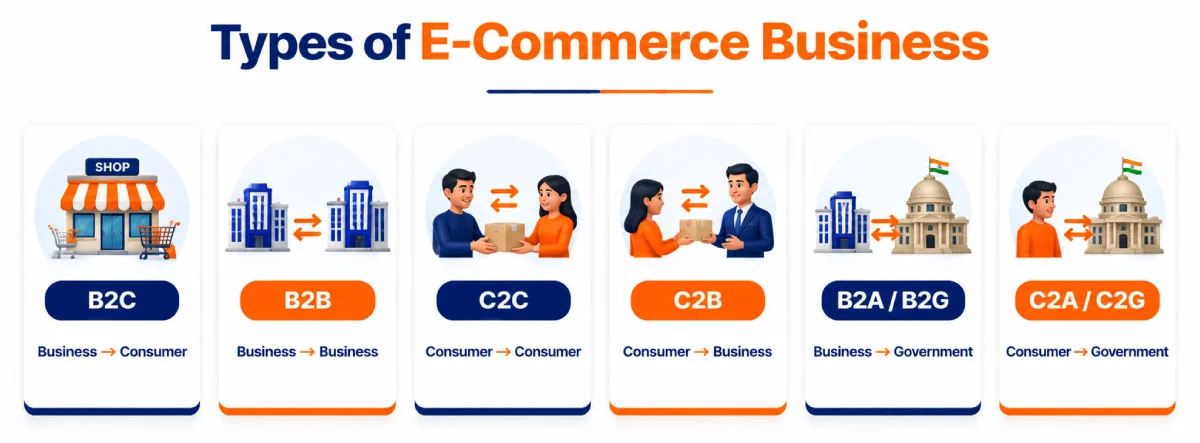
What Are the 6 Types of E commerce Business?
The following are six commonly discussed Types of E commerce Business based on the parties participating in the transaction.
1. B2C: Business to Consumer
B2C is one of the most familiar Types of E commerce Business. Under this model, a business sells products or services directly to individual customers.
For example, a customer purchasing clothes, electronics, or household products from an online retailer is participating in a B2C transaction. Online marketplaces and brand websites commonly use this model. Businesses selling directly to consumers online should also review whether GST registration for e-commerce sellers applies based on their business model and transactions.
2. B2B: Business to Business
In the B2B model, one business sells products or services to another business.
Examples may include a manufacturer selling goods to a wholesaler, a software company providing online tools to another company, or a supplier accepting bulk orders through an online portal.
B2B transactions often involve larger quantities, negotiated prices, recurring orders, or longer business relationships.
3. C2C: Consumer to Consumer
C2C e-commerce takes place when one individual sells goods or services to another individual through an online platform.
For example, a person may list a used mobile phone, furniture, vehicle, or other personal item on an online marketplace and sell it directly to another consumer.
The platform generally helps connect buyers and sellers and may also provide communication or payment facilities.
4. C2B: Consumer to Business
C2B is the reverse of the traditional B2C model. Here, an individual provides a product, service, or value to a business.
For example, a freelance designer providing design services to a company, a photographer licensing an image to a business, or a content creator collaborating with a brand may fall under the C2B model.
Such transactions should not be described as B2B when the service provider is acting as an individual consumer or independent professional.
5. B2A: Business to Administration
B2A, also called Business to Government or B2G in some classifications, covers electronic transactions between businesses and government or public authorities.
Examples may include:
- Businesses submitting online tenders
- Companies supplying goods or services through government procurement systems
- Online applications or filings made by businesses with public authorities
This model has expanded with the growing use of digital government platforms. Businesses participating in government procurement or online filings should also keep track of applicable company compliance requirements.
6. C2A: Consumer to Administration
C2A covers electronic interactions between individuals and government or public authorities.
Examples may include individuals making certain government payments, submitting online applications, paying taxes or fees, or accessing eligible public services through government portals.
C2A is also sometimes described as Consumer to Government or C2G.
It is important to note that classifications of Types of E commerce Business can vary. Modern frameworks may separately include models such as D2C, B2G, B2B2C, subscriptions, or marketplace commerce. This article focuses on the six participant-based models above.
How Do Types of E commerce Business Affect Business Operations?
The selected e-commerce model can influence how a business operates.
Impact of E-commerce on Businesses
Businesses operating online generally need to plan for:
- Order fulfilment: Products must be packed, shipped, tracked, and delivered efficiently.
- Inventory management: Stock levels should match online demand.
- Customer service: Buyers expect quick responses to order, refund, or product-related queries.
- Payments: Businesses need reliable methods for receiving and reconciling online payments.
- Marketing: Search engines, marketplaces, social media, and digital advertising may influence customer acquisition.
- Compliance: Applicable business registrations, GST and tax requirements, consumer protection rules for e-commerce, and product-specific requirements should be reviewed based on the nature of the business.
A business can also use more than one of the Types of E commerce Business. For example, a manufacturer may sell directly to customers through a website while also supplying products in bulk to other businesses.
Registration and Tax Support for E-commerce Businesses
Ebizfiling can assist businesses with compliance and registration requirements connected with setting up and operating an online business, depending on their business structure and activities.
Assistance may include:
- Business registration and entity setup
- GST registration and related compliance
- Trademark registration for brand protection
- FSSAI registration or licensing for eligible food businesses
- Accounting and tax compliance support
- Professional guidance on applicable business registrations
Planning to start or manage an e-commerce business?
Ebizfiling can assist with business registration, GST registration, trademark registration, tax compliance, and other applicable requirements. Get expert assistance for your e-commerce business today.
Conclusion
Understanding the Types of E commerce Business helps entrepreneurs identify who their customers are and how online transactions will take place. B2B, B2C, C2C, C2B, B2A, and C2A represent different relationships between businesses, individuals, and public authorities. The right model depends on the products or services offered, target customers, and business operations.
Frequently Asked Questions
1. Can one company operate under multiple Types of E commerce Business?
Yes. A company can follow multiple Types of E commerce Business at the same time. For example, it may sell products directly to consumers through a B2C model while also supplying products in bulk to other businesses through B2B e-commerce.
2. How should a startup choose between different types of e-commerce models?
A startup should evaluate its target customer, product category, pricing structure, order volume, delivery model, and sales channel before choosing between the different types of e-commerce. The right model depends on how and to whom the business plans to sell.
3. Is D2C considered a separate e-commerce business model?
D2C, or Direct-to-Consumer, is often treated as a specific form of B2C e-commerce. In this model, a brand sells directly to the final customer without relying on a traditional distributor or retailer.
4. What compliance requirements can differ across e-commerce business models?
Compliance may vary depending on the e-commerce business models, business structure, products sold, turnover, customer location, and applicable laws. Requirements may include business registration, GST compliance, invoicing, consumer protection, trademark protection, or sector-specific licences.
5. How is B2B e-commerce different from a normal wholesale business?
B2B e-commerce involves business-to-business transactions carried out through digital channels such as websites, portals, or online marketplaces. A traditional wholesale business may operate offline, while B2B e-commerce uses electronic systems for orders, payments, communication, or account management.
6. What factors should be checked before starting a B2C e-commerce business?
Before starting a B2C e-commerce business, entrepreneurs should review product demand, pricing, payment options, delivery arrangements, return policies, customer support, tax obligations, and applicable registrations.
7. Does C2C e-commerce require a marketplace platform?
Not always. C2C e-commerce simply refers to online transactions between consumers. A marketplace often makes such transactions easier by connecting buyers and sellers, but the transaction may also take place through another digital channel.
8. How does the choice of e-commerce model affect taxation and invoicing?
The applicable tax and invoicing requirements depend on the nature of the transaction, the seller, buyer, product or service, location, and applicable tax law. Understanding what an e-commerce business is and identifying the transaction structure helps businesses identify which tax and invoicing rules may apply.
9. Can Ebizfiling help identify the registrations required for an e-commerce business?
Yes. Ebizfiling can help businesses understand the registrations and compliance requirements that may apply based on their business structure and activities. Assistance may include company or LLP registration, GST registration, trademark registration, and other applicable compliances.
10. Can Ebizfiling support a business operating under more than one e-commerce model?
Yes. If a business operates across multiple Types of E commerce Business, Ebizfiling can assist with relevant registration, tax, accounting, and compliance requirements based on the nature of each activity. Government approvals and applicability remain subject to the relevant laws and competent authorities.





E- Commerce Registration
Easily Start an E-Commerce Business in India. End-to-end legal assistance.
About Ebizfiling -



Reviews
DEEPAK BAGRA
08 Sep 2018I find the service, working approach and commitments very professional. Their progress updates are commendable. I really liked working with them.
Jobin Mathew
19 Nov 2021I reached ebizfiling for DSC renewal , Ms anitha KV assisted in renewal it was done on timely and hassle free.
Shanthi
17 Sep 2017Very good and very satisfying service.
October 27, 2026 By Srishti M
October 26, 2026 By Srishti M
October 21, 2026 By Srishti M
Tax Planning for NRI Returning to India Before Becoming ROR Introduction Tax planning for NRI returning to India should start before the person becomes Resident and Ordinarily Resident, also known as ROR. Under the Income-tax Act, 2025, residential status decides […]