


-
August 26, 2026
-
BySteffy A
Funding of an Indian Subsidiary: Available Foreign Funding Options
Introduction
India continues to attract foreign businesses looking to establish and expand their operations. After incorporating an Indian subsidiary, the foreign parent must choose the right method for the Funding of an Indian Subsidiary to meet working capital, expansion, asset purchase, and other commercial requirements.
The Funding of an Indian Subsidiary may take place through equity investment, convertible instruments, External Commercial Borrowings, rupee-denominated overseas bonds, Non-Convertible Debentures, and genuine commercial arrangements. The suitable option depends on the purpose of funding, repayment terms, ownership structure, sectoral conditions, foreign exchange exposure and applicable FEMA, RBI, Companies Act and tax provisions.
Investment Through Shares and Convertible Instruments
Equity investment is one of the most common methods for the Funding of an Indian Subsidiary. A foreign parent company can subscribe to the following eligible equity instruments:
- Equity shares
- Fully and mandatorily convertible preference shares
- Fully and mandatorily convertible debentures
- Share warrants
Preference shares or debentures that are not fully and mandatorily convertible into equity are generally treated as debt instruments rather than foreign equity instruments.
Equity funding is suitable when the foreign parent intends to make a long-term investment without creating a fixed repayment obligation for the Indian subsidiary.
The funds may be used for permitted business expansion, working capital, employee costs, asset purchases, and infrastructure development.
The investment must comply with the applicable FDI entry route, sectoral cap, pricing guidelines and other conditions. For convertible equity instruments, the price or conversion formula must generally be determined at the time of issuance.
FEMA Reporting for Equity Investment
For the Funding of an Indian Subsidiary through equity instruments, the Indian company must generally issue the instruments within 60 days from the date of receiving the investment amount. If the instruments are not issued within this period, the amount must ordinarily be refunded within the following 15 days.
The company must also file Form FC-GPR through the prescribed RBI reporting system within 30 days from the date on which the equity instruments are issued.
An Indian company that has received foreign investment may also be required to submit the annual Foreign Liabilities and Assets return to the RBI by 15 July each year, where applicable.
Options for Funding of an Indian Subsidiary
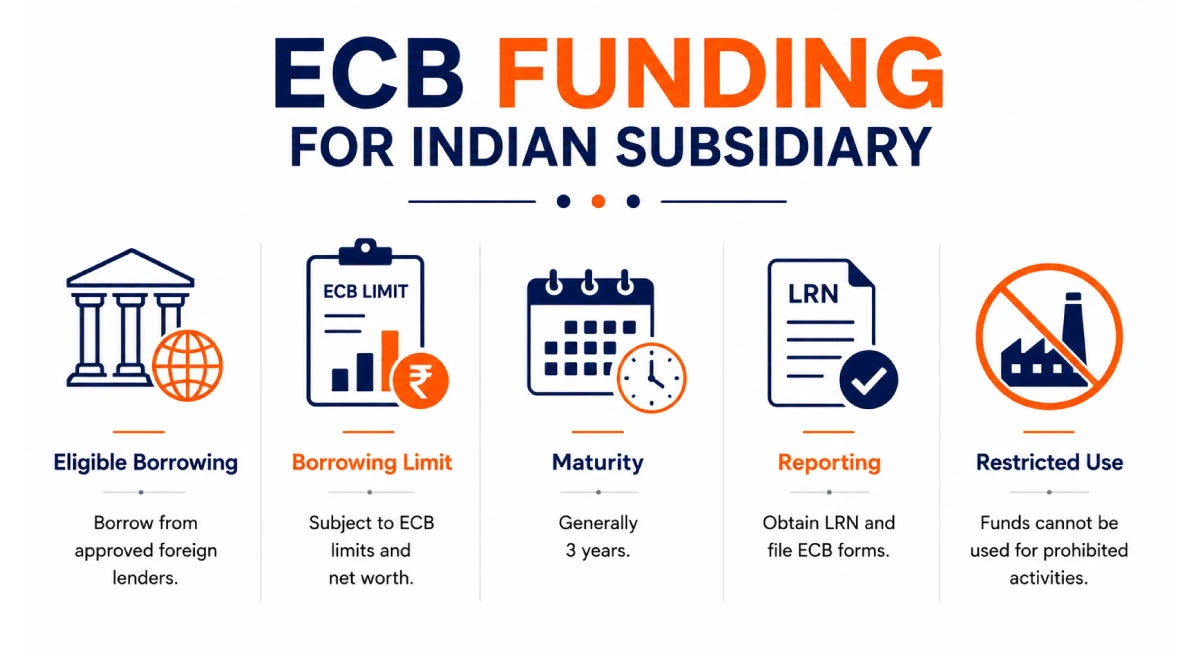
External Commercial Borrowings
External Commercial Borrowing, commonly known as ECB, is another route for the Funding of an Indian Subsidiary. It allows an eligible Indian entity to borrow funds from a recognised non-resident lender.
Under the ECB framework effective from February 16, 2026, a person resident in India, other than an individual, incorporated, established or registered under a Central or State law, may qualify as an eligible borrower, subject to the law governing that entity.
An Indian subsidiary may raise an ECB from:
- A person resident outside India
- An overseas branch of an entity whose lending business is regulated by RBI
- A financial institution or its branch established in an IFSC
The ECB may be denominated in foreign currency or Indian rupees.
ECB Borrowing Limit
An eligible borrower may raise the ECB within the higher of:
- Outstanding ECB of up to USD 1 billion; or
- Total outstanding external and domestic borrowing of up to 300% of its net worth, based on its latest audited standalone balance sheet
The proposed ECB must also be included while checking the borrowing limit. Separate conditions may apply to borrowers regulated by financial-sector regulators.
Minimum Maturity Period
The minimum average maturity period for an ECB is generally three years.
However, an eligible borrower engaged in manufacturing may raise an ECB with an average maturity between one and three years, provided the total outstanding ECB under this shorter-maturity category does not exceed USD 150 million.
Cost and Related-Party ECB
Where the Funding of an Indian Subsidiary is arranged through an ECB from a related party, including the foreign parent company, the borrowing cost must be consistent with prevailing market conditions and structured on an arm’s-length basis.
ECB Registration and Reporting
Before drawing the funds, the Indian subsidiary must obtain a Loan Registration Number through its designated AD Category-I bank.
The borrower must submit:
- Form ECB 1: To report the proposed ECB and obtain the LRN
- Revised Form ECB 1: To report changes in previously submitted ECB details
- Form ECB 2: To report receipt of ECB proceeds and repayment or servicing of the debt
Revised Form ECB 1 must generally be submitted within seven calendar days from the end of the month in which the change occurred. Form ECB 2 must also be submitted within seven calendar days from the end of the month in which funds were received or debt was serviced.
Restricted Uses of ECB Funds
ECB proceeds cannot be used for restricted purposes. These include, among others:
- Chit-fund activities
- Nidhi Company activities
- Certain real estate business activities
- Construction of farmhouses
- Trading in transferable development rights
- Specified transactions in listed or unlisted securities
- On-lending for restricted purposes
- Repayment of domestic loans used for prohibited activities
- Repayment of domestic loans classified as non-performing assets
Certain exceptions may apply to permitted construction-development, infrastructure, and strategic corporate transactions. Therefore, the proposed end use should be reviewed before drawing an ECB.
Rupee-Denominated Overseas Bonds
Rupee-denominated overseas bonds, commonly known as Masala Bonds, may also support the Funding of an Indian Subsidiary. These bonds allow an Indian company to raise debt from overseas investors in Indian rupees.
Since the principal and interest are denominated in rupees, the overseas investor generally bears the INR exchange-rate risk, subject to any hedging or contractual arrangement.
Rupee-denominated overseas borrowing falls within the ECB framework. Therefore, it must comply with borrower eligibility, recognised-lender requirements, borrowing limits, maturity, cost, end-use, and reporting conditions.
Masala Bonds should not be treated as an unrestricted funding route merely because the borrowing is denominated in Indian rupees.
Funding Through Non-Convertible Debentures
An Indian subsidiary may also raise debt through Non-Convertible Debentures (NCDs). Where a registered Foreign Portfolio Investor invests in eligible corporate debt securities issued by the Indian company, the investment is governed by the FEMA debt-instrument framework along with applicable RBI and SEBI requirements.
NCD funding differs from equity because it creates a debt obligation. The issuing company must repay the principal and comply with the agreed interest, maturity and redemption terms.
FPI investment in NCDs may be made subject to applicable investment limits, issue conditions, listing requirements and other RBI, SEBI and Companies Act provisions. The applicable route should be identified before the investment is accepted because a debt investment by a foreign parent that does not qualify under the FPI or another permitted debt-investment framework may instead fall within the ECB rules.
Therefore, NCDs should be considered only after reviewing the status of the foreign investor, nature of the instrument, proposed maturity, listing requirements and applicable foreign-investment regulations.
Commercial Payments from the Foreign Parent
Genuine commercial receipts may support the Funding of an Indian Subsidiary only when the Indian entity actually supplies goods or services to its foreign parent under a properly documented arrangement.
For example, the Indian subsidiary may provide:
- Software development services
- Consulting services
- Marketing support
- Administrative support
- Research services
- Accounting or back-office services
The parties should enter into a commercial agreement describing the services, responsibilities, consideration, invoicing terms, and supporting documents.
Service payments should not be used merely as a substitute for equity or debt funding. There must be an actual service, commercial substance, valid invoices, and evidence that the subsidiary performed the agreed work.
Transactions between a foreign parent and its Indian subsidiary may qualify as international transactions between associated enterprises. Income, expenses, and interest arising from such transactions must generally be evaluated according to the arm’s-length principle.
The subsidiary should also review transfer-pricing documentation, GST, withholding-tax, foreign exchange and income-recognition requirements.
Which Funding Option Should an Indian Subsidiary Choose?
The appropriate Funding of an Indian Subsidiary structure depends on:
- Purpose for which the funds are required
- Expected duration of the funding
- Ability of the subsidiary to repay
- Requirement to maintain ownership or control
- Applicable FDI sectoral limits
- Foreign exchange exposure
- Tax implications for both entities
- FEMA and RBI reporting requirements
- Cost of borrowing and interest payments
- Restrictions on the use of funds
Equity funding may be suitable for long-term expansion where the subsidiary does not want an immediate repayment obligation.
ECB may be considered when the subsidiary requires debt funding from its foreign parent or another recognised overseas lender.
NCDs may suit structured debt investment through an eligible FPI. Genuine commercial arrangements may generate regular business receipts but should not be treated as a replacement for capital investment.
Manage Subsidiary Funding Compliance with Ebizfiling
Ebizfiling assists Indian subsidiaries with the regulatory filings required for receiving and reporting foreign investment.
- FDI Compliance: Support with foreign investment documentation and applicable requirements.
- FC-GPR Filing: Assistance with reporting shares issued to foreign investors.
- FLA Return Filing: Support with annual RBI reporting of foreign assets and liabilities.
- ROC Compliance: Assistance with share allotment and related company filings.
Connect with Ebizfiling for professional support with Indian Subsidiary Registration, FDI, RBI, and ROC compliance requirements.
Conclusion
The Funding of an Indian Subsidiary requires careful planning because each route has separate regulatory, tax, pricing, maturity and reporting requirements. A foreign parent should assess whether funds should be introduced through equity shares, convertible instruments, ECB, rupee-denominated overseas bonds, NCDs or genuine commercial receipts. Selecting the right structure and completing the applicable FEMA, RBI, tax and company-law compliances can help the Indian subsidiary receive funds without creating avoidable regulatory issues.
Frequently Asked Questions
1. How can a foreign parent arrange the Funding of an Indian Subsidiary?
A foreign parent may provide funds through equity shares, fully and mandatorily convertible instruments, or an eligible ECB. It may also pay the subsidiary for genuine goods or services supplied under a commercial agreement. The selected route must comply with applicable FEMA, RBI, Foreign Direct Investment (FDI) and tax conditions.
2. Can a foreign parent give an ordinary loan to its Indian subsidiary?
A foreign parent cannot provide an unrestricted ordinary loan outside the applicable foreign-exchange framework. A repayable loan will generally need to satisfy ECB requirements relating to eligibility, maturity, permitted end use, Loan Registration Number, and reporting.
3. Which instruments qualify as FDI in an Indian subsidiary?
Equity shares, fully and mandatorily convertible preference shares, fully and mandatorily convertible debentures, and eligible share warrants may qualify as equity instruments. Optionally convertible, partly convertible or non-convertible preference shares and debentures are generally treated as debt.
4. What is the current ECB limit for a foreign parent funding an Indian subsidiary?
An eligible borrower may raise ECB up to the higher of outstanding ECB of USD 1 billion or total outstanding external and domestic borrowing of up to 300% of net worth. The calculation is based on the latest audited standalone balance sheet, subject to applicable exceptions.
5. What is the minimum maturity period for an ECB raised by an Indian subsidiary?
The minimum average maturity period is generally three years. An eligible manufacturing company may raise an ECB with a maturity between one and three years if the outstanding amount under this category does not exceed USD 150 million.
6. Can ECB funds be used to purchase property or securities?
ECB funds cannot generally be used for restricted real estate business, construction of farmhouses, or transactions in listed and unlisted securities. Limited exceptions may apply to permitted development projects, infrastructure activities, and specified strategic corporate transactions.
7. Is Form FC-GPR required for every subsidiary funding option?
No. Form FC-GPR is required when an Indian company issues eligible equity instruments to a person resident outside India. It is not used for an ECB or FPI investment in NCDs. Form FC-GPR must generally be filed within 30 days from the date of issuing the equity instruments.
8. Can an Indian subsidiary issue NCDs to a foreign investor?
An Indian subsidiary can issue NCDs to a registered FPI, subject to FEMA Debt Instruments Regulations, RBI/SEBI rules, and the Companies Act. Eligibility depends on the investment route, type and maturity of NCDs, listing status, and applicable FPI limits. Proper structuring and compliance are essential to avoid regulatory issues.
9. How can Ebizfiling help with the Funding of an Indian Subsidiary?
Ebizfiling can assist businesses in understanding the compliance requirements connected with equity investment, ECB reporting, corporate approvals and applicable company filings. The final structure should be selected after reviewing the company’s sector, ownership, proposed end use, and repayment terms.
10. Which funding option is best for a foreign parent investing in an Indian subsidiary?
The right option depends on whether the foreign parent wants permanent capital, repayment with interest, or payment against genuine services. Ebizfiling can help assess the documentation and compliance requirements based on the proposed transaction and business circumstances.





Indian Subsidiary
Register Indian Subsidiary in India at affordable prices
About Ebizfiling -



Reviews
Amrish Ganatra
28 Nov 2017"Our Company being an Indian Subsidiary requires much compliance, but ebizfiling has provided us end to end services. They are very important part of our business. They handle all of the legal tasks in India. I highly recommend ebizfiling for non-residents thinking of starting a project in India."
Rehan Khan
30 Jan 2018Timely services + Best Pricing + Efficient staff = Ebizfiling. It is the best company that I have come across for my compliance needs. Thank you, Ebizfiling
July 9, 2026 By Steffy A
AML obligations for Practicing CS under FIU-IND Framework Introduction AML obligations for Practicing CS are becoming increasingly important in today’s evolving regulatory environment, where the role of Practicing Company Secretaries has expanded beyond traditional compliance functions into areas involving corporate […]
June 26, 2026 By Steffy A
Why Online Legal Services Are Growing in India? Introduction The legal industry is evolving rapidly as technology reshapes how legal assistance is delivered. In India, online legal services are growing because they address historical challenges such as court backlogs, complex […]
June 26, 2026 By Steffy A
Why More Businesses Are Choosing Outsourcing Legal Work? Introduction Businesses are increasingly turning to outsourcing legal work to manage compliance, contracts, and regulatory responsibilities more efficiently. Through Legal Process Outsourcing, companies can reduce operational costs while gaining access to experienced […]