


-
June 23, 2026
-
BySteffy A
Form 121 Income Tax: New Rule Replacing Form 15G and 15H
Form 121 Income Tax : The New Unified Declaration for Nil TDS
The new rules of the Income-tax Act, 2025 mandate that the standard form of declaration for TDS exemption is now Form 121 Income Tax.
Form 121 declaration is an advance declaration form that allows resident individuals and HUFs to declare that their projected tax burden for the fiscal year is zero. If this form is approved, the payer will not be able to deduct TDS on specified income. Essentially, the aim of Form 121 is to allow taxpayers the option of not having their tax deducted at source if the tax owed is zero.
Form 121 Income Tax does not exclude your income from taxation. It prohibits tax deducted at source (TDS) from being levied in certain cases. Before completing the form, taxpayers should ensure that all of the information they have submitted is correct, full, and genuine.
Why Did the Government Replace Form 15G and 15H?
The goal to simplify and enhance the efficiency of the TDS declaration procedure for taxpayers was the primary driving force for the introduction of new forms in place of the previous iterations of 15G and 15H. The form used to have two versions for every age group. Banks have to keep track of and validate both forms independently since people frequently misunderstand them. The system was unduly burdened by its complexity.
The government’s transition to a one-form system is shown by Form 121 Income Tax. This modification is a part of a broader move away from human mistakes and toward digital tax compliance. In addition to guaranteeing openness for taxpayers, a uniform form facilitates reporting and verification.
The other key factor is to establish uniformity. Rather than multiple forms for the same purpose, the Form 121 Income Tax brings about a uniform system for all eligible taxpayers, regardless of whether they’re below 60 years of age or senior citizens.
In all, the move from Forms 15G and 15H Information to the new one is part of a broader effort to simplify, digitize, and streamline tax compliance.
Eligibility Criteria: Who Can File Form 121 Income Tax?
- Resident individuals who is below 60 years
- Resident individuals who aged 60 years or above (senior citizens)
- Hindu Undivided Families (HUFs)
- Other specified eligible entities as per Income Tax rules
Not Eligible
- Companies
- Partnership firms
- Non-residents
Specified Income Sources Covered Under Form 121 Income Tax
- PF withdrawals and pension income
- Insurance commission earnings
- Rental income
- Interest income from bank deposits or FDs
- Income from mutual funds
- Payments from life insurance policies
- Dividend income
How to Properly Furnish Form 121?
The procedure of completing Form 121 Income Tax includes giving accurate personal and income information.
Steps to Fill Form 121 Income Tax
- Enter the declarant’s name and PAN
- Mention the financial year for which the declaration is being made
- Provide details of your estimated total income
- Confirm that your expected tax liability is nil
- Sign the declaration
Important:
- Always review the form carefully before submission
- Ensure all details are accurate and complete to avoid rejection or compliance issues
The Role of the Payer and UIN Generation
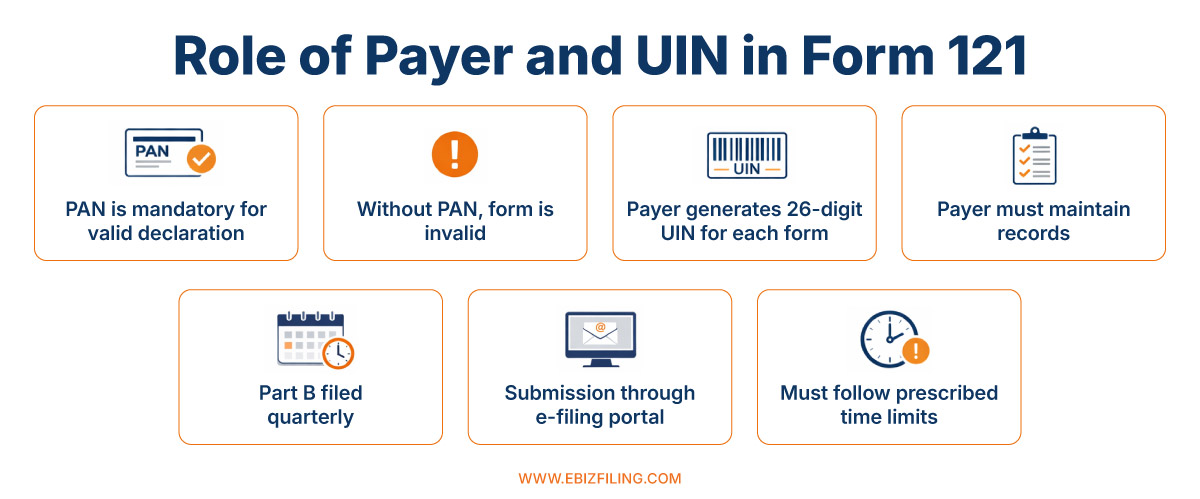
- The declaration must provide a valid PAN in the form.
- Without PAN, the declaration will be treated as invalid.
- The payer must generate a 26-character Unique Identification Number (UIN) for each declaration received.
- The payer is required to maintain proper records of all declarations.
- Part B of Form 121 must be submitted by the payer on a quarterly basis.
- Submission is done electronically through the income tax e-filing portal
- The reporting must be completed within the time limit specified under Section 393(7) of the Income Tax Act, 2025.
Common Changes Made Across Forms:
1. To make forms system-friendly and enable e-filing and uploading, certain anomalies found due to grouping of Name, Designation, Address and PAN have been separated into different boxes.
2. Assessment / Financial / Previous year or years have been replaced with Tax year or years, wherever appearing in the form or annexures.
3. Changes in sections, clauses and schedules have been aligned as per the Income-tax Act, 2025.
4. Currency symbol “Rs.” has been replaced with “₹”.
Real-Life Example
Recently, we at Ebizfiling helped a customer whose pension and FD income was below the taxable threshold. To avoid TDS, we suggested that they file Form 121. Nevertheless, they made extra money from mutual funds that same year.
We helped them establish the appropriate tax and correctly completing their return to avoid penalties as their whole income became taxable. This is an average situation that emphasizes how important it is to plan before filing Form 121.
Comparison: How Form 121 Income Tax Differs from the Old Regime
|
Basis |
Form 15G |
Form 15H |
Form 121 |
|
What it was for |
A declaration to ask the payer not to deduct TDS on eligible income | The same purpose, but meant for senior citizens |
A single replacement form is now used for the same broad purpose |
|
Who it applied to |
Resident individuals below 60 and certain other eligible resident persons, excluding companies and firms | Resident individuals aged 60 or above |
Eligible taxpayers who would earlier have used either Form 15G or Form 15H |
|
Age split |
Below 60 years | 60 years or more |
No separate form by age since both earlier forms are merged into one |
|
Tax condition |
Could be used only where the estimated tax liability for the year was nil | Could be used only where the estimated tax liability for the year was nil |
The nil-tax-liability condition continues under the new framework |
|
Income threshold point |
Also carried the additional condition that the person’s total income for the year, including the income for which the declaration was being filed, should not exceed the basic exemption limit. | This extra cap did not apply in the same way for senior citizens |
The merged form retains the underlying eligibility conditions but removes the need for separate forms based on age, both below-60 and senior citizen taxpayers now use a single form |
|
Legal basis |
Section 197A of the Income-tax Act, 1961 | Section 197A of the Income-tax Act, 1961 |
Section 393(6) of the Income-tax Act, 2025 |
|
Form format |
Separate form | Separate form |
Unified form that replaces both from tax years starting on or after 1 April 2026 |
|
Main practical change |
Taxpayers had to decide whether 15G was the right form | Taxpayers had to decide whether 15H was the right form |
That confusion is removed because there is now one common form instead of two |
For detailed understanding and the official format of Form 121, you can refer to the Income Tax Department’s official PDF available here: Download Form 121 PDF.
How Ebizfiling Helps You with Form 121 Income Tax
- We help you understand the new changes replacing Forms 15G and 15H.
- Evaluate your eligibility to file Form 121 Income Tax based on your income and tax position.
- We ensure your declaration is accurate, complete, and compliant with the Income-tax Act, 2025.
- Our expert guides you through the proper submission process and required documentation.
- We help you avoid common mistakes that may lead to TDS deduction or reply to tax notices.
- Our Team supports you in managing multiple income sources for better tax planning.
Conclusion
Form 121 Income Tax is a stride towards a simpler tax compliance regime in India. The consolidation of Forms 15G and 15H into one form has eliminated confusion and standardised the process. But with simplicity comes accountability. It’s important for taxpayers to declare accurately and ensure they have no tax liability. Improper use and filing can result in non-compliance. Properly utilising Form 121 can help you plan your income effectively, without the liability of TDS, making the tax planning process less uncertain.
Frequently Asked Questions
1. What happens If Form 121 is filed and the taxpayer's income becomes taxable?
Form 121 Income Tax is a declaration of estimated income. If the taxpayer files the form and assumes that his/her income will be exempt from tax, and subsequently earns more income which will take him/her to the taxable income, then he/she will be liable to pay tax.
2. Why do one need to submit different for the same source?
Every employer/payer (bank, company, financial institution) is responsible for deducting TDS from the payment made by them. As they do not have information about your total income from all sources, they are dependent on the information provided by you.
3. How does the UIN system enhance compliance under Form 12 over previous forms?
The Unique Identification Number (UIN) system brings in an element of monitoring and accountability. All declarations filed with the payer are given a UIN, and the payer reports the UIN to the Income Tax Department in quarterly statements. This enables the tax department to monitor all non-deductions of TDS due to Form 121 Income Tax.
4. Can Form 121 be filed if the taxpayer has multiple sources of income but total tax is nil?
Yes, a taxpayer who has more than one source of income (such as interest, dividend, rent and pension), but overall tax liability is nil, can use Form 121 Income Tax. But it is necessary that the total tax payable is nil, not the income from one source.
5. Why doesn't Form 121 eliminate the need to file an income tax return?
Form 121 Income Tax is only meant to resolve the problem of TDS deduction. It does not exempt you from filing an income tax return if you are liable. You may need to file a return if your income is above the basic exemption limit or for other reasons.
6. What happens if I file Form 121 without calculating my income?
Filing Form 121 Income Tax without properly calculating your income can have severe repercussions. You could be issued a notice by the Income Tax Department if they determine your income was taxable. This will require you to pay the pending tax, along with interest and sometimes penalties.
7. What is the effect of digital reporting and AIS on Form 121 Income Tax declarations?
Now, with the introduction of the AIS (Annual Information Statement) and other reporting mechanisms, the Income Tax Department has access to all financial flows, such as interest income, dividends and other income. When you file a Form 121, the income tax department receives a report from the payer with a UIN number.
8. Is it possible to correct or revise the income tax form 121?
There is no provision to revise Form 121 once it has been submitted to the Payer. If an error is made, it’s best to notify the payer as soon as possible and provide a revised declaration if possible.
9. When filing Form 121, how can taxpayers avoid non-compliance?
The first step for taxpayers is to estimate their total income and include all income streams, including interest, rent, dividend and other income.CA Services for Income Tax Return Filing at Ebizfiling assist taxpayers to determine eligibility, review income and ensure the Form 121 Income Tax is filed accurately, without risking any future tax notices and penalties.
10. How can Ebizfiling help taxpayers with multiple incomes for Form 121?
At Ebizfiling, we know taxpayers have diverse sources of income, investments, and financial circumstances, making the process of filing Form 121 Income Tax complex. We offer complete support from income review to submission advice.





Business Income Tax Return Filing
Quick & Accurate ITR Filing
About Ebizfiling -



October 15, 2026 By Srishti M
TDS and TCS Compliance Calendar November 2026: Compliance Guide Introduction The TDS and TCS Compliance Calendar November 2026 covers important tax deduction, collection, payment, certificate and reporting requirements applicable during the month. It helps businesses, government offices and other responsible […]
October 14, 2026 By Srishti M
GST Compliance Calendar November 2026: Key Due Dates & Filings Introduction The GST Compliance Calendar November 2026 highlights the major GST return filing, tax payment, invoice reporting and year-end adjustment deadlines applicable during the month. It covers regular taxpayers, QRMP […]
October 13, 2026 By Srishti M