


-
September 22, 2026
TDS Return for Post Office Interest: Complete Guide
Introduction
Interest earned from eligible Post Office deposits can attract Tax Deducted at Source when the prescribed conditions are met. From 1 April 2026, TDS events where the earlier of credit or payment occurs on or after that date are governed by the Income-tax Act, 2025.
The TDS Return for Post Office Interest is mainly the responsibility of the deductor. The depositor reports taxable interest in the applicable income tax return and claims eligible credit for tax already deducted.
This guide explains the TDS Return for Post Office Interest under the new law, including thresholds, Form 140, Form 121, due dates, and tax credit.
Quick Insights
- Section 393 covers TDS on qualifying Post Office interest paid to a resident.
- The threshold is ₹1,00,000 for senior citizens and ₹50,000 for others.
- Once the threshold is exceeded, deduction applies to the entire covered interest amount.
- Form 140 is the quarterly statement for non-salary TDS paid to residents.
- Form 121 can be used by eligible persons for specified income without TDS.
What is TDS on Post Office Interest?
TDS is a mechanism under which the payer deducts tax from specified income and deposits it with the Central Government. Section 393(1), Table Sl. No. 5(ii) covers interest other than interest on securities paid by a Post Office for a deposit under a scheme notified by the Central Government.
Where the aggregate covered interest exceeds the prescribed threshold, tax is deducted on the entire amount, generally at the earlier of credit or payment. The TDS Return for Post Office Interest is the deductor’s quarterly reporting of this tax.
When Does TDS Apply to Post Office Interest?
TDS on Post Office interest applies when the deposit is covered under the relevant provision and the total eligible interest credited or paid during the tax year exceeds the prescribed limit.
|
Depositor Category |
Annual Interest Threshold |
|
Senior citizen |
₹1,00,000 |
| Person other than senior citizen |
₹50,000 |
Once the relevant threshold is crossed, TDS applies to the entire covered interest amount and not only to the amount exceeding the threshold.
For example, if a non-senior citizen earns ₹55,000 as covered Post Office interest during the tax year, the ₹50,000 threshold is crossed. Subject to other applicable provisions, TDS will apply to the covered amount and must be reflected in the TDS Return for Post Office Interest.
TDS Rate on Post Office Interest
The applicable TDS rate for interest other than interest on securities paid to a resident is generally 10%, subject to PAN availability and other applicable provisions. Before preparing the TDS Return for Post Office Interest, the deductor should verify the applicable rate, PAN details, and the nature of the deposit.
It is also important to remember that TDS on interest income is only a mechanism for collecting tax in advance. The final tax liability depends on the depositor’s total taxable income, applicable deductions, exemptions, and tax regime.
Which Form is Used for TDS Return for Post Office Interest?
For Tax Year 2026-27 onward, Form 140 is used as the quarterly statement for TDS on non-salary payments made to residents. It replaces the earlier Form 26Q under the new Income-tax framework. Therefore, the TDS Return for Post Office Interest is reported through Form 140 wherever the relevant TDS provisions apply.
The deductor must have a valid Tax Deduction and Collection Account Number, commonly known as TAN, and should use the prescribed return preparation and validation utilities.
Details Required for TDS Return for Post Office Interest
Accurate information is important while preparing the TDS Return for Post Office Interest because errors can result in mismatched tax credits or correction requirements.
The return generally requires the following information:
- TAN and details of the deductor
- PAN and name of the depositor
- Amount of interest paid or credited
- Date of payment or credit
- Amount of TDS deducted
- Date of deduction
- TDS payment details
- Relevant tax year
- Applicable quarter
- Relevant TDS provision
The depositor’s category should also be verified because the threshold for senior citizens is different from the threshold applicable to other taxpayers.
How to File TDS Return for Post Office Interest?
The TDS Return for Post Office Interest is filed through the prescribed Form 140 process.
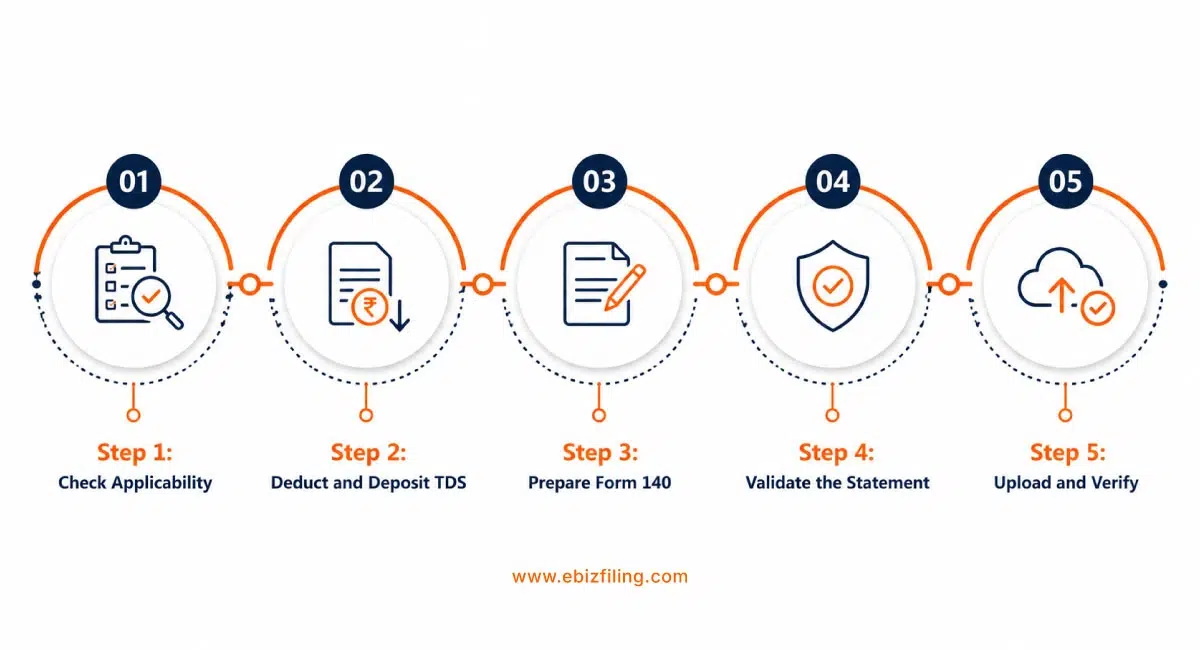
Step 1: Check Applicability
The deductor should first check whether the interest is covered under Section 393(1), Table Sl. No. 5(ii), and whether the applicable annual threshold has been crossed.
Step 2: Deduct and Deposit TDS
Calculate TDS using the applicable rate and deposit the deducted amount with the Central Government within the prescribed timeline.
Step 3: Prepare Form 140
Enter deductor, depositor, interest, TDS, and payment details in the latest Return Preparation Utility.
Step 4: Validate the Statement
Validate the statement using the prescribed utility and correct any errors relating to PAN, TAN, tax year, quarter, deduction amount, or payment information.
Step 5: Upload and Verify
Log in to the Income Tax e-Filing portal using TAN, select the relevant Form 140, upload the validated return file, and complete the verification process. If errors are discovered after filing, a TDS return revision may be required to correct the reported information.
Due Dates for TDS Return for Post Office Interest
The TDS Return for Post Office Interest is filed quarterly through Form 140.
|
Quarter |
Period |
Due Date |
|
Q1 |
April to June | 31 July |
| Q2 | July to September |
31 October |
|
Q3 |
October to December | 31 January |
| Q4 | January to March |
31 May of the following year |
Filing the return within the applicable due date helps ensure proper compliance and timely reflection of TDS credit in the taxpayer’s records.
Can TDS on Post Office Interest Be Avoided?
Under the Income-tax Rules applicable from Tax Year 2026-27, Form 121 replaces the earlier Forms 15G and 15H for eligible declarations relating to specified income without deduction of tax. Form 121 can be submitted by an eligible person when the prescribed conditions are satisfied and the estimated tax liability for the tax year is nil.
For individuals below 60 and other eligible declarants, additional income-related conditions may apply. Senior citizens may submit the declaration where tax on their estimated total income is nil, subject to the prescribed requirements. This provision is relevant to the TDS Return for Post Office Interest because a valid declaration may allow eligible Post Office interest to be received without TDS.
However, avoiding TDS does not automatically mean that the interest income is exempt from tax. The taxpayer must still determine the taxability of the interest while filing the applicable income tax return.
TDS Certificate for Post Office Interest
Under the new Income-tax framework, Form 131 replaces the earlier Form 16A for TDS on income other than salary. The deductor issues Form 131 to the deductee as evidence of the tax deducted and deposited with the Government.
The depositor should verify the information in the TDS certificate, including PAN, interest income, and tax deducted, and ensure that it matches the TDS Return for Post Office Interest filed by the deductor. Any difference should be addressed before the taxpayer claims the corresponding TDS credit.
How to Check TDS Credit?
From Tax Year 2026-27 onward, Form 168 serves as the Annual Information Statement under the new Income-tax framework and corresponds to the earlier Form 26AS. The statement contains information relating to TDS, TCS, tax payments, and other prescribed financial information linked to the taxpayer’s PAN.
After the TDS Return for Post Office Interest is processed, the depositor should check Form 168 to confirm whether the TDS amount has been correctly reflected. The PAN, interest amount, and TDS amount should match the depositor’s records. If the TDS credit is missing because incorrect details were reported, the deductor may have to revise the statement.
The eligible credit can then be claimed while completing the taxpayer’s Income Tax Return filing.
TDS Return vs Income Tax Return
A TDS Return for Post Office Interest and an Income Tax Return are not the same.A TDS return is filed by the deductor to report tax deducted from specified payments and deposited with the Government. An Income Tax Return is filed by the taxpayer to report income earned during the tax year, calculate the final tax liability, claim deductions or exemptions, and claim eligible TDS credit.
Therefore, a depositor generally does not file a separate TDS return simply because the Post Office has deducted tax from the interest. Instead, the taxpayer reports the taxable Post Office interest in the applicable Income Tax Return and claims eligible credit for the tax already deducted.
It is also important to remember that no TDS does not necessarily mean no tax. Interest may still be taxable even when the amount is below the TDS threshold or when a valid Form 121 declaration has been submitted.
Mistakes in TDS Return for Post Office Interest
Several errors can occur while preparing the TDS Return for Post Office Interest. One common mistake is applying the wrong threshold. The threshold applicable to senior citizens is different from the threshold for other taxpayers. Another error is deducting TDS only on the amount exceeding the threshold. Once the prescribed limit is crossed, deduction applies to the entire amount covered by the provision.
Incorrect PAN details can also result in the tax credit not appearing correctly in the taxpayer’s records. Other common mistakes include selecting the wrong tax year, filing under the wrong quarter, entering an incorrect interest amount, ignoring an eligible Form 121 declaration, or reporting incorrect TDS payment information.
Deductors should therefore verify all information before filing the TDS Return for Post Office Interest.
Why Accurate TDS Reporting Matters
- Correct Credit: Accurate reporting helps ensure that the deducted amount is credited to the correct taxpayer.
- Record Matching: Correct PAN, interest, and TDS information helps maintain consistency between the return and Form 168.
- Timely Compliance: Filing the TDS Return for Post Office Interest within the prescribed due date helps avoid compliance issues.
- Fewer Corrections: Accurate information reduces the need for revised TDS statements and additional reconciliation.
File Your Post Office Interest TDS Return with Confidence
Changes under the Income-tax Act, 2025 may bring new section references, forms, and reporting requirements for deductors filing TDS statements. Keeping track of these changes while ensuring accurate reporting can take time and attention.
Ebizfiling can support businesses and deductors with the TDS Return for Post Office Interest, from preparing and filing the return online to reviewing TDS details and correcting reporting errors. Our team can also assist taxpayers with TDS credit reconciliation and the correct reporting of taxable post office interest in their Income Tax Return. With Ebizfiling, you can manage your TDS filing requirements with better clarity, accuracy, and professional support.
Need help with TDS Return for Post Office Interest? Connect with Ebizfiling today and get expert assistance with accurate preparation, filing, and TDS compliance.
Conclusion
The TDS Return for Post Office Interest is an important compliance requirement when qualifying Post Office interest paid to a resident exceeds the prescribed threshold under Section 393. The annual threshold is ₹1,00,000 for senior citizens and ₹50,000 for other eligible taxpayers. When the applicable threshold is crossed, TDS is generally deducted on the entire amount covered by the provision.
For Tax Year 2026-27 onward, Form 140 is used for quarterly non-salary TDS reporting, while Form 121 is used by eligible persons for declarations relating to specified income without TDS. Form 131 serves as the TDS certificate for non-salary income, and Form 168 provides annual tax information.
Understanding the TDS Return for Post Office Interest helps deductors file accurate statements and enables depositors to verify and claim the correct tax credit while filing their Income Tax Return.
Frequently Asked Questions
1. Can excess or short TDS on Post Office interest be adjusted within the same tax year?
Yes. The deductor can increase or reduce a subsequent TDS deduction during the same tax year to adjust an excess deduction, short deduction, or earlier failure to deduct. This adjustment facility is specifically available for interest covered under Section 393(1), including qualifying Post Office interest. The adjustment should be properly reflected while preparing the TDS Return for Post Office Interest.
2. Can a taxpayer apply for a lower or nil TDS certificate on Post Office interest?
Yes. A taxpayer can apply for a certificate for deduction at a lower rate or nil rate under Section 395 of the Income-tax Act, 2025, if the estimated total income justifies it. The application is made through Form 128, which replaces the earlier Form 13. Once issued, the deductor must follow the rate specified in the certificate during its validity.
3. Must Form 121 be reported if no TDS is deducted on Post Office interest?
When a valid Form 121 declaration is received, the payer must comply with the prescribed quarterly Form 121 reporting requirements. The payer is required to furnish the relevant declaration details, including the UIN, through Form 121 within the prescribed timeline.
4. Is PAN mandatory for submitting Form 121 for Post Office interest?
Yes. The declarant must quote a valid PAN in Form 121. The payer is also required to allot a 26-character Unique Identification Number, or UIN, to each declaration received. The UIN and declaration details are used for subsequent TDS reporting, allowing the tax department to identify cases where specified income was paid without deduction of tax.
5. What is the TDS rate on Post Office interest if PAN is not provided?
If a valid PAN is not furnished, TDS can apply at a substantially higher rate. Under Section 397(2), tax is deducted at the highest of the rate specified in the relevant provision, the rate in force, or 20% for Post Office interest and other cases not covered by the special 5% categories. Providing a valid PAN is therefore important for correct TDS deduction and credit.
6. What happens if the Post Office fails to deduct TDS but the depositor has already paid the tax?
The deductor may obtain relief from being treated as an assessee in default if the depositor has filed the income tax return, included the relevant interest income, and paid the applicable tax. For this purpose, Form 149, which replaces the earlier Form 26A, contains an accountant’s certificate confirming that these conditions have been fulfilled. Interest liability for the deductor may still apply.
7. What interest applies if TDS on Post Office interest is deducted or deposited late?
If TDS was required but was not deducted on time, interest generally applies at 1% per month or part of a month from the date it was deductible until the date of deduction. If TDS was deducted but deposited late, interest generally applies at 1.5% per month or part of a month from the date of deduction until actual payment. These consequences are covered under Section 398(3) of the Income-tax Act, 2025.
8. What is the time limit for correcting an incorrect Form 140 TDS statement?
A correction statement can generally be furnished within two years from the end of the tax year in which the original TDS statement was required to be delivered. This can be used to correct errors such as incorrect PAN, challan information, deduction details, or deductee information reported in Form 140. Correcting errors early can also help prevent delays in TDS credit.
9. Can Ebizfiling help correct PAN or challan errors in a TDS Return for Post Office Interest?
Yes. Ebizfiling provides TDS return revision services for errors involving PAN, challan details, deduction amounts, deductee information, and omitted entries. The service also includes assistance with consolidated files from TRACES and validation of correction statements using FVU. This can help where incorrect information in a TDS Return for Post Office Interest affects the depositor’s tax credit.
10. Can Ebizfiling assist with a TDS notice caused by an incorrect Post Office interest return?
Yes. Ebizfiling offers TDS return revision support that can include downloading the justification file, identifying the reason for a TDS demand, preparing the required correction, and assisting with replies to Income Tax notices depending on the selected service package. This can be useful when a Form 140 mismatch, incorrect PAN, challan error, or deduction difference results in a notice or demand.





File TDS Returns
Quickly file error-free TDS Returns with EbizFiling. This ensures seamless credit to the deductee. Prices Starting INR 999/-.
About Ebizfiling -



Reviews
Amrish Ganatra
28 Nov 2017"Our Company being an Indian Subsidiary requires much compliance, but ebizfiling has provided us end to end services. They are very important part of our business. They handle all of the legal tasks in India. I highly recommend ebizfiling for non-residents thinking of starting a project in India."
Deepika Khan
29 Sep 2018I would rate 5/5 for their services, pricing and transparency.
Ganesh Pujari
15 Oct 2017I would give 5 stars to Ebizfiling for everything. Service, Professionalism, Dedication, Timely Action and Good Pricing.
October 15, 2026 By Srishti M
TDS and TCS Compliance Calendar November 2026: Compliance Guide Introduction The TDS and TCS Compliance Calendar November 2026 covers important tax deduction, collection, payment, certificate and reporting requirements applicable during the month. It helps businesses, government offices and other responsible […]
October 14, 2026 By Srishti M
GST Compliance Calendar November 2026: Key Due Dates & Filings Introduction The GST Compliance Calendar November 2026 highlights the major GST return filing, tax payment, invoice reporting and year-end adjustment deadlines applicable during the month. It covers regular taxpayers, QRMP […]
October 13, 2026 By Srishti M