GST refund on flat booking cancellation explained

GST Refund on Flat Booking Cancellation: Guide for Unregistered Buyers

Introduction

Cancelling a flat booking after paying GST can leave buyers with an important question — what happens to the GST amount already paid to the builder?
A GST Refund on Flat Booking Cancellation may be available depending on whether the builder can still adjust the tax through a GST credit note or whether the buyer needs to claim the amount directly from the GST department.


To address such situations, CBIC issued Circular No. 188/20/2022-GST, which explains the refund mechanism for unregistered persons in cases where a contract or agreement for supply of services, such as construction of a flat, is cancelled and the supplier is unable to issue a credit note within the permitted time.


In such cases, an eligible buyer may file a refund application directly with the GST department, subject to the prescribed conditions, documents and time limit.


This article explains the GST Refund on Flat Booking Cancellation, including when the builder should refund the GST, when the buyer may approach the GST department, the filing process, documents required, applicable time limit and refund calculation.


Quick Insights

  • GST refund on flat booking cancellation may be claimed by eligible unregistered buyers.
  • This refund applies where GST was charged on construction services for a flat or building.
  • The buyer can file refund only when the builder cannot adjust GST through a credit note.
  • FORM GST RFD-01 is filed under the category “Refund for Unregistered Person”.
  • The refund claim should generally be filed within 2 years from the cancellation letter date.


What is GST Refund on Flat Booking Cancellation?

GST refund on flat booking cancellation means refund of GST paid by a buyer when an agreement or contract for construction of an under-construction flat or building is cancelled. This refund issue arises only where GST was actually charged. If no GST was charged on the transaction, no GST refund claim arises.


In many real estate transactions, a buyer pays the booking amount or installments to the builder along with GST. Later, the flat booking may be cancelled due to delay in construction, non-completion of the project, change in buyer’s decision or another reason permitted under the agreement. In such cases, the builder may refund the amount paid after retaining the GST portion already deposited, especially where the time limit for issuing a credit note has expired.


CBIC Circular No. 188/20/2022-GST specifically covers cases where unregistered buyers entered into an agreement with a builder for construction of flats/buildings, paid GST and later cancelled the agreement.


Legal Basis for GST Refund by Unregistered Person

The legal basis for GST refund by unregistered person comes from Section 54 of the CGST Act, 2017. Section 54 allows “any person” to claim refund of tax, interest or any other amount paid by him before the expiry of 2 years from the relevant date. CBIC has clarified that this includes unregistered persons in eligible cases.


The same circular also refers to Section 54(8)(e), which states that where an unregistered person has borne the incidence of tax and has not passed it on to another person, the refund can be paid to such person instead of being credited to the Consumer Welfare Fund.


Therefore, GST refund on flat booking cancellation may be claimed where the buyer has actually borne the GST cost, the construction agreement is cancelled and the builder cannot refund GST through the credit note route.


When Can an Unregistered Buyer Claim GST Refund?

An unregistered buyer may claim GST refund on flat booking cancellation if the following conditions are satisfied:

  • The buyer is not registered under GST.
  • The buyer entered into an agreement or contract with the builder for construction of a flat or building.
  • GST was charged and paid to the builder.
  • The agreement or contract was later cancelled.
  • The time limit for issuing a credit note under Section 34 has expired.
  • The buyer has borne the GST amount and has not passed it on to anyone else.
  • The refund amount is ₹1,000 or more.

CBIC has clarified that refund by an unregistered person can be filed only where, at the time of cancellation or termination of the agreement, the time period for issuing a credit note under Section 34 of the CGST Act has already expired.


The refund is subject to verification of invoices, cancellation documents, credit note status, supplier certificate and other supporting records by the GST officer.


Builder Refund vs GST Department Refund: Which Route Applies?

The refund route depends on the credit note status, refund amount, supplier details and how much amount the builder has returned. Here is a situation-wise guide to understand whether the builder should refund GST or the buyer should file a refund claim with the GST department.


Not every cancelled flat booking follows the same GST refund route. Depending on the credit note time limit, refund amount, partial refund status and supplier details, a buyer may fall under any one of the five situations explained below. Identifying the correct situation is important because it decides whether the builder should refund GST, whether the buyer should file FORM GST RFD-01, or whether no refund is payable.

Situation 1: Builder Can Still Issue a Credit Note

Route: Builder refund

Applies when: The time limit for issuing a credit note under Section 34 has not expired.

What happens: The builder can issue a credit note, adjust the GST and return the GST portion to the buyer.

Buyer action: No separate FORM GST RFD-01 refund claim is generally required.

Key point: The buyer should first ask the builder to process the GST refund through the credit note route.

Situation 2: Credit Note Time Limit Has Expired

Route: GST department refund

Applies when: The flat booking or construction agreement is cancelled after the Section 34 credit note time limit has expired.

What happens: The builder may not be able to adjust GST through a credit note.

Buyer action: The buyer may obtain temporary GST registration and file FORM GST RFD-01 under “Refund for Unregistered Person”.

Key point: This is the main route for GST refund on flat booking cancellation where the builder cannot refund GST through a credit note.

Situation 3: Builder Refunds Only Part of the Amount

Route: Proportionate GST refund

Applies when: The builder refunds only part of the consideration paid by the buyer.

What happens: The buyer cannot claim the full GST originally paid if the full amount has not been refunded.

Buyer action: Claim GST only in proportion to the amount refunded by the builder.

Key point: Excess refund claim may lead to GST officer queries or rejection.

Situation 4: Refund Amount Is Below ₹1,000

Route: Refund not payable

Applies when: The calculated GST refund amount is less than ₹1,000.

What happens: Section 54(14) of the CGST Act restricts refund payment below ₹1,000.

Buyer action: Do not file the refund claim if the eligible refund amount is below ₹1,000.

Key point: Check the refund amount before applying to avoid unnecessary filing.

Situation 5: Invoices Are From Different Suppliers

Route: Separate refund applications

Applies when: The buyer has invoices from more than one supplier.

What happens: Separate refund applications are required for invoices issued by different suppliers.

Buyer action: File supplier-wise refund applications. If suppliers are registered in different States or UTs, obtain temporary registration in each relevant State or UT.

Key point: Refund filing is supplier-wise and State/UT-wise.

Quick Decision Summary

  • Builder route: Applies when the credit note time limit under Section 34 is still available. The builder can issue a credit note and refund the GST portion to the buyer.
  • GST department route: Applies when the credit note time limit has expired. The buyer may file FORM GST RFD-01 under “Refund for Unregistered Person”.
  • Proportionate refund route: Applies when the builder refunds only part of the amount paid. The buyer may claim GST only to the extent related to the amount refunded.
  • No refund route: Applies when the eligible refund amount is below ₹1,000. In such cases, refund is not payable under GST law.
  • Separate application route: Applies when invoices are issued by different suppliers or suppliers are registered in different States/UTs. Separate refund applications or temporary registrations may be required.

Therefore, GST refund on flat booking cancellation should be checked situation-wise before filing. The correct route depends on credit note status, refund amount, partial refund details and supplier-wise invoice records.


How to Claim GST Refund on Flat Booking Cancellation?

The process for GST refund by unregistered person is prescribed under CBIC Circular No. 188/20/2022-GST. The application is filed on the GST portal through FORM GST RFD-01.


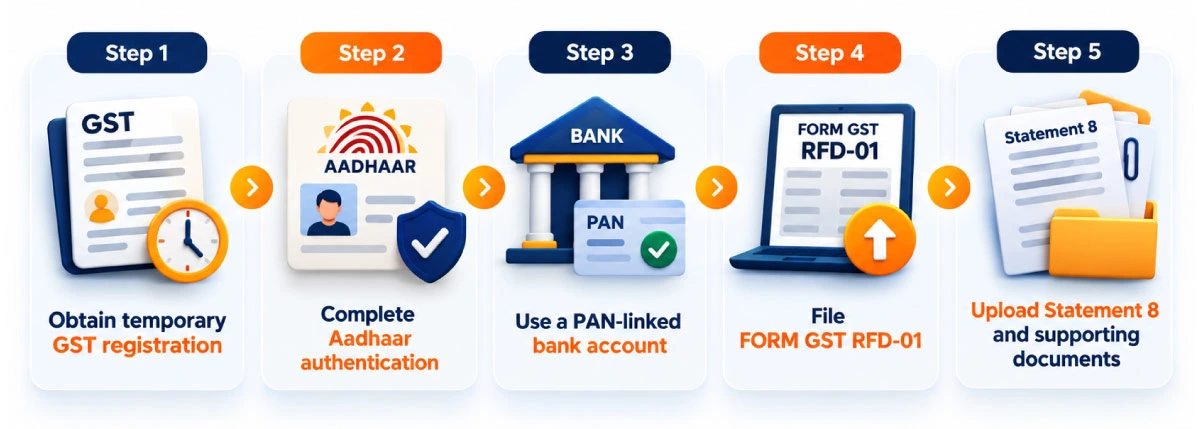
How to claim GST refund after flat booking cancellation


Step 1: Obtain temporary GST registration

The unregistered buyer must obtain temporary registration on the GST portal using PAN. While applying, the buyer should select the same State or Union Territory where the builder is registered for the invoice on which refund is claimed.


For example, if the builder’s invoice is issued from Gujarat GST registration, the buyer should obtain temporary registration in Gujarat.


Step 2: Complete Aadhaar authentication

The buyer must complete Aadhaar authentication as required under Rule 10B of the CGST Rules. The applicant also has to provide bank account details for receiving the refund.


Step 3: Use a PAN-linked bank account

The refund bank account should be in the name of the applicant and linked with the applicant’s PAN. This helps the department verify that the refund is credited to the correct person.


Step 4: File FORM GST RFD-01

After temporary registration, the buyer must file FORM GST RFD-01 on the GST portal. The refund category should be selected as “Refund for Unregistered Person”.


Step 5: Upload Statement 8 and supporting documents

The applicant must upload Statement 8 in PDF format and all required documents under Rule 89(2) of the CGST Rules. Notification No. 26/2022-Central Tax inserted Statement 8 in FORM GST RFD-01 for refund by unregistered persons.


The refund amount claimed cannot exceed the GST amount declared in the invoices for which refund is claimed.


Documents Required for GST Refund by Unregistered Person

For GST refund on flat booking cancellation, the buyer should keep all documents ready before filing FORM GST RFD-01. These documents help prove three important points: GST was paid to the builder, the flat booking or construction agreement was cancelled, and the buyer has actually borne the GST amount.


Document

Why it is required

PAN card

Required for temporary GST registration on the GST portal
Aadhaar details

Required for Aadhaar authentication under GST rules

Flat booking agreement or construction contract

Proves that the buyer entered into a transaction with the builder
GST invoice issued by the builder

Shows the GST amount charged on the flat booking or instalments

Payment receipts or bank statement

Proves that the buyer paid the amount, including GST, to the builder
Cancellation letter issued by the builder

Confirms cancellation and helps determine the relevant date for refund filing

Refund settlement statement or proof

Shows how much amount was refunded by the builder and whether GST was retained
Statement 8 in FORM GST RFD-01

Provides invoice-wise, payment-wise and refund-wise details for the claim

Supplier certificate under Rule 89(2)(kb)

Confirms that the supplier paid the tax and has not adjusted it through a credit note
PAN-linked bank account details

Required for crediting the approved refund amount


The supplier certificate is a key document because it supports the buyer’s claim that GST was paid to the government and was not adjusted by the builder through a credit note. The refund claim should also match the GST amount shown in the invoices and the amount actually refunded by the builder.


Time Limit for GST Refund on Cancelled Flat Booking

The time limit for GST refund on flat booking cancellation is generally 2 years from the relevant date under Section 54 of the CGST Act. For an unregistered buyer, identifying the correct relevant date is important because a refund claim filed after the limitation period may be rejected.


In cancelled flat construction contracts, CBIC has clarified that the date of issuance of the cancellation letter by the builder/supplier will be treated as the date of receipt of services for determining the relevant date. This clarification applies because in long-term construction contracts, the service may not be fully completed when the agreement is cancelled.


For Example


Suppose a buyer booked an under-construction flat and paid GST to the builder. Later, the booking was cancelled and the builder issued the cancellation letter on 10 July 2026. In this case, the 2-year period for filing the refund claim should generally be counted from 10 July 2026.


This is only an illustrative example. Actual eligibility will depend on the GST invoice, cancellation letter, credit note status, refund settlement details, documents submitted and verification by the GST officer.


Minimum Refund Amount and Proportionate Refund

For GST refund on flat booking cancellation, the refund amount must be ₹1,000 or more. Section 54(14) of the CGST Act provides that no refund shall be paid if the amount is less than ₹1,000. CBIC Circular No. 188/20/2022-GST also states that no refund should be claimed if the amount is less than ₹1,000.


The refund amount also cannot exceed the GST amount shown in the invoices for which refund is being claimed. This means the buyer should calculate the refund strictly on the basis of GST charged in the builder’s invoice.


Where the builder refunds only part of the amount paid by the buyer, the GST refund will also be restricted proportionately. For example, if the builder refunds only part of the consideration after cancellation, the buyer cannot claim the full GST originally paid. Only the proportionate tax related to the amount refunded by the builder may be claimed.


Simple example of proportionate refund

If the buyer paid ₹10,00,000 plus GST to the builder, but the builder refunds only ₹6,00,000 after cancellation, the GST refund claim should be calculated only in proportion to the ₹6,00,000 refunded amount. The buyer should not claim GST linked to the amount retained by the builder.


This proportionate calculation should match the cancellation settlement, invoice value and payment records.


Separate Refund Applications in Some Cases

A buyer may need to file more than one refund application if invoices are issued by different suppliers. CBIC has clarified that separate refund applications must be filed for invoices issued by different suppliers.


If the suppliers are registered in different States or Union Territories, the buyer must obtain temporary registration in each concerned State or Union Territory where such suppliers are registered. For example, if invoices are issued by one supplier registered in Gujarat and another supplier registered in Maharashtra, separate temporary registrations and refund applications may be required.


This makes GST refund on flat booking cancellation supplier-wise and State/UT-wise. Before filing, the buyer should check:

  • Builder’s GSTIN
  • State or Union Territory mentioned in the invoice
  • Number of suppliers involved
  • Invoice-wise GST amount
  • Whether separate refund applications are required


Mistakes to Avoid While Filing Refund Claim

Many refund claims are delayed or rejected because of incorrect filing or incomplete documents. While filing GST refund on flat booking cancellation, buyers should avoid these mistakes:

  • Selecting the wrong refund category instead of “Refund for Unregistered Person”.
  • Taking temporary registration in a State/UT different from the supplier’s registration State/UT.
  • Filing refund even though the builder can still issue a credit note under Section 34.
  • Not uploading Statement 8 in FORM GST RFD-01.
  • Missing the supplier certificate required under Rule 89(2)(kb).
  • Filing the claim after the 2-year time limit.
  • Claiming refund below ₹1,000.
  • Claiming more GST than the tax shown in the builder’s invoices.
  • Claiming full GST when the builder has refunded only part of the amount.
  • Uploading unclear invoices, payment receipts or cancellation letters.
  • Giving bank account details that are not in the applicant’s name or not linked with PAN.

A careful document check before filing can reduce queries from the GST officer and improve the chances of smooth processing. Businesses that have obtained GST registration but are no longer required to remain registered should also understand how to cancel GST registration if no longer required.


How Will the GST Officer Process the Refund Claim?

The proper officer will process the refund claim filed by an unregistered buyer in a manner similar to other FORM GST RFD-01 refund claims. The officer will check whether the application is complete and whether the refund claim is legally eligible. CBIC states that the officer will scrutinize the application and, if satisfied, issue the refund sanction order in FORM GST RFD-06 along with a detailed speaking order.


The officer may verify:

  • Whether the applicant is the person who paid and bore the GST amount.
  • Whether the contract or agreement for construction of flat/building was cancelled.
  • Whether the credit note time limit under Section 34 had expired at the time of cancellation.
  • Whether the refund amount matches the GST shown in invoices.
  • Whether the builder has issued the required supplier certificate.
  • Whether the buyer has uploaded Statement 8 and supporting records.
  • Whether the claim is filed within the 2-year time limit.

Approval of GST refund by unregistered person depends on proper documents, correct filing and GST officer verification. Filing FORM GST RFD-01 does not guarantee refund.

GST Refund Filing Checklist for Unregistered Buyers

Before filing GST refund on flat booking cancellation, the buyer should confirm the following points:

  • The buyer is not registered under GST.
  • GST was charged and paid to the builder.
  • GST invoice from the builder is available.
  • The agreement or contract for construction of flat/building has been cancelled.
  • The builder has issued a cancellation letter.
  • The credit note time limit under Section 34 has expired.
  • The refund amount is ₹1,000 or more.
  • The refund amount does not exceed the GST shown in invoices.
  • If only partial amount is refunded, GST refund is calculated proportionately.
  • Temporary registration is taken in the same State/UT where the supplier is registered.
  • Aadhaar authentication is completed.
  • Bank account is in the applicant’s name and linked with PAN.
  • Statement 8 in FORM GST RFD-01 is ready.
  • Supplier certificate under Rule 89(2)(kb) is available.
  • Payment proof, cancellation proof and refund settlement proof are uploaded clearly.

For broader GST compliance support, businesses and professionals can also refer to Ebizfiling’s GST registration assistance and GST return filing services . Where GST cancellation relates to a company, the role of directors and shareholders in GST cancellation may also become relevant depending on the circumstances.

Stuck with GST Refund After Flat Cancellation?

A cancelled flat booking is already stressful. It becomes more frustrating when the builder refunds the base amount but holds back the GST portion. Many buyers are unsure whether they should go back to the builder, apply on the GST portal, or leave the amount as a loss.


This is where Ebizfiling can help you take the right next step. Our team can review your GST invoice, cancellation letter, builder refund statement and payment records to understand whether your case falls under the “Refund for Unregistered Person” route. Based on the documents, we can guide you on temporary GST registration, FORM GST RFD-01 filing, Statement 8, supplier certificate and other refund-related requirements. For businesses looking to discontinue an existing GST registration, refer to our complete guide on cancellation of GST registration.


For GST-related support, you can explore Ebizfiling’s GST cancellation, GST registration modification and use ours GST Calculator to understand GST amounts before filing-related review. The final refund decision is taken by the GST department after verification, but correct documents and careful filing can help avoid unnecessary mistakes, delays and queries.


Cancelled your flat booking and unsure about the GST amount? Let Ebizfiling review your refund route and help you prepare the GST refund claim correctly.


Conclusion

GST refund on flat booking cancellation can be claimed by an eligible unregistered buyer when GST was paid on an under-construction flat and the builder cannot refund it through a credit note. The buyer must check the credit note status, refund amount, cancellation letter date and required documents before filing FORM GST RFD-01.


A timely and properly documented refund claim can reduce the chances of delay, mismatch or rejection. Since the final refund approval depends on GST officer verification, buyers should review the facts carefully before submitting the application.


Frequently Asked Questions


1. Can an unregistered buyer claim GST refund if the builder has already deposited GST with the government?

Yes. GST deposited by the builder does not stop an eligible unregistered buyer from filing a refund claim. In fact, the refund process requires confirmation that the builder has paid tax on the invoice, has not adjusted it through a GST credit note, and has not claimed or will not claim refund of the same tax amount. This helps the GST officer ensure that the same GST is not refunded twice.


2. What if the builder refuses to issue the supplier certificate under Rule 89(2)(kb)?

The supplier certificate is an important supporting document for refund by an unregistered person. It helps prove that the builder has paid GST and has not adjusted the tax through a credit note. If the builder does not issue this certificate, the refund application may face officer queries or rejection. The buyer should request this certificate before filing FORM GST RFD-01.


3. Can GST refund be claimed if the builder deducts cancellation charges?

Yes, but the refund has to be calculated carefully. If the builder deducts cancellation charges and refunds only part of the amount paid, the buyer cannot claim GST on the full original payment. The refund should be restricted to the proportionate GST related to the amount actually refunded by the builder.


4. Which date is used for calculating the 2-year refund time limit?

For cancelled flat construction contracts, the date of issuance of the cancellation letter by the builder is treated as the relevant date. The 2-year refund period should generally be counted from this cancellation letter date, not from the date on which the buyer receives the settlement amount.


5. What if invoices are issued from two different GSTINs of the same builder?

The buyer should check whether the GSTINs belong to different supplier registrations or different States/Union Territories. Separate refund applications may be required for invoices issued by different suppliers. If the suppliers are registered in different States or UTs, the buyer may also need separate temporary GST registration in each relevant State or UT.


6. Can GST refund be claimed if only advance payment was made and no final sale agreement was registered?

A refund claim may be examined if the buyer has a valid booking document, agreement, registered agreement or contract, as applicable, along with GST invoice, payment proof, cancellation letter and refund proof. The final eligibility will depend on the documents available and verification by the GST officer.


7. Can compensation, interest or damages paid by the builder be included in the GST refund claim?

No. The refund claim under this mechanism should relate only to the GST amount shown in the invoices for which refund is claimed. Any compensation, interest, damages or separate settlement amount should not be automatically included in the GST refund calculation.


8. What if the builder issued a commercial credit note but not a GST credit note?

A commercial credit note alone does not necessarily mean GST has been adjusted under Section 34. The key point is whether the builder has adjusted the tax liability through a GST credit note. The buyer should check the supplier certificate and GST-related records to confirm whether tax was actually adjusted.


9. Can Ebizfiling review whether the claim should be filed supplier-wise or State-wise?

Yes. Ebizfiling can review the builder’s GSTIN, invoice State, supplier details and cancellation records to identify whether one refund application is enough or separate applications are required. This is useful where invoices involve different suppliers, different GSTINs or different States/Union Territories.


10. Can Ebizfiling help calculate the GST refund amount before filing FORM GST RFD-01?

Yes. Ebizfiling can help review the invoice value, GST charged, amount paid, amount refunded by the builder, cancellation deductions and proportionate GST amount. This can help prepare a supportable refund working before filing FORM GST RFD-01. The final refund sanction depends on GST department verification.

About Ebizfiling -

EbizFiling is a concept that emerged with the progressive and intellectual mindset of like-minded people. It aims at delivering the end-to-end corporate legal services 0f incorporation, compliance, advisory, and management consultancy services to clients in India and abroad in all the best possible ways.
 
To know more about our services and for a free consultation, get in touch with our team on  info@ebizfiling.com or call 9643203209.
 
Ebizfiling

Author: srishti

Srishti Mukherjee is an Advocate with an LL.M. in Constitutional Law and Criminal Law, with experience in handling civil and criminal matters. Her legal expertise is supported by strong skills in legal research, interpretation, and compliance. At Ebizfiling, she applies her practical legal knowledge and research-oriented approach to developing well-structured content on Income Tax, GST, Intellectual Property Rights (IPR), and regulatory compliance. She aims to make complex legal and compliance matters more accessible by delivering content that is accurate, practical, and easy to understand for startups, businesses, and professionals.

Follow Author

Leave a Reply

Your email address will not be published. Required fields are marked *

  • Rating

Hi, Welcome to EbizFiling!

Hello there!!! Let us know if you have any Questions.

Thank you for your message.

☎
whatsapp