


-
September 15, 2026
-
BySteffy A
Dormant Company Compliance and Voluntary Strike-Off Process
Introduction
A company that has stopped active business operations may obtain dormant status under the Companies Act, 2013. However, dormant status does not mean that all statutory obligations automatically stop. Understanding Dormant Company Compliance is important for maintaining the company’s legal status and for completing a voluntary strike-off correctly.
Section 455 of the Companies Act, 2013 deals with dormant companies, while Section 248 deals with removal of the name of a company from the register of companies. A common concern is whether a dormant company must first become active before filing for voluntary strike-off and which filings remain applicable during the dormant period.
Proper understanding of Dormant Company Compliance, Form MSC-3, Form MSC-4 and Form STK-2 can help a company follow the correct legal process.
What is Dormant Company Compliance under Section 455?
A company having dormant status continues to remain registered with the Registrar of Companies (ROC). Dormant status provides a different compliance framework, but it does not make the company completely free from statutory requirements.
Business owners who want to understand the status in detail can also read about a dormant company under the Companies Act, 2013 and the conditions associated with maintaining such status.
Under Section 455(5), a dormant company is required to file prescribed documents and pay the prescribed annual fee to retain its dormant status.
An important requirement of Dormant Company Compliance is the annual filing of Form MSC-3. Rule 7 of the Companies (Miscellaneous) Rules, 2014 requires a dormant company to file a “Return of Dormant Company” annually in Form MSC-3.
The form must indicate the financial position of the company, duly audited by a Chartered Accountant in practice.
Companies considering this status can also explore the process to apply for dormant company status before deciding whether dormancy is suitable for their situation.
Annual Compliance Requirements for a Dormant Company
The specific annual filing connected with Dormant Company Compliance is Form MSC-3.
A company should not assume that no filings are required merely because its status has changed from active to dormant. The prescribed requirements must continue to be followed while the company retains dormant status.
Form MSC-3 Filing for Dormant Companies
Form MSC-3 is the Return of Dormant Company prescribed under Rule 7 of the Companies (Miscellaneous) Rules, 2014.
The form provides information regarding the financial position of the dormant company. The financial position reported through Form MSC-3 must be duly audited by a Chartered Accountant in practice.
Therefore, timely Form MSC-3 filing is an important part of Dormant Company Compliance.
Due Date for Filing Form MSC-3
A dormant company must file Form MSC-3 within thirty days from the end of each financial year.
Where the financial year ends on March 31, the filing would generally fall due by April 30.
Companies should monitor this requirement every year because maintaining dormant status does not remove the obligation to complete the prescribed Dormant Company Compliance.
Other Filings During Dormant Status
Rule 7 also provides that a dormant company must continue to file the applicable returns relating to allotment of securities and changes in directors whenever such events occur.
Therefore, Dormant Company Compliance is not limited to simply obtaining dormant status. Event-based filings may continue to apply depending on the activities or changes taking place in the company.
Are AOC-4 and MGT-7 Required for a Dormant Company?
Dormant status should not be treated as a blanket exemption from filing requirements under the Companies Act, 2013.
Section 137 deals with filing of financial statements with the Registrar, while Section 92 deals with the annual return of a company. The applicable forms include AOC-4 for financial statements and MGT-7 or MGT-7A for annual returns, depending on the type of company and the applicable provisions.
For a detailed understanding of these forms, businesses can refer to the guide on Form MGT-7 and AOC-4 filing.
Form MSC-3 is a separate filing specifically connected with Dormant Company Compliance under Section 455 and Rule 7 of the Companies (Miscellaneous) Rules, 2014.
Therefore, it would not be legally appropriate to state that Form MSC-3 automatically replaces AOC-4 or MGT-7/MGT-7A. A company should determine its applicable filing obligations under the relevant provisions of the Companies Act and Rules.
This distinction becomes particularly important when a dormant company later decides to apply for voluntary strike-off.
What Happens if Company Filings are Pending Before Strike-Off?
Before applying for a Dormant Company Strike-Off, the company should review its pending statutory filings. Any pending Dormant Company Compliance, including applicable Form MSC-3 filings, should be examined before proceeding with the closure process.
The Companies (Removal of Names of Companies from the Register of Companies) Rules, 2016, as amended in 2023, specifically address overdue financial statements and annual returns before a voluntary strike-off application. A company cannot file the strike-off application unless it has filed overdue financial statements under Section 137 and overdue annual returns under Section 92 up to the end of the financial year in which it ceased carrying on its business operations.
Where the Registrar has already initiated action under Section 248(1), the company must file all pending financial statements under Section 137 and all pending annual returns under Section 92 before filing its own strike-off application.
Companies that need assistance with regular statutory returns can also review the company annual return filing service before proceeding with closure. Therefore, reviewing pending filings is an important part of both Dormant Company Compliance and the voluntary closure process.
Can a Dormant Company Apply for Voluntary Strike-Off?
A dormant company is not automatically prevented from filing Form STK-2 merely because its MCA status is shown as “Dormant” or “Dormant u/455.” The current MCA instruction framework for Form STK-2 permits these statuses to proceed with the form where the applicable legal conditions are satisfied.
This means that a company does not have to become active merely because it wants to file Form STK-2. However, this does not mean that every dormant company automatically qualifies for voluntary strike-off. Section 248(2) allows a company to apply for removal of its name only on one or more of the grounds specified in Section 248(1). The company must therefore independently satisfy the applicable legal conditions for strike-off.
The restrictions contained in Section 249 must also be considered before filing the application. For a broader comparison of the two closure routes, businesses can read about voluntary and involuntary strike-off of a company.
Accordingly, Dormant Company Compliance and eligibility for strike-off are separate matters. Dormant status may be permitted for Form STK-2 filing, but the company must still satisfy the legal conditions applicable to voluntary strike-off.
Is Form MSC-4 Required Before Dormant Company Strike-Off?
Form MSC-4 is used when a dormant company wants to obtain the status of an active company. Rule 8 of the Companies (Miscellaneous) Rules, 2014 provides for an application in Form MSC-4 for obtaining active status. However, Form MSC-4 should not be treated as a mandatory step solely because a dormant company intends to apply for voluntary strike-off.
Since the MCA filing framework for Form STK-2 permits companies having “Dormant” and “Dormant u/455” status to file the form, the process should not automatically be represented as:
MSC-3 → MSC-4 → Active Status → STK-2
Instead, the company should first review its Dormant Company Compliance, pending filings and eligibility under Sections 248 and 249. Form MSC-4 becomes relevant where the company actually intends to obtain active status.
Step-by-Step Process for Voluntary Strike-Off of a Dormant Company
The Voluntary Strike-Off of Dormant Company should be approached through a structured process.
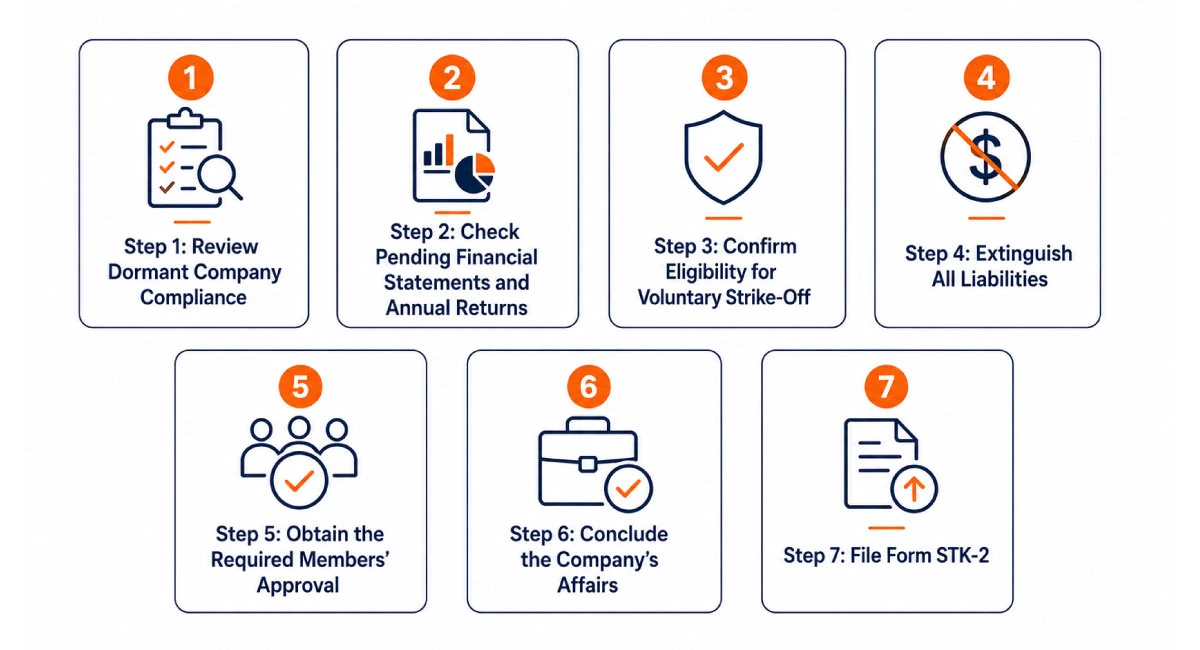
Step 1: Review Dormant Company Compliance
The company should first review whether all applicable Dormant Company Compliance requirements have been completed.
This includes checking Form MSC-3 filings for the relevant financial years and identifying any other filings that may remain pending.
Step 2: Check Pending Financial Statements and Annual Returns
The company should review whether financial statements under Section 137 or annual returns under Section 92 remain overdue.
For a voluntary strike-off application, overdue financial statements and annual returns must be filed up to the end of the financial year in which the company ceased carrying on business operations.
If the Registrar has already initiated action under Section 248(1), all pending financial statements and annual returns must be filed before the company makes its application.
This review should be completed along with other Dormant Company Compliance checks.
Step 3: Confirm Eligibility for Voluntary Strike-Off
Before filing Form STK-2, the company should determine whether it satisfies one or more of the grounds specified under Section 248(1).
The company should also ensure that the restrictions under Section 249 do not prevent it from making the application.
Therefore, dormant status alone should not be treated as sufficient eligibility for voluntary strike-off.
Step 4: Extinguish All Liabilities
Section 248(2) specifically requires the company to extinguish all its liabilities before applying for voluntary removal of its name.
Accordingly, outstanding liabilities should be identified and settled before Form STK-2 is filed.
This requirement is separate from Dormant Company Compliance and is an important legal condition for voluntary strike-off.
Step 5: Obtain the Required Members’ Approval
After extinguishing its liabilities, the company must obtain the approval required under Section 248(2).
The company may proceed through:
- A special resolution, or
- Consent of seventy-five per cent of members in terms of paid-up share capital.
A board resolution alone should not be treated as a substitute for the members’ approval specifically required under Section 248(2).
Step 6: Conclude the Company’s Affairs
The company should ensure that its affairs are properly concluded before proceeding with closure.
Where the company continues to maintain a bank account, dealing with and closing that account may form part of concluding its affairs. However, closure of a bank account should not be described as a separate statutory condition specifically stated under Section 248(2).
The express statutory requirement is that all liabilities must be extinguished before the application is made.
Step 7: File Form STK-2
After completing the applicable Dormant Company Compliance, clearing the required pending filings, confirming eligibility, extinguishing liabilities and obtaining members’ approval, the company may proceed with Form STK-2.
Form STK-2 is the prescribed application for voluntary removal of the company’s name from the register of companies. Businesses can also refer to this detailed guide on filing Form STK-2 for closing a company for further information on the filing process.
A company with “Dormant” or “Dormant u/455” status may file Form STK-2, subject to satisfying the applicable legal requirements.
Forms Relevant to Dormant Company Compliance and Strike-Off
|
Form |
Purpose |
|
Form MSC-3 |
Return of Dormant Company indicating its audited financial position |
| Form MSC-4 |
Application by a dormant company for obtaining active status |
|
Form STK-2 |
Application for voluntary removal of the company’s name from the register |
These forms serve different purposes. Form MSC-3 relates specifically to Dormant Company Compliance, Form MSC-4 is relevant where active status is sought, and Form STK-2 is used for voluntary strike-off.
Dormant Company Strike-Off Process Flow
The legally clearer process flow is:
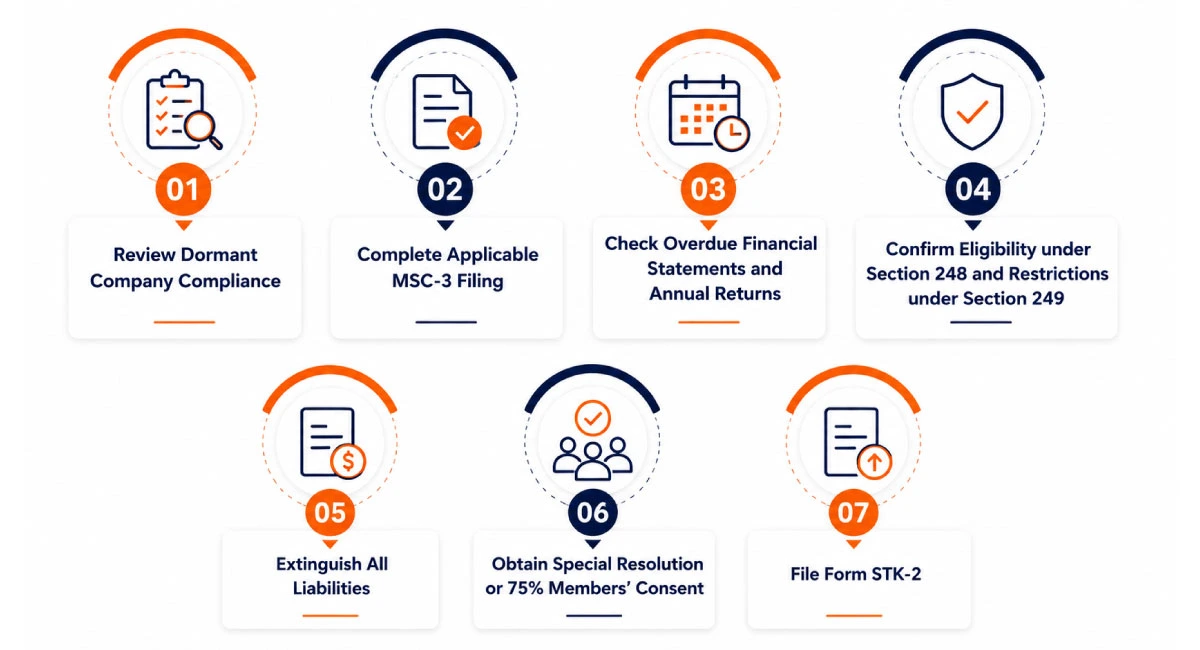
Note: This process avoids the incorrect assumption that every dormant company must first obtain active status before applying for strike-off.
Key Requirements Before Dormant Company Strike-Off
- A dormant company continues to have statutory compliance responsibilities.
- Form MSC-3 is an important annual Dormant Company Compliance requirement.
- Form MSC-3 must be filed within thirty days from the end of each financial year.
- The financial position reported through Form MSC-3 must be duly audited by a Chartered Accountant in practice.
- Dormant status should not automatically be treated as an exemption from every other applicable company filing.
- Form MSC-3 should not automatically be considered a substitute for filings under Sections 92 and 137.
- Pending financial statements and annual returns should be reviewed before filing Form STK-2.
- Dormant status by itself does not make a company automatically eligible for strike-off.
- A dormant company does not have to obtain active status merely for filing Form STK-2 if it otherwise satisfies the applicable legal requirements.
- Form MSC-4 is relevant when a dormant company seeks active status.
- All liabilities must be extinguished before making an application under Section 248(2).
- The company must obtain a special resolution or consent of 75% of members in terms of paid-up share capital.
- Eligibility under Section 248 and restrictions under Section 249 should be checked before filing Form STK-2.
Dormant Company? Stay Compliant or Close It the Right Way
Managing a dormant company involves more than simply stopping business operations. Pending filings, dormant company compliance requirements, and strike-off eligibility should be reviewed carefully before taking the next step.
Ebizfiling can assist with Form MSC-3 compliance, pending ROC filings, eligibility checks, documentation, and Form STK-2 filing for voluntary company strike-off.
Our professionals help businesses understand the applicable process under the Companies Act, 2013 and complete the required filings correctly.
Whether you want to maintain dormant status or close the company, proper compliance can help avoid unnecessary delays and procedural issues.
Need help with dormant company compliance or strike-off? Connect with Ebizfiling today.
Conclusion
Proper Dormant Company Compliance remains important even when a company has stopped carrying on active business. Form MSC-3 must be filed annually within the prescribed period, and companies should also review other statutory filings that may remain applicable.
Where a dormant company intends to close, it should first review its pending Dormant Company Compliance and applicable overdue financial statements and annual returns. It should then confirm its eligibility under Section 248, consider the restrictions under Section 249, extinguish all liabilities and obtain the required members’ approval.
A company does not need to obtain active status merely because it wants to file Form STK-2 where it otherwise satisfies the applicable requirements for voluntary strike-off.
Businesses that need professional assistance with eligibility review, pending filings, documentation and Form STK-2 can consider our company strike-off service.
Following this legally structured approach helps ensure that Dormant Company Compliance and the voluntary strike-off process are handled in the correct sequence.
Suggested Reads:
Penalties for Non-Filing of AOC-4 and MGT-7
Important ROC Compliance Forms for Private Limited Companies
How to Check Annual Filing Status of a Company
Producer Company Strike Off: Complete Process & ROC Filing
Frequently Asked Questions
1. Can a Section 8 company apply for voluntary strike-off through Form STK-2?
No. Section 248(3) of the Companies Act, 2013 specifically excludes a company registered under Section 8 from making an application for voluntary strike-off under Section 248(2).
2. Can a company file Form STK-2 immediately after shifting its registered office from one State to another?
No. Section 249 restricts a company from making an application under Section 248(2) if it has shifted its registered office from one State to another during the preceding three months.
3. Does changing the company name affect eligibility for voluntary strike-off?
Yes. A company cannot apply for voluntary strike-off if it has changed its name at any time during the three months immediately preceding the application. The company must first complete the restricted period specified under Section 249.
4. Can a company dispose of its property immediately before filing Form STK-2?
Section 249 places restrictions on certain disposals of property or rights during the three months preceding a strike-off application. Transactions should therefore be reviewed carefully before filing Form STK-2 to ensure they do not fall within the prohibited circumstances.
5. Can a company apply for strike-off while a compromise or arrangement is pending before the Tribunal?
No. If an application for sanction of a compromise or arrangement has been made before the Tribunal and the matter has not been finally concluded, Section 249 restricts the company from filing a voluntary strike-off application.
6. Can a company undergoing winding-up proceedings apply for voluntary strike-off?
No. A company that is being wound up under Chapter XX cannot make an application under Section 248(2). This restriction is expressly covered under Section 249 of the Companies Act, 2013.
7. Are directors and members released from all liabilities after the company is struck off?
No. Strike-off does not automatically eliminate existing liabilities of directors, managers, officers or members. Section 248(7) provides that such liability may continue and can be enforced as if the company had not been dissolved.
8. Can the NCLT wind up a company even after its name has been struck off?
Yes. Section 248(8) clarifies that removal of a company’s name from the register does not affect the Tribunal’s power to wind up the company. Strike-off and winding up are therefore legally distinct mechanisms.
9. Can Ebizfiling review whether recent company transactions create a Section 249 restriction before STK-2 filing?
Yes. Ebizfiling can assist in reviewing the company’s recent status changes, transactions and compliance position before the strike-off process is initiated. This can help identify whether circumstances such as a recent name change, interstate registered office shift or other restricted activity need to be considered before filing Form STK-2.
10. Can Ebizfiling assist when a dormant company has complex issues before voluntary strike-off?
Yes. Ebizfiling can assist in reviewing the company’s compliance status, strike-off eligibility and required documentation before Form STK-2 filing. Where issues such as pending charges, regulatory requirements or other compliance concerns exist, these should be identified before proceeding with the company closure application.





Simplify Your Company Strike-Off Process
Make the strike-off process simple with reliable assistance for documentation, filing, and essential compliance requirements.
About Ebizfiling -



October 21, 2026 By Srishti M
Tax Planning for NRI Returning to India Before Becoming ROR Introduction Tax planning for NRI returning to India should start before the person becomes Resident and Ordinarily Resident, also known as ROR. Under the Income-tax Act, 2025, residential status decides […]
October 19, 2026 By Srishti M
October 21, 2026 By Srishti M
TDS and TCS Compliance Calendar November 2026: Compliance Guide Introduction The TDS and TCS Compliance Calendar November 2026 covers important tax deduction, collection, payment, certificate and reporting requirements applicable during the month. It helps businesses, government offices and other responsible […]