

-
July 15, 2026
-
BySteffy A
New TDS Rates Chart FY 2026-27: A Complete Breakdown
The New TDS Rates chart in FY 2026-27 gives a clear picture of the new tax deduction rules in India. It assists the taxpayers to know the amount of tax they should deduct in relation to payments such as salary, rent, and professional fees. The novel structure is geared towards simplicity and improved compliance.
Digital systems are also supported by new TDS rates chart to enable faster processing. The awareness of such rates prevents mistakes and fines. This guide describes important parts, rates and practical impact. It can be applied in businesses and individuals who are involved in managing TDS.
What is TDS and Why It Matters?
TDS (Tax Deducted at Source) is paid at the point of payment to promote prior collection of taxes and curb tax evasion.Tax Deducted at Source (TDS) is levied on income like salary, interest, rent and professional fees.
It guarantees a stable collection of taxes and assists taxpayers to monitor their tax credit in Form168 (earlier Form 26AS).
New TDS Rates Chart (FY 2026-27)
TDS Rates for Residents
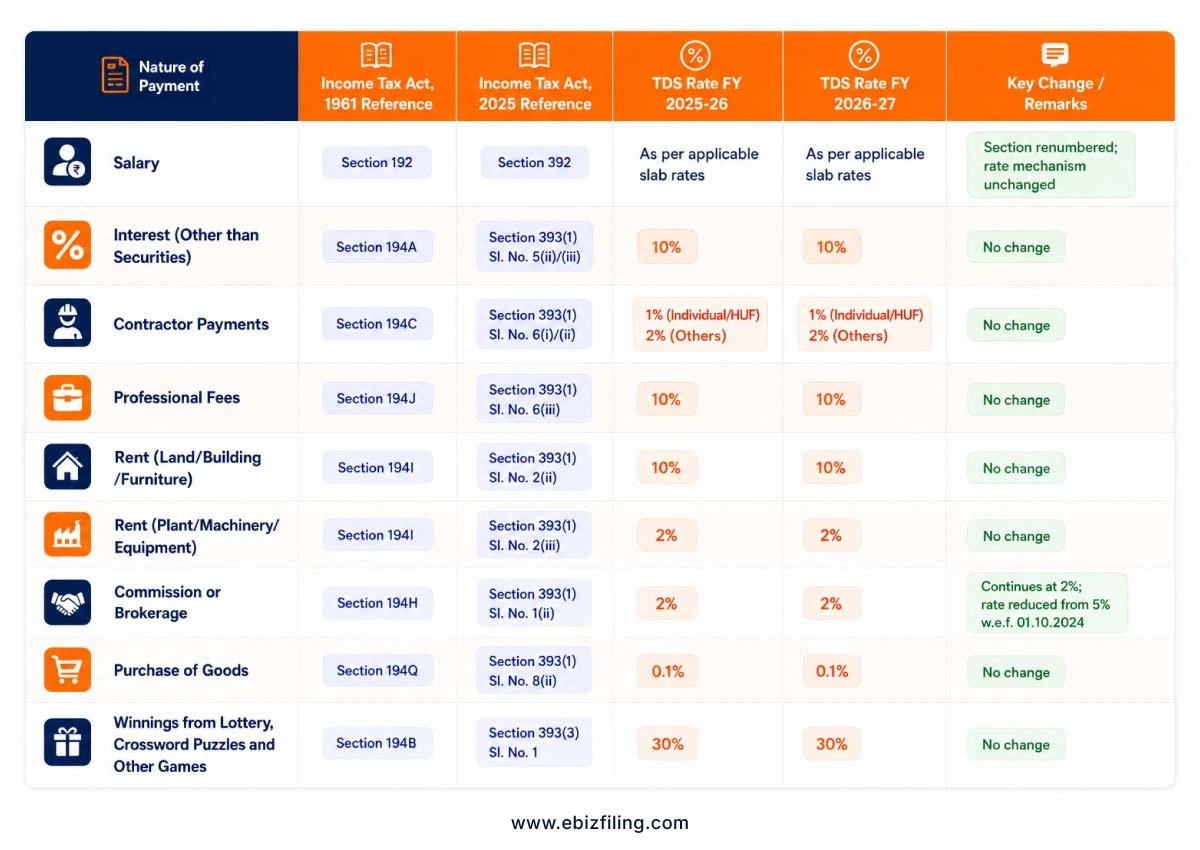
Note: The Income Tax Act, 2025 comes into effect from 1 April 2026. While TDS provisions have been recodified under Sections 392 and 393, the rates for the above resident payments remain substantially unchanged. TDS deduction is subject to applicable threshold limits prescribed under the Income Tax Act, 2025.
TDS Rates for Non-Residents FY 2026-27
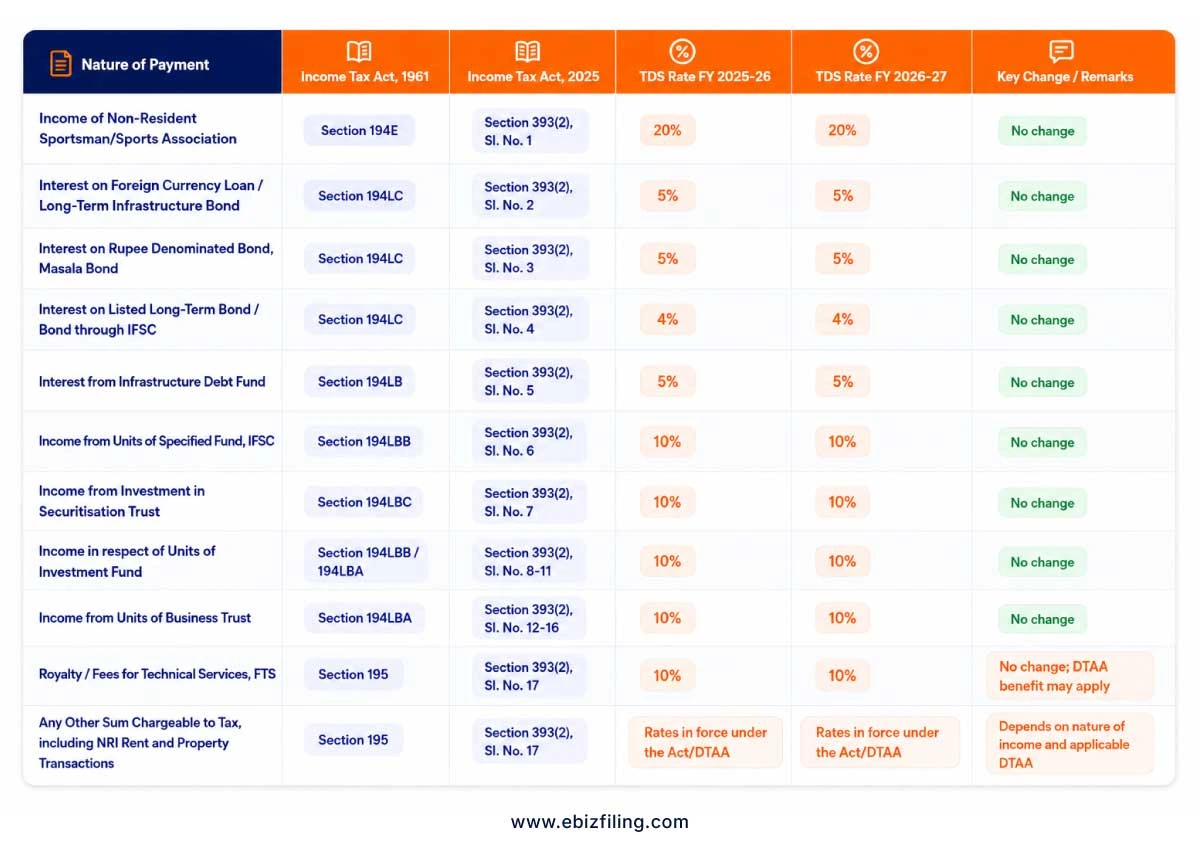
Note: For non-resident payments, surcharge and Health & Education Cess may apply in addition to the base TDS rate. Where a Double Taxation Avoidance Agreement (DTAA) exists, the beneficial treaty rate may be applied subject to furnishing a valid Tax Residency Certificate (TRC) and other prescribed documents.
Key TDS and TCS Section Changes under the Income Tax Act, 2025
|
Income Tax Act, 1961 |
Nature of Payment/Collection |
Income Tax Act, 2025 |
|
Section 192 |
Salary |
Section 392 |
|
Section 193 |
Interest on Securities |
Section 393 |
|
Section 194 |
Dividend |
Section 393 |
|
Section 194A |
Interest other than Securities |
Section 393 |
|
Section 194B |
Lottery, Crossword Puzzle, Games Winnings |
Section 393 |
|
Section 194BA |
Virtual Digital Assets (Crypto) |
Section 393 |
|
Section 194BB |
Horse Race Winnings |
Section 393 |
|
Section 194C |
Contractor Payments |
Section 393 |
|
Section 194D |
Insurance Commission |
Section 393 |
|
Section 194DA |
Payments under Life Insurance Policy |
Section 393 |
|
Section 194EE |
Payments from NSS |
Section 393 |
|
Section 194F |
Repurchase of Units by Mutual Fund |
Section 393 |
|
Section 194G |
Lottery Ticket Commission |
Section 393 |
|
Section 194H |
Commission or Brokerage |
Section 393 |
|
Section 194I |
Rent |
Section 393 |
|
Section 194IA |
Transfer of Immovable Property |
Section 393 |
|
Section 194IB |
Rent by Individuals/HUF (Not Subject to Tax Audit) |
Section 393 |
|
Section 194IC |
Joint Development Agreement |
Section 393 |
|
Section 194J |
Professional and Technical Services |
Section 393 |
|
Section 194K |
Income from Mutual Fund Units |
Section 393 |
|
Section 194LA |
Compensation on Acquisition of Immovable Property |
Section 393 |
|
Section 194LBA |
Income from Business Trust |
Section 393 |
|
Section 194LBB |
Income from Investment Fund |
Section 393 |
|
Section 194LBC |
Income from Securitisation Trust |
Section 393 |
|
Section 194LC |
Interest on Certain Bonds and Borrowings |
Section 393 |
|
Section 194LD |
Interest on Certain Government Securities/Bonds | Section 393 |
| Section 194M | Contractual/Professional Payments by Individuals/HUF |
Section 393 |
|
Section 194N |
Cash Withdrawals |
Section 393 |
| E-commerce Transactions |
Section 393 |
|
|
Section 194Q |
Purchase of Goods | Section 393 |
|
Section 195 |
Payments to Non-Residents |
Section 393(2) |
|
Section 196A |
Income of Offshore Funds | Section 393(2) |
| Section 196B | Income from Units to Offshore Funds |
Section 393(2) |
| Section 196C | Foreign Currency Bonds/GDR Income |
Section 393(2) |
|
Section 196D |
Income of Foreign Institutional Investors | Section 393(2) |
| Section 206C | Tax Collected at Source (TCS) |
Section 394 |
Also read: Key changes: New vs old Income Tax Act
Major Changes in TDS Rates for FY 2026-27
|
Change Area |
What Has Changed in FY 2026-27 |
Practical Impact on Taxpayers & Businesses |
|
Simplified TDS Rate Structure |
Multiple TDS rates have been rationalized and reduced to fewer standard rates across common sections. |
Easier calculation of TDS, reduced confusion, and fewer classification errors while deducting tax. |
|
Uniformity Across Sections |
Similar types of payments now attract consistent TDS rates instead of varying percentages. |
Improves clarity for businesses making multiple types of payments (salary, rent, professional fees, etc.). |
|
Faster Digital Processing |
TDS return filing, correction, and processing are now fully digitized with quicker turnaround times. |
Faster reflection in Form 26AS, quicker refunds, and reduced delays in reconciliation. |
|
Stricter Penalties for Non-Compliance |
Higher penalties for late deduction, late deposit, and incorrect filing of TDS returns. |
Encourages timely compliance and reduces tax evasion risks; increases accountability. |
|
Real-Time Reporting Requirements |
Enhanced reporting through updated return formats and system validations. |
Reduces mismatches, improves transparency, and ensures accurate tax credit to deductees. |
|
Integration with Compliance Systems |
TDS systems are now integrated with PAN, Aadhaar, and other compliance databases. |
Minimizes errors due to incorrect details and strengthens compliance tracking. |
|
Automation & AI-Based Validation |
Introduction of automated checks and AI-based scrutiny in TDS filings. |
Early detection of errors, reduced notices, and improved compliance efficiency. |
|
Focus on Transparency |
More detailed disclosures required in TDS returns and statements. |
Better audit trail and easier verification by tax authorities. |
You can verify the official circular on Official Govt. Site
TDS Compliance and Business Impact for FY 2026-27
Impact of TDS on Businesses and Taxpayers
The new regulations have an impact on both deductors and taxpayers:
- Companies need to deduct and deposit TDS as soon as possible.
- Form 168 provides credit to taxpayers.
- Penalties and interest are a result of delays.
In addition, the financial credibility is enhanced through the appropriate compliance with TDS.
TDS Deduction Rules 2026-27
- Deduct TDS upon payment or credit.
- Use the appropriate section and rating.
- Make deposits on due dates.
- File TDS return is quarterly.
TDS Compliance Guide for Businesses FY 2026-27
Step 1: Select an appropriate TDS section depending on the type of payment.
Step 2: Use the current TDS rate according to the current chart.
Step 3: Subtract TDS and deposit it in the required time.
Step 4: File TDS is correct in terms of filing on time.
TDS Rates Compliance Checklist FY 2026-27
- Check PAN of deductee.
- Use appropriate TDS rates.
- Deduct tax on time.
- Make deposits on due dates.
- Record correct TDS returns.
- Issue TDS certificates.
Real Example of TDS Deduction
Assuming a business remits 50000 as professional fees, the business is liable to deduct 5000 TDS as per Section 194J and then remits the money. This guarantees conformity to the current TDS regulations (new TDS rates chart) on the financial year 2026-27.
Need Help with TDS Compliance?
Managing the New TDS rates chart, returns, and compliance can be complex. Ebizfiling offers expert support for TDS return filing, rate application, and end-to-end compliance.
- Expert review of TDS applicability
- Accurate TDS calculation
- Timely return filing
- Error-free compliance support
Get accurate filings, avoid penalties, and stay compliant with the latest TDS regulations.
It can be complicated to manage the New TDS rates chart, returns, and compliance. Ebizfiling India Pvt. Ltd. provides professional assistance in filing the TDS returns, rate application, and end-to-end compliance.
- TDS applicability review by experts.
- Accurate TDS calculation
- Timely return filing
- Error-free compliance support
Get the right filings, escape penalties and keep up with the new TDS rules.
Conclusion
The New TDS Rates chart simplifies the process of tax deduction but it must be followed closely. It is important to use the right rates and sections. Penalties are avoided by paying TDS on time and filing returns. The records should be accurate and up to date in businesses. Tracking and reporting has become quicker on digital systems.
Remaining updated is a good way of managing taxes. Compliance and financial discipline can be achieved by following these rules.
Suggested reads: Changes impacting Salaried Taxpayers
Frequently Asked Questions
1. Which payments are most commonly covered under TDS?
TDS is primarily deducted on salary, contractor payment, professional fee, rent, and interest incomes. The chart is commonly used by businesses when applying the appropriate rates to their payments and avoiding confusion, especially in cases of mixed payments such as consultancy plus reimbursement.
2. How do I know which TDS section applies to my payment?
You need to first determine the type of payment—salary, contract, commission, or professional service. Each has its specific section. Referring to the New TDS Rates chart helps in selecting the correct section and avoiding incorrect deductions.
3. Is TDS deducted on the full invoice amount or excluding GST?
TDS is generally calculated on the amount excluding GST, provided GST is mentioned separately in the invoice. However, misinterpretation is common, so referring to the New TDS Rates chart ensures proper compliance with applicable rules.
4. How can Ebizfiling help in TDS compliance?
Ebizfiling helps businesses identify the correct TDS sections, apply accurate rates, and file returns on time. Their expert support reduces errors, avoids penalties, and ensures smooth compliance without the burden of handling everything in-house.
5. What happens if I deduct TDS at a lower or higher rate?
If TDS is deducted incorrectly, you may have to pay the shortfall along with interest. In cases of excess deduction, the deductee can claim a refund while filing their income tax return.
6. Can I revise a TDS return after filing it?
Yes, TDS returns can be revised multiple times to correct errors such as incorrect PAN, challan mismatches, or wrong deduction details. Timely corrections help avoid notices and penalties.
7. Why is TDS not showing in Form 26AS?
This usually happens due to late filing of returns, incorrect PAN details, or mismatched challan information. TDS credit will only reflect once the deductor files an accurate return.
8. What are the most common TDS mistakes businesses make?
Common mistakes include using incorrect sections, entering wrong PAN details, delaying deposits, or mismatching challan data. These errors can lead to penalties, notices, and additional compliance efforts.
9. What extra support does Ebizfiling provide for TDS?
Apart from filing, Ebizfiling offers end-to-end compliance services such as reconciliation with Form 26AS, error corrections, handling notices, and advisory support. This helps businesses stay compliant and focus on growth.
10. Do startups and small businesses also need to comply with TDS?
Yes, TDS compliance becomes mandatory once your business crosses certain thresholds or makes specified payments. Many startups rely on the New TDS Rates chart to ensure correct deductions and avoid penalties due to lack of awareness.





How to File TDS Online
File TDS online - quick, easy, compliant.
About Ebizfiling -



September 29, 2026 By Srishti M
TDS and TCS Compliance Calendar October 2026: Compliance Guide Introduction The TDS and TCS Compliance Calendar October 2026 provides an overview of important tax deduction and collection obligations applicable to deductors and collectors. It helps businesses, government offices and other […]
September 25, 2026 By Steffy A
September 5, 2026 By Steffy A
Property Acquisition Tax Planning: A Complete Guide Introduction Buying a residential property requires careful financial planning because it involves significant decisions related to taxation, funding, ownership structure, and long-term financial goals. Whether an individual is purchasing a first home or […]