


-
September 23, 2026
-
BySteffy A
ITR-2 form filing AY 2026-27: Process and Due Date.
Overview
ITR-2 form filing is a significant procedure to individuals and HUFs earning income that is not based on mere salary frameworks. It is applicable in situations where the income comprises capital gains, several house properties, or foreign income. Using the right filing will also keep you out of trouble, and you will not receive unnecessary notices. To AY 2026-27, it is necessary to know the eligibility, date of payable, and proper filing procedures.
ITR-2 form filing Eligibility Chart (AY 2026-27)
|
Category |
Who Can File ITR-2 |
Who Cannot File ITR-2 |
|
Basic Eligibility |
Individuals & HUFs without business income |
Individuals with business or professional income |
|
Salary Income |
Salary or pension income allowed |
Eligible for simpler ITR-1 (if conditions met) |
|
House Property |
More than one house property income |
Not applicable restriction |
|
Capital Gains |
Income from shares, mutual funds, and property |
Not applicable restriction |
|
Foreign Income |
Foreign assets or foreign income included |
Not applicable restriction |
|
Company Role |
Directors or holders of unlisted shares |
Not applicable restriction |
|
Income Limit |
Income above ₹50 lakh allowed |
ITR-1 preferred for simpler cases under ₹50 lakh |
|
Presumptive Income |
Not allowed |
Must use ITR-4 instead |
|
Partnership Income |
Not allowed | Cannot file ITR-2 |
Important Deadline for ITR-2 form filing for AY 2026-27
The expected due date of filling the ITR-2 form will be:
31st July 2026
This is the officially anticipated ITR-2 form filing due date 2026 of those individuals and HUFs not under audit. A failure to meet this deadline may lead to late filing fees, interest and loss of benefits like carry forward losses.
Always make sure to file in good time before the due date to prevent errors or problems with the portal.
Structure of ITR-2 form filing for AY 2026-27
View pdf here – To know the structure of Form ITR-2 filing.
What are the documents required ITR-2 form filing?
- Form 16 by your employer.
- Form 16A: In case TDS has been deducted on interest earnings on fixed deposit or savings bank accounts.
- Form 26AS: To confirm TDS on non-salary and pay income.
- Rent receipts: To compute HRA (assuming that you have already filled them out and submitted them to your employer).
- Capital Gains Statement: When you have transactions in stocks or mutual funds in terms of capital gains.
- Bank Passbook and Fixed Deposit Receipts (FDRs): To calculate interest income.
- Evidence of tax saving deductions: To claim tax saving deductions under 80C, 80D, 80G and 80GG i.e. life and health insurance receipts, contribution receipts, rent receipts, tuition receipts etc.
Simple Process for ITR-2 form filing Online
ITR-2 form filling can be quite complex initially, particularly when you have several sources of income. However, it turns out to be a lot easier when you read it calmly.
1. Sign in to the Income Tax Portal
Begin by entering the Income Tax e-filing site and log in with your PAN and password. This will require you to undergo a rapid registration in case you are a first time user.
2. Choose the ITR-2 form filing
After logging in, select the option to file your return and select ITR-2 form filing as a form of filing your tax AY 2026-27. Re-check the assessment a year before proceeding; this is where most individuals make mistakes.
3. Complete Your Simple Information
You shall be required to verify your own details like name, address, PAN, Aadhaar and bank account details. Much of this is already filled in, but it is necessary to revise all this.
4. Fill In Your Income
The essential element of the return now comes. Enter your income according to appropriate categories such as salary, house property, capital gains, and other income such as interest or dividends. When doing so, it is better to have your documents at hand.
5. Claim Eligible Deductions
Once you have entered in your income, you are allowed to claim deductions under such sections of the act as 80C, 80D, and so on that you are eligible. This will assist in lowering the total amount of taxes you owe, hence taking note of nothing.
6. Check against Tax Records
Compare your particulars with Form 26AS, AIS and TIS before proceeding. This makes sure that all this is identical to what the Income Tax Department has on record.
7. File and Certify Your Return
Lastly, file your return and undergo the verification process. You can confirm it immediately by using Aadhaar OTP, net banking, or any other options. Your return will not be complete without verification. If you are new to tax filing or want a step-by-step understanding, you can also read our detailed guide on the process of ITR filing to avoid common mistakes.
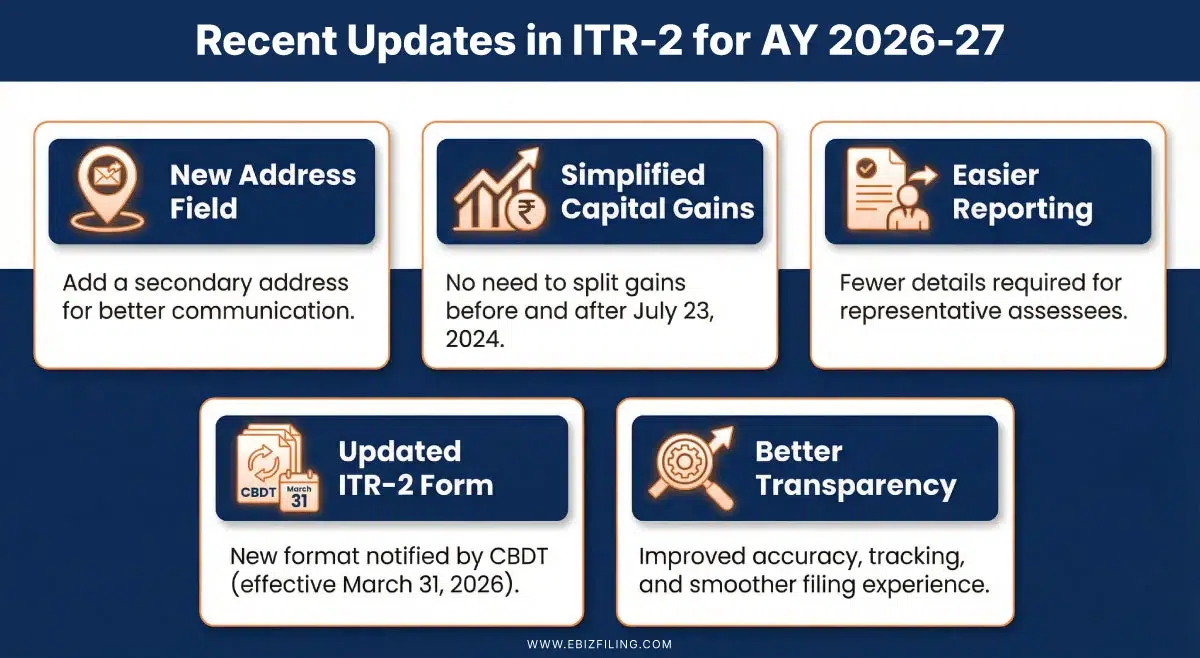
Recent Updates in ITR-2 form filing for AY 2026-27
Example:
For instance, a salaried employee who also earns from stock investments and foreign dividends must use ITR-2 form filing. Filing ITR-1 in such cases can lead to defective return notices.
Why Choose Ebizfiling for ITR Filing?
- Expert help to select the correct ITR form for your Income Tax Return.
- Support in accurate income reporting and deduction claims.
- Up-to-date knowledge of the latest tax rules and changes.
- End-to-end assistance from document collection to final filing.
- Quick and reliable service to ensure timely compliance.
Final Thoughts
ITR-2 form filing AY 2026-27 is not only a matter of a deadline. It concerns remaining compliant, financial transparency, and preventing future troubles. The AY 2026-27 updated rules have made the process much smoother, although close reporting is needed. In case you are in doubt about your eligibility, income category, and deductions, it is always advisable to consult rather than make mistakes. A properly filled in return now may save you time, money, and stress in the future.
Also read:
Documents required for finalizing Income Tax Return
ITR-3 Form Filing AY 2026-27: Process and Eligibility
Frequently Asked Questions
1. When should I choose ITR-2 instead of ITR-1 in AY 2026-27?
When your income is not confined to salary or one home property, you should select ITR-2. ITR-2 is appropriate where the taxpayer is outside ITR-1 eligibility. For AY 2026-27, ITR-1 can allow income from up to two house properties and long-term capital gains under section 112A up to ₹1.25 lakh, subject to the other conditions. Incorrect form submission could result in an Income Tax Department flawed return notice.
2. Can salaried individuals file ITR-2?
Yes, salaried individuals can file ITR-2 if they have additional income such as interest, capital gains, or income from multiple house properties. Even if salary is the primary source of income, the presence of other income sources makes ITR-2 the correct form.
3. Is it mandatory to declare foreign assets in ITR-2?
Yes, you must disclose all foreign assets in ITR-2, including bank accounts, shares, or property held outside India. Non-disclosure, even of small amounts, may lead to penalties under the Black Money Act.
4. Can I file ITR-2 if I have capital gains?
ITR-2 is generally used by eligible individuals/HUFs with capital gains and no business/professional income, but not every capital gain requires ITR-2. For AY 2026-27, an otherwise eligible resident individual may use ITR-1 for section 112A long-term capital gains up to ₹1.25 lakh; ITR-4 has a similar limited section 112A allowance for eligible presumptive taxpayers.
5. Is ITR-2 suitable for multiple house properties?
Yes, ITR-2 is ideal if you own more than one house property. It allows you to report income from each property, whether self-occupied, rented, or deemed let out, along with deductions like home loan interest and municipal taxes.
6. Can I file ITR-2 if I have foreign income?
Yes, individuals with foreign income or foreign assets must file ITR-2. The form includes detailed sections to report such income and assets along with their location and value, ensuring compliance with global reporting requirements.
7. Who is not eligible to file ITR-2?
Individuals or HUFs having income from business or profession cannot file ITR-2. In such cases, they must file ITR-3 or ITR-4 depending on the nature of taxation applicable.
8. Is there any income limit for filing ITR-2?
There is no upper income limit for filing ITR-2. In fact, individuals with income above ₹50 lakh cannot use ITR-1 and must opt for ITR-2 or another applicable form, along with additional disclosures of assets and liabilities.
9. Can company directors file ITR-2?
Yes, company directors can file ITR-2 provided they do not have income from business or profession. They must disclose details such as their Directorship and Director Identification Number (DIN) in the return.
10. How can Ebizfiling help with ITR-2 filing?
Ebizfiling provides expert assistance for ITR-2 filing, especially for individuals with complex income sources like capital gains, foreign assets, or multiple properties. Their team ensures accurate tax computation, proper documentation, and timely filing to avoid penalties and ensure compliance.





Online CA Consultation for ITR Filing
Expert CA, Easy Filing.
About Ebizfiling -



October 21, 2026 By Srishti M
Tax Planning for NRI Returning to India Before Becoming ROR Introduction Tax planning for NRI returning to India should start before the person becomes Resident and Ordinarily Resident, also known as ROR. Under the Income-tax Act, 2025, residential status decides […]
September 30, 2026 By Srishti M
September 29, 2026 By Srishti M
Income Tax Compliance Calendar October 2026: Filing Guide Introduction The Income Tax Compliance Calendar October 2026 highlights important income tax obligations applicable to taxpayers, businesses and entities covered under audit and transfer pricing provisions. October 2026 includes key compliance […]