


International Trademark Renewal: A Guide to Maintaining Global Protection
Introduction
Registering a trademark internationally is only the first step in protecting a brand across markets. Businesses must continue monitoring renewal dates, ownership details, designated jurisdictions, goods and services, and country-specific requirements to maintain their rights.
International Trademark Renewal is especially important for businesses using the Madrid System because one international registration can cover multiple designated members. However, Madrid registrations and separate national or regional trademark registrations do not follow the same renewal procedure.
A business should first identify how its international protection was obtained before deciding how and where renewal must be completed. Businesses planning international trademark protection through the Madrid System can also review Ebizfiling’s International Trademark Registration under the Madrid Protocol service.
Quick Insights
- A Madrid System international registration is valid for 10 years.
- International Trademark Renewal may be completed for successive 10-year periods.
- WIPO permits renewal from six months before expiry.
- A six-month grace period is available after expiry with an additional surcharge.
- The registration may be renewed for some or all designated Madrid System members.
- Renewal itself is not a procedure for adding new goods or services.
- New Madrid System members are generally added through subsequent designation.
- Independent national and regional trademark registrations follow their own renewal laws.
- Changes in ownership, holder details and protection scope should be reviewed before renewal.
What Is International Trademark Renewal?
International Trademark Renewal is the process of extending the term of an international trademark registration after its existing protection period approaches expiry.
Under the Madrid System, an international registration is valid for 10 years from the date of international registration. It may be renewed for further periods of 10 years by complying with the applicable renewal requirements and paying the required fees.
The Madrid System provides a centralised mechanism through WIPO. This differs from trademarks obtained through separate national filings, where renewal is handled by the relevant national trademark office. Therefore, businesses should not assume that one WIPO renewal automatically renews every trademark registration held across the world.
Does Every International Trademark Follow the Same Renewal Process?
No. The applicable International Trademark Renewal process depends on how trademark protection was obtained.
|
Protection Route |
Renewal Authority |
General Approach |
|
Madrid System international registration |
WIPO | Centralised renewal through the Madrid System |
| Separate national registration | National trademark office |
Local renewal law and procedure apply |
|
Regional trademark registration |
Relevant regional IP office |
Regional renewal requirements apply |
Under the Madrid System, WIPO centrally administers the international registration. However, each designated member determines the substantive protection available in its territory under its applicable law.
How Long Is a Madrid International Trademark Registration Valid?
A Madrid international registration is valid for 10 years from its international registration date.
International Trademark Renewal can then extend the registration for additional 10-year periods. The Madrid System does not impose a fixed maximum number of renewals.
The common expiry date is important when managing a growing international portfolio.
A member added later through subsequent designation does not normally receive an independent 10-year term. The subsequent designation remains linked to the international registration and generally expires on the same date as that registration.
When Should You Start International Trademark Renewal?
WIPO currently allows International Trademark Renewal from six months before the 10-year term expires.
If renewal is not completed by the expiry date, WIPO provides a further six-month grace period.
However, renewal during this grace period attracts a surcharge equal to 50% of the basic renewal fee.
Businesses should ideally review their portfolio well before this period begins.
The review should cover:
- Expiry date
- Designated members
- Protection status
- Holder information
- Ownership
- Goods and services
- Representative details
- Commercial importance of each market
Businesses should also maintain their own deadline system rather than depending only on reminder notices.
Step-by-Step International Trademark Renewal Under the Madrid System
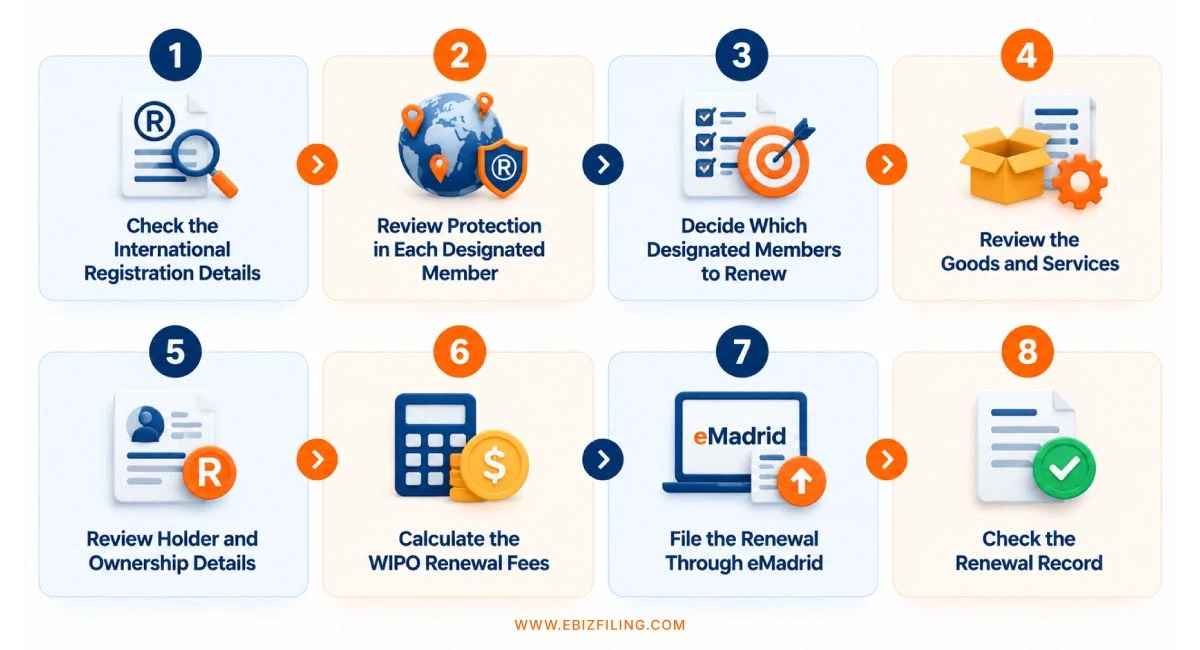
Step 1: Check the International Registration Details
Before beginning International Trademark Renewal, verify:
- International registration number
- Registration date
- Expiry date
- Holder name
- Designated members
- Current goods and services
- Recorded representative
Any difference between internal company records and the International Register should be reviewed before renewal.
Step 2: Review Protection in Each Designated Member
Trademark protection may not have the same status in every designated member.
Depending on previous proceedings, protection may have been:
- Granted completely
- Granted only for some goods or services
- Provisionally refused
- Finally refused
- Limited
- Partially invalidated
- Totally invalidated
- Renounced
The holder should therefore check the actual recorded position before International Trademark Renewal rather than assume that all original designations remain equally protected.
Step 3: Decide Which Designated Members to Renew
A Madrid international registration does not necessarily have to be renewed for every designated member.
The holder can decide which designated members should continue to be covered.
This makes International Trademark Renewal an important portfolio-management exercise.
For example, a business may review whether a particular jurisdiction is still commercially relevant before paying renewal fees for that designation.
However, allowing protection to lapse should be considered carefully because returning to that market later may require a new filing or another available protection route.
Step 4: Review the Goods and Services
Renewal is essentially a continuation of the registration in the form in which it exists at the relevant time. It is not a procedure for freely rewriting or expanding the trademark specification.
A holder cannot ordinarily use the renewal request itself simply to select a new list of goods or services.
If the holder wants to voluntarily restrict the goods or services covered in some or all designated members, a separate limitation procedure may be used. WIPO currently permits limitations to be requested through eMadrid.
Recorded limitations, partial invalidations, cancellations and certain final protection decisions can also affect the scope that continues at renewal.
Therefore, International Trademark Renewal should include a review of the actual goods and services remaining relevant to each designation.
Can You Renew Only Some Goods or Services?
Not simply by rewriting the specification in the ordinary renewal request.
If the holder wants to voluntarily reduce the goods or services covered by the international registration for one or more designated members, the appropriate separate limitation or cancellation procedure should be considered.
However, International Trademark Renewal will reflect restrictions already recorded in the International Register.
For example, a recorded:
- Limitation
- Partial invalidation
- Partial cancellation
- Final decision granting protection for only some goods or services
May affect the scope of protection continuing at renewal.
Renewal should therefore be based on the actual recorded scope rather than only the specification originally filed.
Step 5: Review Holder and Ownership Details
Before International Trademark Renewal, confirm whether the following remain correct:
- Holder name
- Holder address
- Legal entity details
- Representative
- Ownership details
If ownership has changed, it should not simply be ignored until the next renewal cycle.
WIPO provides procedures for recording changes affecting Madrid registrations.
Where an Indian trademark is separately transferred as part of a broader IP transaction, businesses may also review Ebizfiling’s Trademark Assignment service for the relevant Indian trademark requirements.
Step 6: Calculate the WIPO Renewal Fees
As of September 2026, WIPO states that Madrid renewal fees include:
Basic fee: 653 Swiss francs
Individual fee: variable for designated members that charge an individual fee
Complementary fee: 100 Swiss francs for applicable designated members
Supplementary fee: 100 Swiss francs for each class above three where the complementary-fee structure applies
The exact amount depends on the designated members and applicable fee structure.
Because individual fees may change, the WIPO fee calculator should be checked close to the filing date rather than relying on an old renewal invoice.
Step 7: File the Renewal Through eMadrid
International Trademark Renewal may be completed through WIPO’s eMadrid system.
The holder or authorised representative can generally:
- Access the relevant international registration.
- Select the renewal function.
- Review the designated members.
- Confirm renewal information.
- Calculate applicable fees.
- Complete payment.
- Submit the renewal request.
WIPO checks the renewal request for formalities and payment requirements.
Step 8: Check the Renewal Record
If the renewal meets the applicable formal requirements and fees are paid, WIPO records it in the International Register.
WIPO then sends a Certificate of Renewal.
The business should retain this certificate and update its internal trademark portfolio records.
Can You Renew an International Trademark in Only Some Designated Members?
Yes. A holder can choose to continue protection in selected Madrid System members instead of maintaining every designation. This makes International Trademark Renewal useful for reviewing whether trademark protection still matches the company’s commercial markets.
Before dropping a designation, businesses should consider:
- Current sales
- Planned expansion
- Licensing arrangements
- Manufacturing activity
- E-commerce activity
- Counterfeiting risks
- Distributor relationships
Renewal decisions should therefore reflect both legal and commercial considerations.
What Happens If You Miss the International Trademark Renewal Deadline?
A Madrid international registration normally expires at the end of its 10-year term unless renewed.
WIPO provides a six-month grace period following expiry.
International Trademark Renewal during this grace period requires the applicable renewal fees plus a surcharge equal to 50% of the basic renewal fee.
The six-month Madrid grace period should not be automatically applied to independent national or regional trademark registrations.
Those registrations must be reviewed under the applicable local law.
For Indian national trademarks requiring separate renewal, businesses can review Ebizfiling’s Trademark Renewal Services.
Does Renewal Automatically Maintain Protection in Every Designated Member?
Not necessarily. International Trademark Renewal keeps the international registration renewed for the designated members included in the renewal, but the substantive scope of protection can differ between members.
Protection may have previously been affected by:
- Refusal
- Limitation
- Partial invalidation
- Total invalidation
- Renunciation
- Cancellation
- A decision restricting goods or services
For example, where a total invalidation or renunciation has been recorded for a designated member, the international registration cannot simply be renewed for that member as though those rights still existed.
Businesses should therefore review the status of each designated member rather than equating payment of a renewal fee with identical protection everywhere.
Why Is the Five-Year Dependency Period Important?
For the first five years from the international registration date, a Madrid international registration remains dependent on the basic application or registration. If the basic mark ceases to have effect during this dependency period, the international registration may be cancelled to the corresponding extent.
The international registration may also be affected where proceedings that began during the five-year dependency period later result in the basic mark ceasing to have effect. This issue is separate from International Trademark Renewal, which ordinarily occurs at the end of the 10-year registration term.
However, businesses using the Madrid System should understand both concepts because protection can be affected before the first renewal date.
Should the Basic Trademark Be Maintained Separately?
Yes, where protection in the basic jurisdiction remains important. During the first five years, maintaining the basic application or registration is particularly significant because of Madrid dependency. After the dependency period, the international registration generally becomes independent of the basic mark, subject to the consequences of qualifying proceedings commenced during the dependency period.
Indian businesses should therefore monitor both their Indian basic mark and the Madrid international registration rather than treating them as the same right.
Can You Add New Members During International Trademark Renewal?
Renewal itself is not the process used to add new Madrid System members. If the holder wants to extend the international registration to additional eligible members, the usual mechanism is a subsequent designation. A subsequent designation may extend protection to additional members after the original international registration has been filed.
However, it generally does not create a separate independent 10-year renewal term. The subsequently designated member remains linked to the international registration’s overall renewal cycle.
Therefore, subsequent designation and International Trademark Renewal should be treated as separate portfolio actions.
What Changes Should Be Recorded Before Renewal?
Before International Trademark Renewal, businesses should verify:
- Holder’s legal name
- Address
- Ownership
- Representative details
- Recorded limitations
- Designated members
- Goods and services
- Protection status
Changes should not be left unresolved simply because renewal is approaching.
WIPO’s eMadrid system provides separate tools for managing international registrations, including ownership and portfolio-related changes.
International Trademark Maintenance Beyond Renewal
International Trademark Renewal is only one part of maintaining global trademark protection.
Businesses should also:
- Monitor conflicting trademark applications
- Maintain evidence of trademark use where relevant
- Review local non-use requirements
- Track opposition and invalidation proceedings
- Keep ownership records current
- Review licences
- Monitor assignments and corporate restructuring
- Check whether each protected market remains commercially relevant
Businesses that want to monitor potentially conflicting trademark filings can also review Ebizfiling’s Trademark Watch Services. Renewal alone does not override the substantive trademark law of a designated member.
International Trademark Renewal Checklist
Before filing, confirm:
- International registration number
- Expiry date
- Current holder
- Designated members
- Protection status
- Goods and services
- Ownership details
- Representative information
- Basic mark status, where relevant
- Applicable WIPO fees
- Renewal territories
- Payment completion
- Renewal certificate
Using an International Trademark Renewal checklist can help businesses identify portfolio issues before the renewal deadline.
International Trademark Renewal Mistakes
Businesses should avoid:
- Assuming every international trademark uses the Madrid renewal process
- Missing the normal renewal date
- Depending entirely on reminder notices
- Ignoring the grace-period surcharge
- Renewing every designation without reviewing commercial need
- Assuming renewal can add new designated members
- Trying to expand goods or services through renewal
- Ignoring limitations or invalidations already recorded
- Failing to update ownership details
- Confusing the five-year dependency period with the 10-year renewal term
- Assuming WIPO renewal satisfies every country-specific trademark requirement
A planned International Trademark Renewal process helps businesses manage both legal deadlines and portfolio costs.
How Ebizfiling Can Help With International Trademark Renewal
Managing trademarks across multiple jurisdictions can involve different registration routes, ownership records, renewal deadlines and protection requirements.
Ebizfiling can assist businesses in reviewing how their international trademark portfolio is structured and identifying whether protection is held through a Madrid international registration, an Indian national registration or another filing route.
For businesses expanding internationally, Ebizfiling also provides assistance with International Trademark Registration under the Madrid Protocol, including Madrid filing and designated-member selection. Before proceeding with International Trademark Renewal, businesses should verify the registration route, expiry date, designated members and current protection status so that the correct renewal procedure is followed.
Need help reviewing your international trademark portfolio? Talk to an Ebizfiling expert to understand the applicable renewal route and next steps for maintaining your trademark protection.
Conclusion
International Trademark Renewal is more than paying a renewal fee every 10 years. Businesses using the Madrid System should review designated members, protection status, ownership records, goods and services, applicable fees and the status of the basic mark where relevant.
Independent national or regional trademark registrations should be renewed according to the rules of the relevant jurisdiction rather than being treated as part of the Madrid renewal process. A well-planned International Trademark Renewal strategy can help businesses maintain commercially relevant trademark protection while keeping their global portfolio accurate and manageable.
Frequently Asked Questions
1. What is the deadline for renewing a Madrid international trademark registration?
A Madrid international registration can be renewed from six months before the end of its 10-year term. If the normal expiry date is missed, WIPO allows a further six-month grace period, but renewal during that period attracts a surcharge equal to 50% of the basic renewal fee.
2. Can an international trademark be renewed for only some designated Madrid System members?
Yes. The holder may complete International Trademark Renewal for only selected designated members instead of renewing every territory covered by the registration. If a member is omitted, it may still be included through a complementary renewal during the six-month grace period; after that, a subsequent designation may be required to seek protection again.
3. Can only selected goods or services be renewed under the Madrid System?
Not simply through the ordinary renewal request. The holder cannot normally use renewal itself to rewrite the specification and select only certain goods or services. If the scope needs to be voluntarily reduced, a separate limitation or cancellation procedure should be considered. Existing recorded limitations, partial invalidations or other restrictions can affect the scope that continues at renewal.
4. Can a new country or Madrid System member be added during International Trademark Renewal?
No. Renewal itself is not the procedure for adding new designated members. Additional territories are generally added through a subsequent designation. A subsequent designation does not receive a separate 10-year term; it normally expires on the same date as the existing international registration.
5. Does renewing a Madrid registration revive protection that was previously refused or invalidated in a designated member?
No. Renewal does not automatically reverse a refusal, invalidation, limitation or other decision already affecting protection in a designated member. International Trademark Renewal continues the registration according to the protection status and scope recorded for the relevant territory.
6. How are Madrid international trademark renewal fees calculated?
Madrid renewal fees currently include a basic fee of 653 Swiss francs, plus individual fees for designated members that charge them and/or a complementary fee of 100 CHF for other applicable members. A supplementary fee of 100 CHF for each class above three may also apply where the complementary-fee structure is used. Individual fees vary by designated member and can change.
7. Can the basic trademark affect an international registration before its first renewal?
Yes. A Madrid international registration remains dependent on its basic application or registration for the first five years from the date of international registration. If the basic mark ceases to have effect during that period, the international registration may be cancelled to the corresponding extent. Certain proceedings begun during the five-year period may also affect the international registration even if concluded later.
8. Does WIPO International Trademark Renewal also renew separate national trademark registrations?
No. WIPO renewal applies to the Madrid international registration and the designated members included in that registration. A separate national or regional trademark registration remains a distinct right and must be renewed according to the applicable national or regional system unless another specific legal mechanism applies.
9. Can Ebizfiling review designated members and renewal requirements before an International Trademark Renewal?
Yes. Ebizfiling provides support for international trademarks under the Madrid Protocol, including assistance with international trademark filing, territory selection, tracking and renewal-related support. Before renewal, businesses can review their designated members, registration details and international trademark portfolio to identify the appropriate next steps.
10. Can Ebizfiling help determine whether a trademark needs Madrid renewal or separate Indian trademark renewal?
Yes. The renewal route depends on how the trademark protection was obtained. Ebizfiling provides assistance for both International Trademark Registration under the Madrid Protocol and Trademark Renewal in India, so the registration route should first be identified before proceeding with the applicable renewal process.





Register Your Brand Internationally
Make Trademark Registration simple with reliable assistance for protecting your brand and managing essential trademark requirements.
About Ebizfiling -



Reviews
Akshay Apte
16 Apr 2018They have managed my Company’s Annual Filling in a way no one could. We are really happy with their services. Great going!
Ateek Mohd
23 Apr 2022Ebizfiling India pvt ltd is leading account services provider across the country. They have a very good and genuine staff. They give all the services in given time frame. My two company’s accountability done by this firm. Awesome service ..!
Gaurav Pandey
04 Apr 2022Best place for formation of the company, they are quick, efficient and reasonable. most recommended place for company formation.
October 12, 2026 By Srishti M
Company Compliance Calendar November 2026: Key Due Dates & Filings Introduction The Company Compliance Calendar November 2026 highlights important annual return, dematerialisation and income tax compliances that companies may need to complete during the month. November 2026 is particularly […]
October 10, 2026 By Srishti M
October 10, 2026 By Srishti M
Compliance Calendar November 2026: Key Statutory Due Dates Introduction The compliance calendar November 2026 covers important statutory obligations under GST, Income Tax, TDS/TCS, Company Law, LLP regulations, EPF and ESI. It helps businesses identify the filings, payments and regulatory requirements […]