


-
September 30, 2026
-
BySteffy A
ITR-3 Form Filing AY 2026-27: Process and Eligibility
Introduction
The filing of the ITR-3 Form Filing is one of the most important compliance requirements for people and HUFs who earn money through their businesses or careers. One way of doing this is to correctly complete your income tax filing to avoid penalties. It is essential to know how to complete the ITR-3 Form filing AY 2026 to 2027 in case you are a professional or a business owner. This handbook gives a concise description of eligibility, the process, and key characteristics.
What is ITR-3 Form Filing?
The ITR-3 form filing is used by individuals and HUFs who receive income from a business or occupation to file their income tax returns. This form requires correct financial reporting and is more thorough than simpler forms like ITR-1 or ITR-2.
It includes financial data such as balance sheets, profit and loss accounts, and business income. Due to its complexity, business owners, independent contractors, consultants, and professionals such as physicians, attorneys, and chartered accountants usually submit it.
ITR-3 Form Filing Eligibility vs Non-Eligibility Chart
|
Category |
ITR-3 Form Filing Eligibility |
ITR-3 form filing Non- Eligibility |
|
Business Income |
Individuals with income from business or profession |
No business or professional income |
|
Firm Partners |
Partners earning income from partnership firms |
Not applicable if eligible for ITR-2 |
|
Freelancers |
Freelancers and consultants with regular income |
Not applicable |
|
Trading Income |
Income from speculative business or intraday trading |
Not applicable |
|
Multiple Income Sources |
Salary, house property, or other income along with business income |
Only salary or pension income |
|
Taxation Scheme |
Regular taxation scheme users |
Those opting for presumptive taxation under Sections 44AD, 44ADA, 44AE |
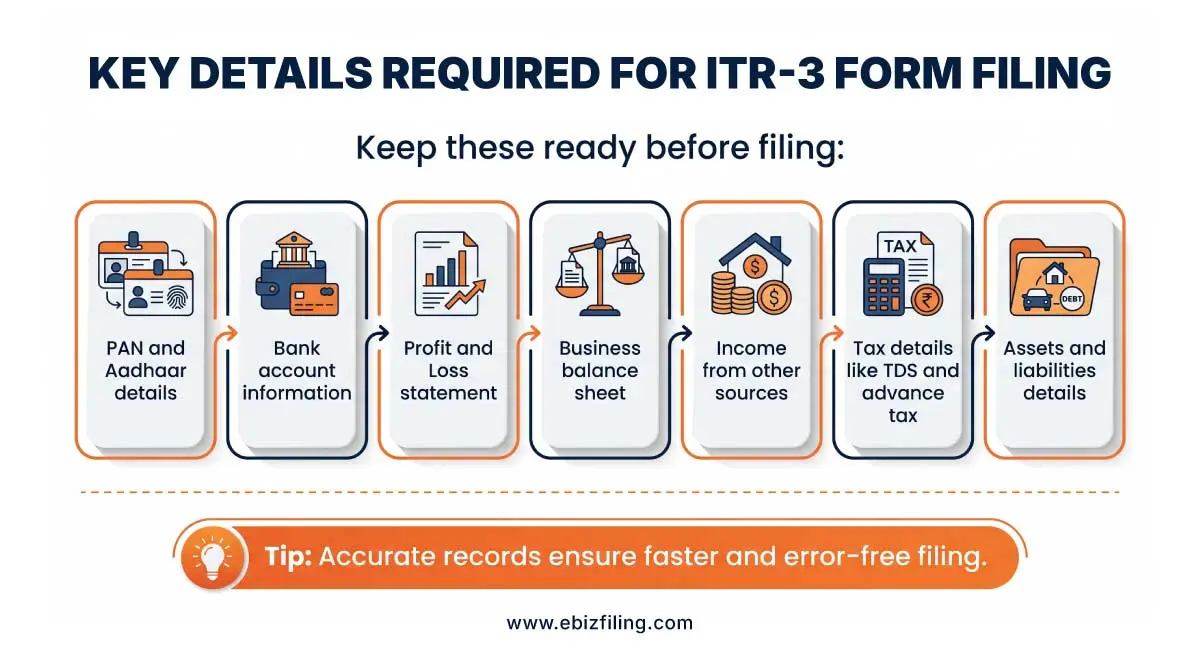
ITR-3 Form Filing Process for AY 2026-27
1. Login to the Income Tax Portal: Begin by visiting the Income Tax e-filing portal and logging in using your PAN credentials.
2. Select Assessment Year and Form: Choose Assessment Year 2026-27 and select ITR-3 form filing as your return form.
3. Enter Personal and Income Details: Fill in your personal information along with income from business, salary, house property, and other sources.
4. Provide Business Information: Enter detailed business data such as turnover, profits, expenses, and balance sheet figures, as this is the most important section.
5. Review Tax Liability: The system will calculate your tax automatically. Carefully check the details to ensure accuracy.
6. Submit and Complete E-Verification: Submit the return and complete e-verification using Aadhaar OTP, net banking, or a digital signature.
To know the structure of form click on the ITR-3 Form pdf.
ITR-3 Form Filing Due Dates for AY 2026-27
The due date for filing ITR-3 depends on whether the taxpayer is subject to tax audit or has transfer pricing requirements. For AY 2026-27, the applicable due dates are:
- 31 August 2026: For taxpayers who are not required to get their accounts audited under the Income-tax Act.
- 21 October 2026: For furnishing the Tax Audit Report where the tax audit under Section 44AB is applicable (extended from 30 September 2026).
- 21 November 2026: For taxpayers whose accounts are required to be audited (extended from 31 October 2026 as per CBDT Circular No. 07/2026).
- 30 November 2026: For taxpayers who are required to furnish a report under Section 92E in respect of international transactions or specified domestic transactions.
- 31 December 2026: For filing belated returns for AY 2026-27.
Note: The extension to 21 October 2026 and 21 November 2026 applies to taxpayers covered under the audit category specified in CBDT Circular No. 07/2026. The separate due date for Section 92E (transfer pricing) cases remains 30 November 2026 unless extended separately by CBDT.
Important Changes in ITR-3 Form Filing for AY 2026-27
Every financial year brings some changes in reporting requirements. For AY 2026-27, taxpayers should pay attention to:
- More detailed disclosure of foreign assets.
- Improved validation checks by the department.
- Detailed reporting of digital transactions.
- Focus on capital gains accuracy.
For instance :
A freelance designer who makes ₹12 lakh a year submitted an ITR-3 but neglected to disclose interest income from accounts for savings. The Income Tax Department sent out a notice as a result. The problem was fixed following repair and accurate reconciliation with Form 26AS. This proves the significance of truthful reporting.
Also read : complete guide on ITR-1 form and ITR-2 form
Common Mistakes to Avoid While Filing ITR-3 Form Filing
1. Incorrect Business Income Reporting: Many taxpayers under report income or fail to match financial statements with actual filings.
2. Missing Income Sources: Even small earnings like interest or freelance income must be properly disclosed.
3. Wrong Bank Details: Incorrect bank information or failure to verify the return can make it invalid.
4. TDS Mismatch Issues: Not reconciling TDS with Form 26AS can lead to refund delays and notices.
5. Late or No Verification: Failing to e-verify the return on time can result in incomplete filing.
How Ebizfiling Supports Your ITR-3 Form Filing?
Ebizfiling is a trusted platform that simplifies tax and compliance for businesses and professionals.
- Accurate ITR-3 Form Filing with complete income reporting.
- Proper review of financial documents and statements.
- Assistance in tax calculation and compliance checks.
- Timely filing to avoid penalties and notices.
Get expert help to ensure smooth, error-free, and timely filing.
Conclusion
ITR-3 Form Filing is important for individuals and HUFs earning income from businesses or profession. While the procedure seems difficult, having the right documents and understanding the requirements can make it manageable. Filing your return accurately and on time not only keeps you compliant but also helps avoid penalties and future problems. If you are not about any part of the process, taking expert assistance can ensure your filing is smooth and error-free.
Suggested read :
Confused About ITR Forms? Here’s a Simple Guide for 2026
ITR Filing Online vs Tax Consultant
Documents required for finalizing Income Tax Return
What is form ITR-1 filing And How to File ITR-1 Sahaj Form?
Section 202 of the Income Tax Act
ITR-3 Form Filing Frequently Asked Questions
1. What is the way you compute business revenues when completing ITR-3?
ITR-3 calculates business income by deducting allowable expenses such as rent, salaries, utilities, and depreciation from total business income. The remaining amount represents profit or loss. These entries must be accurately recorded and supported by proper financial records to avoid issues during assessment.
2. How do we report depreciation in ITR-3 form filing?
Depreciation must be calculated as per the Income Tax Act using prescribed rates for different asset categories. Maintaining a proper asset register is essential. Incorrect claims may lead to notices or rejection, making this section highly important.
3. How to treat loss in ITR-3 form filing?
Business losses can be carried forward and set off against future profits to reduce tax liability. However, failure to file returns on time may lead to penalties and loss of this benefit. Timely filing is crucial to claim such advantages.
4. How do we report partner income of a firm in ITR-3 form filing?
Income such as salary, bonus, commission, or interest received by a partner from a firm must be reported as taxable income. The share of profit is generally exempt but must still be disclosed. Accurate reporting ensures transparency and consistency.
5. Which are the advance and self-assessment tax changes in filing ITR-3 form?
All taxes paid, including advance tax and self-assessment tax, must be reported while filing ITR-3. These are adjusted against total tax liability to determine payable or refundable amounts. Mismatches with Form 26AS can delay processing.
6. How do you record capital gains and business income in ITR-3 form filing?
Capital gains from the sale of assets like property or shares must be reported separately under the capital gains section. These are taxed differently from business income. Proper classification ensures accurate taxation and compliance.
7. What can be the effects of GST turnover in ITR-3 form filing?
If registered under GST, the turnover reported in ITR-3 must match GST returns. Any mismatch may attract scrutiny. Maintaining consistency between GST and income tax records is essential for smooth processing.
8. How might differences in TDS information affect ITR-3 form filing?
Mismatch between TDS details in your return and Form 26AS or AIS may lead to delays or reduced refunds. Proper reconciliation before filing helps avoid notices and ensures accurate processing.
9. How does Ebizfiling ensure accuracy in filing ITR-3?
Ebizfiling reviews financial statements, reconciles income and taxes, and ensures accurate disclosures. Their process helps identify errors related to TDS, GST, and financial reporting, reducing the risk of notices and ensuring smooth filing.
10. How can expert assistance improve ITR-3 form filing?
Professional assistance ensures correct interpretation of tax laws, accurate financial reporting, and error-free filing. Experts help manage complex aspects like depreciation, tax computation, and compliance, resulting in timely and stress-free returns.





ITR filing
Filing of Income Tax return is necessary if you have earned any income. File your ITR with EbizFiling
About Ebizfiling -



Reviews
Akshay shinde
23 Apr 2019Excellent service…
Hemanshu Mahajan
01 Apr 2018I registered my LLP company, from eBizfilling. Great team and very competitive pricing. Will definitely use their services again.Thanks for work well done.
Kartar Singh Sandil
09 Mar 2018Your working team is genius. Thanks.
October 21, 2026 By Srishti M
Tax Planning for NRI Returning to India Before Becoming ROR Introduction Tax planning for NRI returning to India should start before the person becomes Resident and Ordinarily Resident, also known as ROR. Under the Income-tax Act, 2025, residential status decides […]
September 30, 2026 By Srishti M
September 29, 2026 By Srishti M
Income Tax Compliance Calendar October 2026: Filing Guide Introduction The Income Tax Compliance Calendar October 2026 highlights important income tax obligations applicable to taxpayers, businesses and entities covered under audit and transfer pricing provisions. October 2026 includes key compliance […]