


-
July 11, 2026
-
BySteffy A
TDS on Payments under Section 194M of the Income Tax Act, 1961
Introduction
Section 194M of the Income Tax Act was introduced to bring certain high-value payments made by individuals and Hindu Undivided Families (HUFs) under the TDS framework. It applies to individuals who make payments to resident contractors, professionals, or for commission. However, they are not required to deduct TDS under sections like 194C, 194H, or 194J. The provision was added to close a compliance gap and ensure tax deduction on large personal or non-audit transactions. Under the Income tax Act, 2025, the provisions corresponding to Section 194M of the Income tax Act, 1961 have been renumbered as Section 393(1), Table Sl. No. 6(ii).
In this blog, we will discuss TDS on payments made to resident contractors, professionals, and commission or brokerage recipients under Section 194M of the Income Tax Act, 1961.
TDS under Section 194M of the Income Tax Act
According to Section 194M of the Income Tax Act, if an individual or HUF uses contractual services or professional services and the total amount paid is more than Rs. 50 lakhs during the particular financial year, the payer has to deduct TDS at 2%. The purpose of adding this section was to make individuals and HUFs more accountable for their tax compliance and financial accounting.
TDS stands for tax deducted at source. As per the Income Tax Act, any company or person making a payment is required to deduct tax at source if the payment exceeds certain threshold limits. TDS has to be deducted at the rates prescribed by the tax department.
Under the Income-tax Act, 2025, the provisions corresponding to Section 194M of the Income tax Act, 1961 have been renumbered as Section 393(1), Table Sl. No. 6(ii).
To understand the updated provisions and related TDS changes under the new law, read our detailed guide on Section 393(1) of Income Tax Act 2025: TDS on Rent Explained.
Payments Covered under Section 194M of the Income Tax Act
This section outlines the types of payments on which tax must be deducted under Section 194M. It covers specific payments made by individuals and Hindu Undivided Families (HUFs) when the prescribed conditions are met.
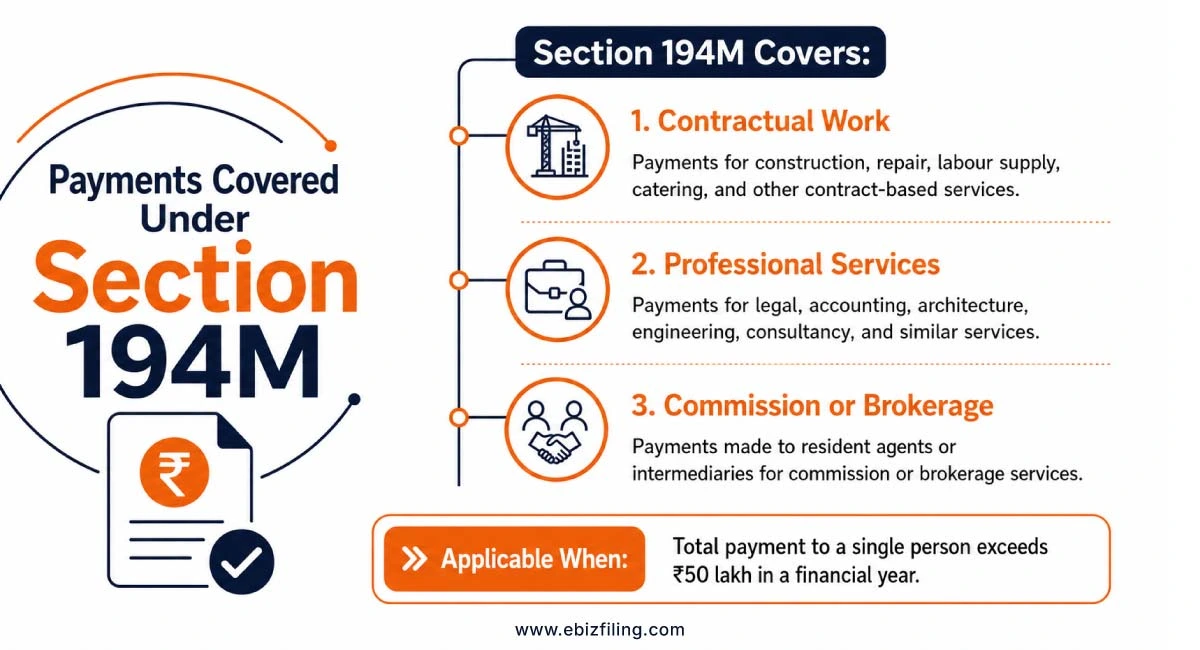
Contractual work – Payments made for carrying out any work under a contract are covered under Section 194M. This includes payments for construction, repair work, labour supply, catering, and similar contractual arrangements where a service or task is executed.
Professional services– Section 194M also applies to payments made for professional services such as legal, accountancy, architectural, engineering, consultancy, and interior decoration services. These services are generally provided by persons with specialised knowledge or professional qualifications.
Commission or brokerage – Payments made in the nature of commission or brokerage to a resident are covered under Section 194M, except insurance commission covered under other TDS provisions. This includes payments made to agents or intermediaries for services rendered, other than insurance commission.
All these payments fall under Section 194M only when the total amount paid to a single person exceeds ₹50 lakh in a financial year.
Who Is Required to Deduct TDS Under Section 194M?
This section explains which individuals and Hindu Undivided Families (HUFs) are required to deduct tax at source under Section 194M of the Income Tax Act. It mainly applies to cases where large payments are made, but regular TDS provisions do not apply.
Applicability to Individuals and HUFs
Section 194M applies when an individual or HUF makes payments exceeding ₹50 lakh in a financial year to a resident contractor, professional, or recipient of commission/brokerage. The threshold limit for Section 194M is ₹50 lakhs. If the total gross payments do not cross this threshold, then Section 194M is not applicable.
By prescribing a threshold limit, the section applies only to high-value payments and reduces compliance requirements for smaller transactions.
When TDS Deduction Becomes Mandatory?
TDS must be deducted when payment is made to a resident contractor, professional, or for commission or brokerage, and the total payment to one person exceeds ₹50 lakh in a financial year. This rule applies even if the payment is for personal purposes.
Cases Where Section 194M Does Not Apply
Section 194M is not applicable in the following cases:
- Payments made to non-residents: Section 194M applies only to payments made to resident contractors, professionals, or persons receiving commission or brokerage. Payments to non-residents are covered under other applicable provisions of the Income Tax Act.
- Payments not covered under specified categories: TDS under Section 194M is applicable only for contractual work, professional services, or commission/brokerage payments. Other types of payments are outside the scope of this section.
- Payments already covered under other TDS provisions: Payments where the payer is already liable to deduct TDS under Sections 194C, 194H, or 194J are outside the scope of Section 194M, as those specific provisions apply.
This version is legally safer and avoids mentioning exclusions that are not specifically provided under Section 194M.
Rate of TDS under Section 194M
|
Particulars |
Details |
|
Applicable payment |
Payment to a resident contractor, professional, or for commission or brokerage |
| Threshold limit |
More than Rs. 50,00,000 in a financial year |
|
TDS rate |
2% |
| If PAN is not furnished |
TDS may be deducted at the higher rate applicable under Section 206AA |
|
Time of deduction |
At the time of credit or payment, whichever is earlier |
When Can Tax Be Deducted at Source under Section 194M?
An individual or HUF shall deduct TDS on payments made to resident contractors or professionals under Section 194M either:
- At the time of credit of such amount; or
- At the time of payment by cash, cheque, draft, or any other mode,
whichever is earlier.
Get Expert Help for TDS Return Filing
TDS compliance under Section 194M of the Income Tax Act can be confusing for individuals and HUFs when payments cross the prescribed threshold limit. From checking the applicable TDS rate to filing the correct return, every step needs proper attention to avoid errors, interest, or late filing issues.
Ebizfiling can assist you with:
- TDS calculation based on the applicable rate and payment amount
- Challan payment guidance for timely TDS deposit
- Deductee details review, including PAN and payment information
- Form 26QD filing assistance for contractor, professional, commission, or brokerage payments
Need help with TDS return filing? Our experts are here to assist you with accurate and timely compliance.
Conclusion
The introduction of Section 194M of the Income Tax Act created a wider base to cover individuals and HUFs that were not subject to tax audit. The provision helps bring high-value payments made by individuals and HUFs within the TDS framework while maintaining a threshold limit for smaller transactions. For individuals and HUFs, it is crucial to know the applicability of Section 194M, the compliance requirements, and the penalties for non-compliance. Under the Income Tax Act, 2025, Section 194M has been renumbered as Section 393(1), Table Sl. No. 6(ii).
FAQs on Section 194M of the Income Tax Act
1. Which form is filed for TDS under Section 194M?
For TDS under Section 194M, the payer has to file Form 26QD. It is a challan-cum-statement used for reporting TDS on payment to resident contractor, resident professional, or payments made in the nature of commission or brokerage. This form contains details of the payer, deductee, payment amount, TDS amount, and date of deduction.
2. What is Form 26QD under Section 194M of the Income Tax Act?
Form 26QD is an online challan-cum-statement used for depositing and reporting TDS under Section 194M of the Income Tax Act. It is mainly applicable to individuals and HUFs who deduct TDS on professional fees, contractor payments, commission, or brokerage. Since Section 194M does not require TAN, the form can be filed using PAN details.
3. What is the due date for filing Form 26QD?
Form 26QD must generally be filed within 30 days from the end of the month in which TDS under Section 194M is deducted. Filing it on time is important because delay may lead to interest, late fees, or compliance issues. The payer should ensure that the TDS amount, PAN details, and payment information are entered correctly before submission.
4. Is Form 16A issued for TDS under Section 194M?
Yes, Form 16A is issued as a TDS certificate after deducting tax under Section 194M of the Income Tax Act. It acts as proof that TDS has been deducted and deposited against the deductee’s PAN. The deductee can use Form 16A to claim TDS credit while filing the income tax return.
5. When should Form 16A be issued for Section 194M TDS?
Form 16A should be issued after Form 26QD is filed and the TDS certificate is generated from the TRACES portal. It should be given to the resident contractor, professional, or person receiving commission or brokerage within the prescribed timeline. This helps the deductee verify the TDS credit in Form 26AS or AIS.
6. Is TAN compulsory for TDS under Section 194M?
No, TAN is not compulsory for deducting TDS under Section 194M of the Income Tax Act. This is one of the key benefits of this provision for individuals and HUFs. The payer can deduct and deposit TDS using PAN details, which makes Section 194M compliance easier for persons who are not otherwise required to deduct TDS under sections like 194C, 194H, or 194J.
7. Can TDS under Section 194M be paid online?
Yes, TDS under Section 194M can be paid online through the income tax portal by filing Form 26QD. The payer must provide correct details such as PAN of the deductor, PAN of the deductee, payment amount, TDS amount, date of payment or credit, and nature of payment. Online filing helps complete TDS compliance in a structured and traceable manner.
8. What details are required for filing Form 26QD?
For filing Form 26QD, the payer generally needs PAN of the payer, PAN of the deductee, address details, amount paid or credited, TDS amount, date of payment or credit, and type of payment. These details must be accurate because errors may affect TDS credit for the deductee. Correct filing is important for smooth Section 194M TDS compliance.
9. What happens if TDS under Section 194M is not deducted?
Failure to deduct or deposit TDS under Section 194M may result in interest liability, late fees, penalties, and other consequences under the Income Tax Act.
10. How can Ebizfiling support Section 194M compliance?
Ebizfiling can support Section 194M compliance by helping individuals and HUFs understand the applicable TDS rate, payment details, Form 26QD filing process, and TDS certificate requirements. Our experts can also assist with TDS return filing support, challan guidance, and documentation review for payments made to resident contractors, professionals, or persons receiving commission or brokerage.





File TDS Returns
Quickly file error-free TDS Returns with Ebizfiling. This ensures seamless credit to the deductee. Prices Starting INR 999/-.
About Ebizfiling -



Reviews
Ashish Paliwal
29 Sep 2018Let me be honest and tell you that I did not choose eBiz filing after my initial LLP company registration did to pricing. A lot of companies contact me with better rates so I generally choose them. However, I will still rate eBiz filing 10/10 on work ethics. You guys are professionals in true sense.
Harshit Gamit
19 Apr 2018My GST process was made easier with Ebizfiling. I really appreciate the hard work by your team. Keep up the same in the future. Good Luck!
Manank Turakhia
14 Jun 2019Ebizfilling.com is one of its kind of organization, believe me guys their working process is very smooth. I had an awesome experience regarding MSME certification. Thank you Kushani & Mansi for your wonderful efforts. Kudos to Ebizfiling, you are doing great keep doing it.
October 15, 2026 By Srishti M
TDS and TCS Compliance Calendar November 2026: Compliance Guide Introduction The TDS and TCS Compliance Calendar November 2026 covers important tax deduction, collection, payment, certificate and reporting requirements applicable during the month. It helps businesses, government offices and other responsible […]
October 14, 2026 By Srishti M
GST Compliance Calendar November 2026: Key Due Dates & Filings Introduction The GST Compliance Calendar November 2026 highlights the major GST return filing, tax payment, invoice reporting and year-end adjustment deadlines applicable during the month. It covers regular taxpayers, QRMP […]
October 13, 2026 By Srishti M