


-
August 22, 2026
-
BySteffy A
Tax Rebate Under Section 87A: Eligibility, Limits and How to Claim
Introduction
Tax Rebate Under Section 87A allows eligible resident individuals to reduce their final income-tax liability. It is applied after income tax is calculated on total income and is different from a tax deduction or income-tax refund. For FY 2025-26, corresponding to AY 2026-27, the rebate depends on the tax regime selected.
Under the old tax regime, a resident individual with total income up to ₹5 lakh can claim a maximum rebate of ₹12,500. Under the new tax regime, a resident individual with total income up to ₹12 lakh can claim a maximum rebate of ₹60,000. Marginal relief may also be available under the new tax regime when total income slightly exceeds ₹12 lakh.
What Is Tax Rebate Under Section 87A?
Tax Rebate Under Section 87A provides a reduction from the income tax payable by an eligible resident individual. It does not reduce gross income or taxable income. Instead, the rebate is deducted from the tax calculated on total income.
The calculation generally follows these steps:
- Calculate income from all applicable sources.
- Claim eligible exemptions, deductions, and loss set-offs.
- Arrive at total income.
- Calculate income tax under the selected tax regime.
- Reduce the eligible Section 87A rebate.
- Add Health and Education Cess at 4% to the remaining tax.
The rebate cannot exceed the actual income-tax liability. For example, if the calculated tax is ₹8,000, the rebate will be limited to ₹8,000 even where the maximum permitted rebate is higher.
Under the new tax regime, the rebate also cannot exceed the tax calculated at normal slab rates under Section 115BAC(1A).
Who Is Eligible to Claim Section 87A Rebate?
A taxpayer can claim Tax Rebate Under Section 87A when:
- The taxpayer is an individual.
- The individual is resident in India during the relevant financial year.
- The individual’s total income is within the limit applicable to the selected tax regime.
- The individual satisfies the conditions prescribed under Section 87A.
Resident senior citizens and super senior citizens can also claim the rebate if they meet the applicable conditions. There is no maximum age limit for claiming the Section 87A rebate.
The rebate is not available to non-resident individuals, Hindu Undivided Families, partnership firms, LLPs, companies, trusts or other non-individual taxpayers.
Taxpayers must also report all sources of income correctly and select the appropriate tax regime while filing their Income Tax Return.
Can ₹12.75 Lakh Salary Be Tax-Free?
A salaried individual earning up to ₹12.75 lakh may have no income-tax liability under the new tax regime if the standard deduction of ₹75,000 is available and there is no income taxable at special rates.
After claiming the standard deduction, the individual’s total income may reduce to ₹12 lakh, making the person eligible for a rebate of up to ₹60,000 under Section 87A.
|
Particulars |
Amount |
|
Gross salary |
₹12,75,000 |
| Standard deduction |
₹75,000 |
|
Total income |
₹12,00,000 |
| Tax before rebate |
₹60,000 |
|
Section 87A rebate |
₹60,000 |
| Final tax payable |
Nil |
The Section 87A income limit remains ₹12 lakh. The ₹12.75 lakh figure applies because eligible salaried individuals and pensioners may claim a standard deduction of ₹75,000 under the new tax regime.
The result may be different if the taxpayer has capital gains, lottery winnings, online gaming income, virtual digital asset income or any other income taxable at special rates.
What Is Marginal Relief Under Section 87A?
Marginal relief is available under the new tax regime when total income slightly exceeds ₹12 lakh.
Without marginal relief, a small increase in income could result in a tax liability higher than the additional income earned. Marginal relief ensures that the income tax payable before cess does not exceed the amount by which total income exceeds ₹12 lakh.
For example, if total income is ₹12.10 lakh:
|
Particulars |
Amount |
|
Income exceeding ₹12 lakh |
₹10,000 |
| Tax before marginal relief |
₹61,500 |
|
Marginal relief |
₹51,500 |
| Tax after marginal relief |
₹10,000 |
|
Health and Education Cess at 4% |
₹400 |
| Final tax payable |
₹10,400 |
Marginal relief under Section 87A is available under the new tax regime in eligible cases. It is different from marginal relief available in relation to surcharge.
Is the Section 87A Rebate Available on Capital Gains?
Special care is required when total income includes capital gains or other income taxable at special rates.
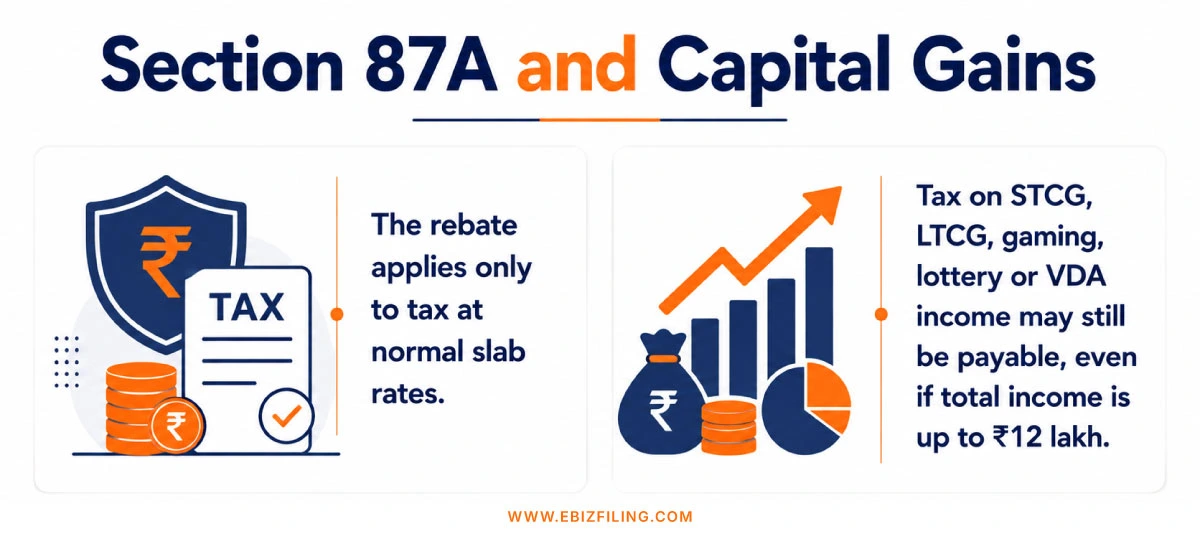
Such income may include:
- Short-term capital gains taxable at a special rate
- Long-term capital gains taxable at a special rate
- Lottery or betting winnings
- Online gaming income
- Income from virtual digital assets
For AY 2026-27 under the new tax regime, the Section 87A rebate cannot exceed the tax calculated at normal slab rates under Section 115BAC(1A).
Therefore, tax attributable to income taxable at special rates may remain payable even when the taxpayer’s total income does not exceed ₹12 lakh.
Taxpayers should calculate income taxable at normal slab rates and income taxable at special rates separately instead of assuming that the entire tax liability will become nil.
Difference Between Tax Rebate, Deduction and Refund
A tax deduction reduces taxable income before tax is calculated. A tax rebate reduces the tax calculated on taxable income.
A tax refund arises when TDS, advance tax, TCS or self-assessment tax already paid is higher than the final tax liability.
Section 87A is therefore a rebate from income tax. It is neither a deduction from income nor an automatic tax refund.
Section 87A and Section 156 of the Income-tax Act, 2025
The Income-tax Act, 2025, came into force on 1 April 2026. For Tax Year 2026-27 and subsequent years, Section 156 contains the corresponding rebate provision.
Income earned up to FY 2025-26 continues to be governed by Section 87A of the Income-tax Act, 1961.
Section 156 broadly continues the rebate of up to ₹12,500 for eligible resident individuals with total income up to ₹5 lakh and up to ₹60,000 under the new tax regime where total income does not exceed ₹12 lakh, subject to the prescribed conditions.
Ebizfiling Assistance for Section 87A Rebate
Ebizfiling can assist individuals with income-tax return filing and the correct calculation of Tax Rebate Under Section 87A. Our tax experts can help with:
- Checking Section 87A rebate eligibility
- Comparing the old and new tax regimes
- Calculating the applicable rebate and marginal relief
- Reviewing salary, pension, capital gains, and other income
- Claiming the correct standard deduction and eligible deductions
- Filing the appropriate Income Tax Return
Contact Ebizfiling for professional assistance with ITR filing and claiming Tax Rebate Under Section 87A.
Conclusion
Tax Rebate Under Section 87A can reduce or eliminate the tax liability of eligible resident individuals. For FY 2025-26, the old tax regime allows a maximum rebate of ₹12,500 where total income does not exceed ₹5 lakh. The new tax regime allows a maximum rebate of ₹60,000 where total income does not exceed ₹12 lakh.
Before claiming the rebate, taxpayers should check their residential status, selected tax regime, total income, and nature of income. Capital gains and other income taxable at special rates must be reviewed separately to avoid an incorrect tax calculation.
Suggested Reads:
Section 111A and 112A of Income Tax Act
Income Tax Rates Slab FY 2013-14
Frequently Asked Questions
1. What is the Section 87A rebate eligibility for FY 2025-26?
The taxpayer must be a resident individual and must satisfy the total income limit applicable to the selected tax regime. Non-residents, HUFs, firms, LLPs, companies and other non-individual taxpayers cannot claim the rebate.
2. What is the Section 87A rebate limit under the old tax regime?
Under the old tax regime, a resident individual with total income of up to ₹5 lakh can claim a rebate of up to ₹12,500. The rebate is restricted to the actual income tax payable if it is lower than ₹12,500.
3. What is the maximum tax rebate under Section 87A in the new regime?
For AY 2026-27, the maximum tax rebate under Section 87A is ₹60,000 when total income does not exceed ₹12 lakh. The rebate cannot exceed the actual tax calculated at the normal slab rates under the new tax regime.
4. Can an individual claim the Section 87A rebate when total income is exactly ₹12 lakh?
Yes. A resident individual whose total income is exactly ₹12 lakh may claim the rebate under the new tax regime. The rebate is limited to ₹60,000, the actual income-tax liability or the tax calculated at normal slab rates under Section 115BAC(1A), whichever is lower. Tax on income taxable at special rates may still remain payable.
5. How does marginal relief work when income exceeds ₹12 lakh?
Marginal relief may apply when total income slightly exceeds ₹12 lakh and the calculated tax is higher than the amount by which income exceeds ₹12 lakh. It restricts the tax before cess to the amount of income exceeding the ₹12 lakh threshold.
6. Is Tax Rebate Under Section 87A available on capital gains?
Under the new tax regime for AY 2026-27, the rebate cannot exceed the tax calculated at normal slab rates under Section 115BAC(1A). Therefore, tax on capital gains taxable at special rates, lottery winnings, virtual digital assets, and other income taxable at special rates may remain payable.
7. Can senior citizens and non-residents claim the rebate?
Rebate under Section 87A for resident individuals is available without any maximum age restriction, so eligible senior and super senior citizens may claim it. A non-resident individual cannot claim the rebate even when total income is within the prescribed limit.
8. How to claim Section 87A rebate while filing an ITR?
To understand how to claim Tax Rebate Under Section 87A, the taxpayer must report all income correctly, select the appropriate tax regime and provide the correct residential status in the ITR. The rebate is considered in the tax calculation after eligible deductions and before Health and Education Cess.
9. Is the Section 87A rebate calculated before or after cess?
The Section 87A rebate is deducted from the income tax calculated before adding Health and Education Cess. Cess at 4% is charged on the tax remaining after the rebate and marginal relief, where applicable.
10. Does interest income affect Tax Rebate Under Section 87A eligibility?
Yes. Interest income forms part of total income and can affect eligibility for the Tax Rebate Under Section 87A. If total income exceeds the prescribed limit after including interest income, the rebate may be reduced or unavailable. Eligible deductions should be claimed before determining the final total income.




Expert Income Tax Return Filing
Maximize eligible tax deductions with expert Income Tax Return filing and accurate tax compliance support.
About Ebizfiling -



October 14, 2026 By Srishti M
September 29, 2026 By Srishti M
Income Tax Compliance Calendar October 2026: Filing Guide Introduction The Income Tax Compliance Calendar October 2026 highlights important income tax obligations applicable to taxpayers, businesses and entities covered under audit and transfer pricing provisions. October 2026 includes key compliance […]
September 21, 2026 By Siddhi R
Section 130 of the Income Tax Act: Home Loan Interest Deduction Introduction Buying a residential house property often involves taking a home loan, and the interest paid on such loans can provide tax benefits under certain provisions of the Income […]